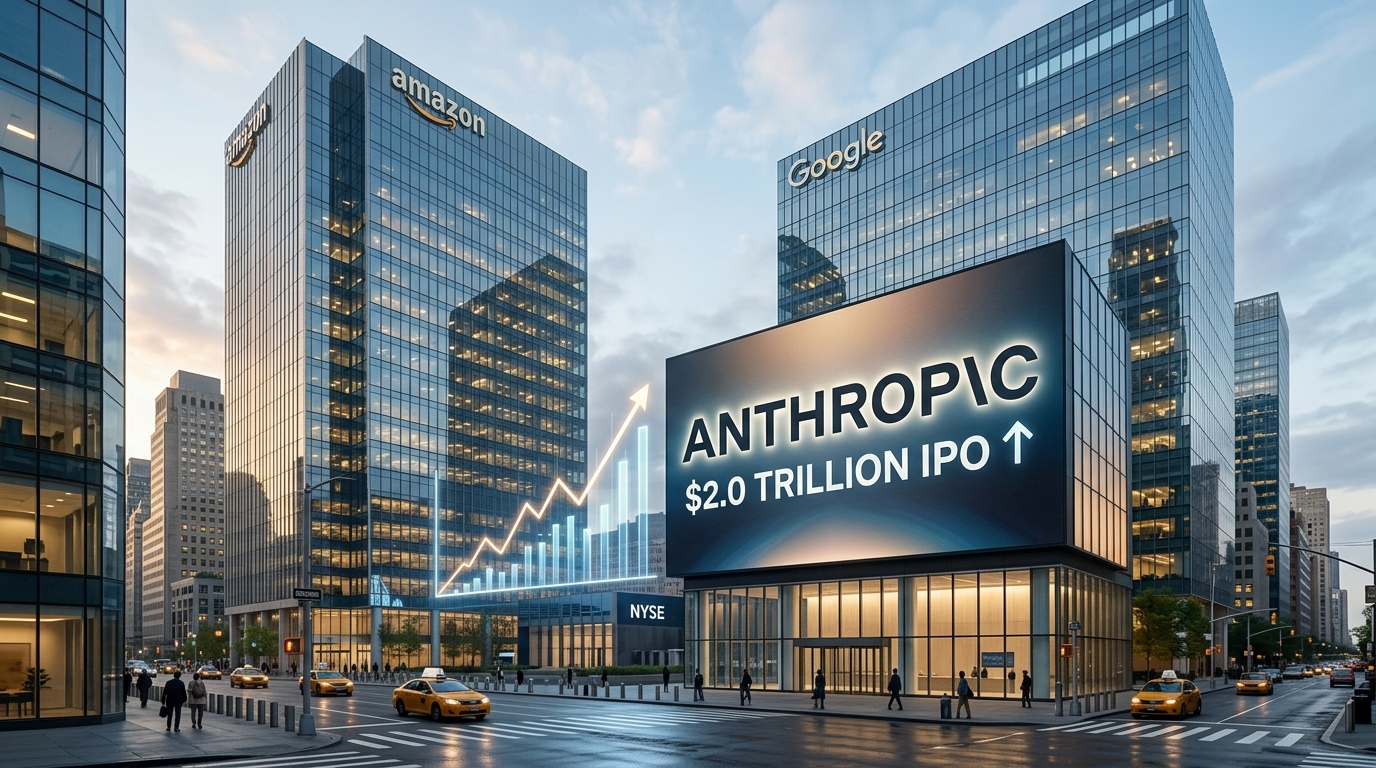
The question institutional investors will spend November arguing about is not whether Anthropic can pull off its IPO. It almost certainly can. The question is what a public price of $1.8 trillion to $2 trillion does to the marks that Amazon, Alphabet, and a long list of venture funds are already carrying on their books.
Anthropic could begin actively marketing the offering during the week of November 9, potentially setting up a stock market debut before Thanksgiving on November 26, according to people familiar with the plans reported by Bloomberg. The company is scheduled to host a pre-IPO investor day on October 14, with invitations sent to a group of institutional investors. That is a compressed schedule for a deal of this size, and the compression is deliberate.
The shift to November lets Anthropic present fresh third-quarter numbers to investors before locking in pricing. Reported financials circulating ahead of the IPO show a 2025 net loss of nearly $42 billion on about $4.6 billion in revenue, with some reports noting a large portion of that loss was tied to non-cash accounting charges from financing. Reports have also indicated Anthropic’s annualized revenue run rate topped $65 billion by the end of July and that investors are looking for a year-end run rate in the $100 billion to $120 billion range. Those are the numbers management wants investors holding when they decide what the company is worth.
The Private-Mark Problem
Here is where the debate gets institutional. No new private round has priced since Anthropic’s $65 billion Series H at a $965 billion valuation in May 2026. An IPO at $2 trillion would roughly double that mark in about six months. That gap lands hardest on the two companies most exposed.
Amazon’s June 30, 2026 filing shows it carried Anthropic exposure across roughly $97.9 billion of convertible notes (reported at fair value) and about $92.5 billion of nonvoting preferred stock, for a combined carrying amount of roughly $190.4 billion on its balance sheet at quarter end. If Anthropic were valued at $2 trillion, Amazon’s economic exposure could be far higher depending on conversion terms and ownership caps, but the exact upside is not a simple percentage-of-market-cap calculation from public information. The practical point for investors is that a move from a private mark to an observable public price can make the reported value of that position more volatile and more visible quarter to quarter.
Alphabet’s position is more precisely described in public reporting tied to court filings: documents reported by The New York Times put Google at roughly 14% of Anthropic, contractually capped at 15%. What that position is “worth” for Alphabet’s financial statements is harder to generalize from the outside because the accounting depends on instrument terms, observability, and whether and when Alphabet can measure fair value through earnings. The market debate is still the same: a public price forces comparability.
Companies that hold minority stakes in private firms often do not remeasure them every quarter unless there is an observable price change, and different instruments can run through different lines in financial statements. A public listing is not a funding round. It is a continuous, observable price. The accounting question every portfolio manager is now asking is how that transition from private mark to public float changes what Amazon and Alphabet report every quarter going forward.
What the Bulls and Bears Are Arguing
The bull case rests on revenue momentum. Investors expect an IPO valuation around $2 trillion or higher, which on a $65 billion annualized revenue run rate implies roughly 31 times revenue. Demanding, but the growth rate arguably justifies the multiple if enterprise adoption continues accelerating. The investor pitch also leans on the idea that Anthropic’s revenue is skewed toward business usage rather than pure consumer subscriptions, which gives the business model a durability that some consumer-led AI plays lack.
The bear case is simpler. The company has been under pressure to keep improving price-performance, and it has cut costs for some users as competition has intensified. Now it wants to be worth $2 trillion. Q3 results will either hold that story together or start unraveling it. A $2 trillion valuation would also put this offering in the same territory as SpaceX’s June 2026 IPO valuation of about $1.77 trillion, putting it in contention as the largest IPO in history. That record comes with expectations that have nowhere to hide once the stock trades.
What Investors Are Missing
The overlooked consequence is not about Anthropic at all. It is about every AI startup still private. Once a public price exists for a frontier AI lab, the hundreds of billions in venture-held AI positions across the industry face a credible benchmark for the first time. If Anthropic prices at $2 trillion and trades down, private marks across the sector get questioned. If it holds and runs, redemption requests at AI-heavy growth funds slow and new capital accelerates into the category. Either way, the market gets a data point it has been missing for two years.
Stocks to Watch
- Amazon (AMZN): The largest single corporate holder by disclosed carrying amounts, with $97.9 billion of Anthropic convertible notes and $92.5 billion of nonvoting preferred stock on its June 30, 2026 balance sheet. The earnings optics of any future remeasurement as Anthropic moves toward a public price could become a recurring feature investors track.
- Alphabet (GOOGL): Reported via court filings to hold roughly 14% of Anthropic, capped at 15%. A successful listing validates the investment; a stumble raises questions about its AI strategy more broadly.
- Nasdaq (NDAQ): Reuters and other reporting have pointed to Nasdaq as the target exchange. A listing of this size generates listing fees and trading volume that are meaningful at the margin, and it reinforces the exchange’s position as a venue for large technology debuts.
- Morgan Stanley (MS): Reported as a lead underwriter alongside Goldman Sachs and JPMorgan. On a raise that some reporting has framed as potentially massive, even a reduced fee structure would be meaningful for the equities franchise.