October 6, 2026
Bonus Content: The FTC Put a Cloud-Shaped Target on Microsoft, Google, and Amazon
Dear Reader,
Institutions own approximately 88% of its shares.
BlackRock reportedly owns 32 million shares worth roughly $716 million. Vanguard owns another 48 million shares worth nearly $1.1 billion.
One major investor nearly doubled its position to 8.2 million shares. And management authorized the repurchase of 40 million shares.
That is not casual interest.
That is serious money surrounding one virtually unknown American company.
So what do they see?
This company generates approximately $3.2 billion in operating income while carrying a market value of only around $8 billion.
It controls a massive American oil and natural gas operation at a moment when AI data centers desperately need reliable electricity.
It has even signed a multi-year, multimillion-dollar agreement with Palantir to use AI to improve equipment reliability, well performance, raw-material use and distribution.
Wall Street knows the name.
Trump publicly defended the company when a major trading partner targeted its profits by raising their taxes.
But Main Street remains largely outside the room.
I believe that information gap creates the opportunity. Once the broader market connects this company’s profits, energy assets and AI relationship, its current valuation could become much harder to justify.
But I refuse to ignore what Wall Street is quietly accumulating.
Click here to learn about the Ultimate Stock Unicorn.
Yours in smart speculation,
Karim Rahemtulla, Head Fundamental Tactician
Monument Traders Alliance
P.S. Institutions control 88% of the shares. BlackRock and Vanguard own tens of millions.
Management authorized a 40-million-share buyback. Main Street may be the last group through the door – click here now to learn about the AI-energy stock Wall Street already knows.
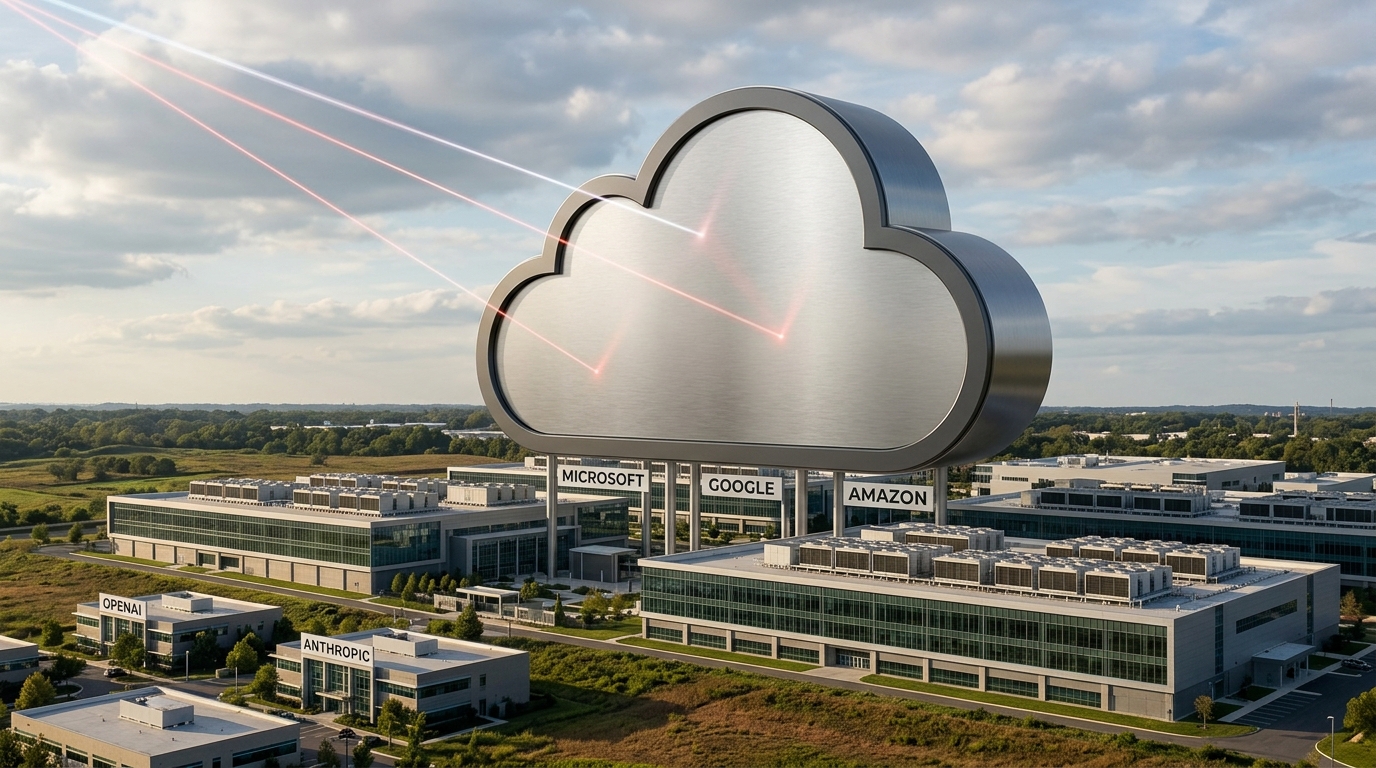
The FTC Put a Cloud-Shaped Target on Microsoft, Google, and Amazon
The headline grabbers are OpenAI and Anthropic. The actual trade is somewhere else.
FTC Chair Andrew Ferguson is preparing civil investigative demands that would compel AI executives to turn over documents and testify about the safety of their models. The agency is specifically probing whether firms are abiding by consumer protection laws. The labs are private. Anthropic still has no ticker. OpenAI is raising capital privately. Neither company can be shorted, hedged, or expressed through options today. But their biggest distribution partners, Microsoft, Google, and Amazon, are all fully listed, highly liquid, and sitting at the center of this risk.
Microsoft and OpenAI ended the exclusivity in their cloud arrangement earlier this year, freeing OpenAI to sell its models through other major cloud providers. Microsoft’s Azure model catalog includes models from OpenAI, Anthropic, Mistral, xAI, and Microsoft. Google and Amazon are in a near-identical position: both resell Anthropic’s Claude through their cloud platforms, and Amazon also offers OpenAI models on Bedrock. These companies do not just host the models, they generate enterprise revenue from them.
That commercial dependency is exactly what the FTC’s consumer protection angle targets. The agency is expected to examine whether firms have broken federal laws prohibiting unfair and deceptive practices, with potential violations including misleading claims about a product’s capabilities or misuse of consumer data. If that framing expands to include resellers, Microsoft, Google, and Amazon face questions they did not sign up to answer.
The timing compounds the pressure. Anthropic is seeking to go public as soon as the middle of November, and Bloomberg has reported the firm could start formal marketing for its IPO as soon as the week of November 9, 2026. A formal investigative demand arriving during a roadshow does not kill an offering, but it raises the risk premium. Prediction markets have put the odds of an Anthropic IPO by year-end 2026 in the neighborhood of roughly 75% to 80%. That number will move with every headline from the FTC.
This is not an imminent enforcement action. The FTC has a long history of privacy and data security cases. Some have ended in large settlements, while other investigations have ended with no action taken. The document requests have not been formally served yet. Resolution could be years away. That timeline matters enormously for options structure.
The Options Perspective
A long put or bear put spread on MSFT, GOOGL, or AMZN targeting a sharp near-term drop misprices the situation. Implied volatility across the hyperscalers is not spiking on this news, the market is reading it correctly as a slow-burn, not a catalyst with a hard date.
A more aligned structure is a calendar spread: sell a shorter-dated put to collect premium in the near-term quiet, while owning a longer-dated put that captures the window where FTC demands land, Anthropic’s IPO documents go public, and congressional attention to AI liability intensifies into year-end. The trade funds itself partially and keeps risk defined. Theta works in your favor while the story develops.
Watch MSFT most closely. It holds equity stakes in both OpenAI and Anthropic, resells both companies’ models, and reports Q1 fiscal 2027 results in late October, a natural re-rating event if the FTC language sharpens before then.
The Beast Verdict
The FTC probe is real, confirmed, and expanding. The labs it names are untradeable. The hyperscalers distributing their models are not. This is a slow-moving regulatory cloud forming directly above three of the most liquid options markets on earth, with a hard catalyst sequence, Anthropic’s roadshow and Q3 earnings, compressing into the next six weeks. That is the window. Calendar spreads on MSFT, with eyes on GOOGL and AMZN as secondary expressions, offer a way to stay positioned without betting on a timeline nobody can confirm.