Wall Street is treating Freeport-McMoRan’s October 27 earnings call as a copper price read. Options data implies roughly a 4% move on the earnings release, a figure that lands nowhere near the size of the structural shift playing out inside FCX’s domestic operations. The earnings number matters, but the real catalyst is a second-half 2026 investment decision the company has flagged around Bagdad, plus continued progress in its leaching initiative.
The Leaching Clock
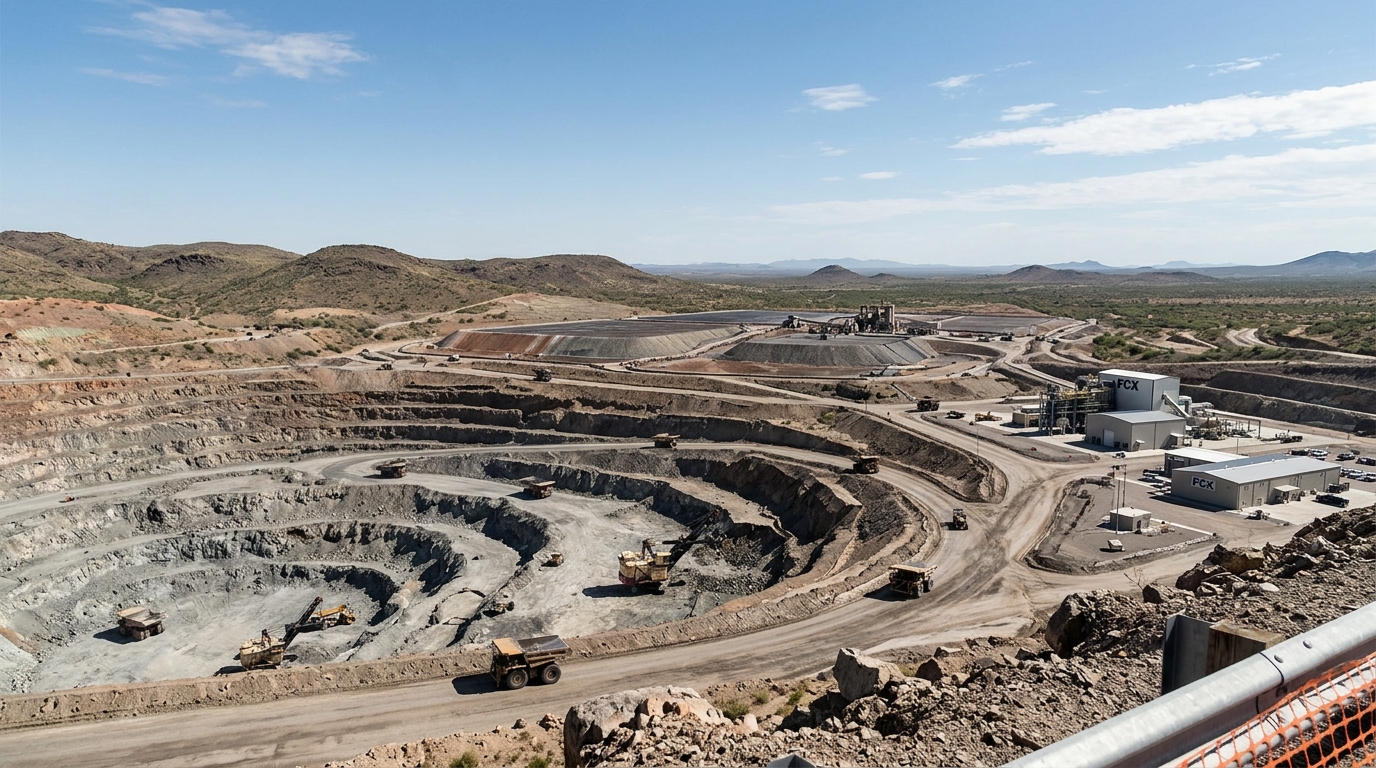
Freeport is advancing leaching technology work that aims to lift copper recovery from material that historically was treated as low-value stockpile feed. The company has described large-scale testing of an internally developed additive product at Morenci with encouraging early results, and it has shown a long-term target on the order of ~800 million pounds per year of copper from its Americas leach innovation initiatives versus 214 million pounds achieved in 2025 and 2024. That is not incremental production from a new mine. The company has also described roughly 39 billion pounds of contained copper in historical placements beyond assumed recovery estimates that are not included in mineral reserves or mineral resources.
During recent updates, FCX has said it is advancing work toward a potential investment decision during the second half of 2026 to construct new concentrating facilities that would increase copper production by 200 to 250 million pounds per year at Bagdad. The Bagdad 2X expansion has been presented with an incremental capital estimate that approximates $3.5 billion and continues to be reviewed.
The Policy Floor Nobody Trades
Copper is not rare earth. But the broader decoupling push that is reshaping strategic materials policy is pulling FCX into defense supply-chain conversations. Federal acquisition rules implementing 10 U.S.C. 4872 include restrictions tied to sourcing from China, Russia, Iran, and North Korea, and the Defense Department’s restrictions tighten on January 1, 2027 for certain covered materials and supply-chain stages. This is a real policy timeline, but it is not specific to copper, and it is not a simple blanket ban on all “critical mineral supply chains” used in military hardware.
Defense procurement is the downstream pressure that gives the policy timeline its teeth. Global defense budgets approaching $2.7 trillion annually are accelerating demand for domestically sourced materials across every weapons platform.
Freeport positions itself as the largest copper producer in the United States. The company has said it supplies approximately 70% of the refined copper produced domestically through its integrated U.S. operations. That concentration makes FCX a natural domestic counterparty for any serious reshoring push. But the draft’s claim that Freeport “no longer sells copper concentrate to Chinese smelters” is not supported as written, and Freeport has discussed a geographically diversified concentrate customer base that includes China.
The Options Opportunity
Copper sits at about $6.61 per pound as of October 20, 2026. Analysts project Q3 earnings of $0.804 per share on $7.36 billion in revenue. A beat here is already expected. What is not priced is the possibility that a 2026 investment decision at Bagdad, alongside continued leaching upside, changes how investors frame FCX’s U.S. asset base.
The trade: a bull call spread with a January 2027 expiration gives you copper price leverage, Grasberg optionality, and exposure to how management frames Bagdad and leaching progress inside a single defined-risk structure. The question is whether management’s leaching update on October 27 is the moment the broader market catches up.
If Quirk signals test results are tracking above expectations, the Bagdad investment decision can look less like a distant slide-deck item and more like a live year-end 2026 catalyst. That is not a 4% event.