
October 22, 2026
Bonus Content: The Short Case Against AI Just Lost a $27.5bn Argument
Below is an important message from one of our highly valued sponsors. Please read it carefully as they have some special information to share with you.
Dear Reader,
In 2016, one major election model gave Hillary Clinton more than a 99% chance of winning right up until election night.
They were wrong.
Right before the vote, Jim Rickards went on TV, show after show, and said Trump would win.
He was right.
Now Jim has issued a new warning.
“Beware November 3rd.”
He’s so concerned about what’s coming, he’s moved more than a million dollars of his own money to get ready.
Click here to see it. It’s a BOMBSHELL…
When it hits, it will send shockwaves through the financial markets.
Regards,
Matt Insley
Publisher, Paradigm Press
The Short Case Against AI Just Lost a $27.5bn Argument
The Short Case Against AI Just Lost a $27.5bn Argument
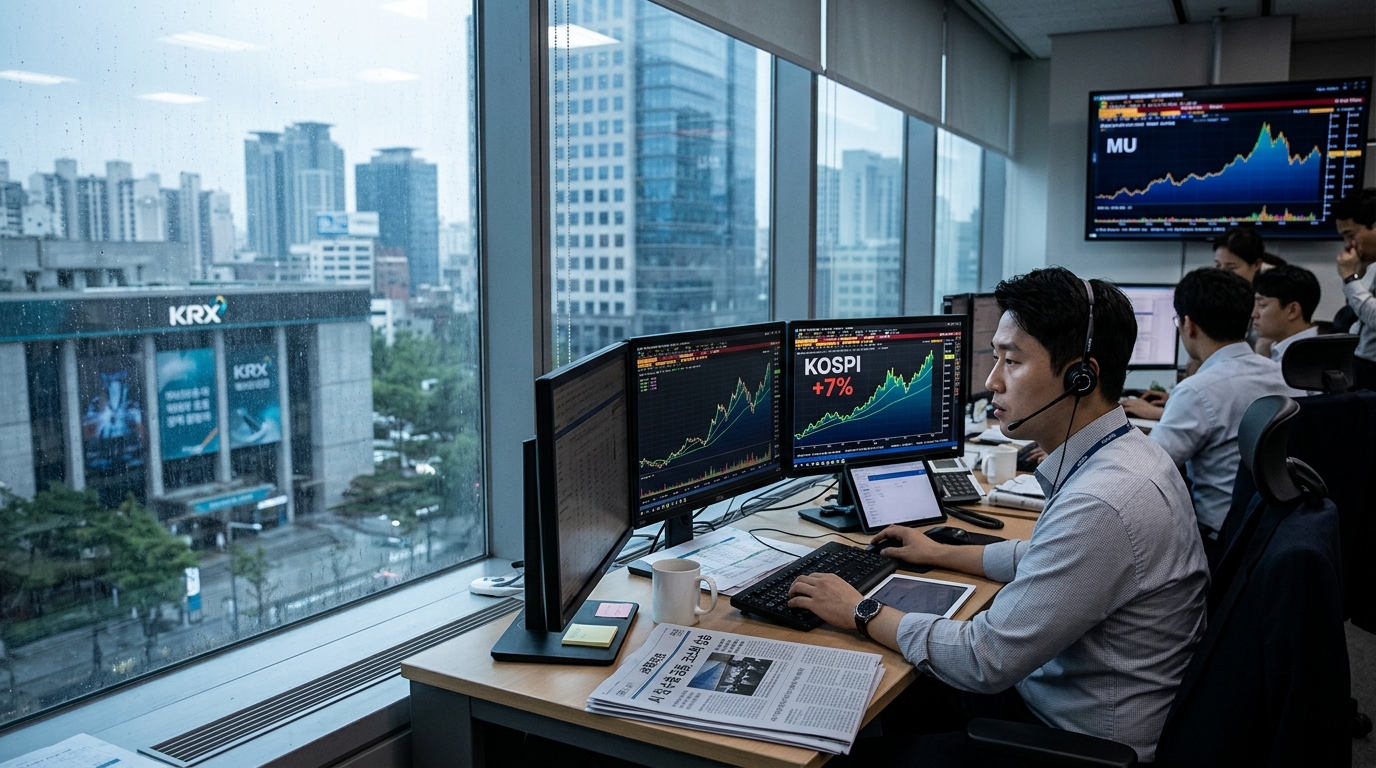
Korea customs data flipped the KOSPI 7% in 48 hours, and put Micron bears on defense.
Tuesday was supposed to be the moment the skeptics won. The KOSPI plunged 3.73% as foreign and institutional investors sold a combined 1.5355 trillion won (about $1.16 billion) in shares amid concerns about AI investment returns. Samsung and SK Hynix got caught in the middle, dragged down by the same question that has dogged the memory trade all autumn: what if the AI buildout is real demand, but the spending runs ahead of any payoff?
Twenty-four hours later, the Korea Customs Service answered with hard numbers. South Korea exported a record $27.5 billion of semiconductors during the first 20 days of October, up 222.5% from a year earlier, with chips representing 44.7% of the country’s $61.6 billion in total exports. Samsung closed at 223,500 won, up 5.67%, while SK Hynix rose 5.81% to 1,294,000 won. The KOSPI finished up 3.29% at 5,735.66. A 7% combined swing in two sessions, and the driver on the upside was not a rumor or a rating change. It was a customs declaration.
That whipsaw is the entire thesis. The ‘AI capex is overbuilt’ short case depends on a gap between infrastructure spending and actual chip demand. The chip export figure measures value, not units shipped, so higher memory prices can lift revenues even without an equivalent rise in volumes, but the combination of both volume and pricing pressure implied by a 222.5% year-on-year surge is genuinely difficult to dismiss as accounting noise. Adjusted for 13 working days in the period, average daily exports rose 65.9% to $4.74 billion, the highest ever recorded for any month’s first-20-day window, surpassing the previous record set in September.
The US proxy for this trade is Micron. The stock was down roughly 18% from its October 7 close to its October 20 close before Wednesday’s data landed, pressured by doubts about AI data-center construction and reports highlighting rising competitive pressure from Chinese producer CXMT. Wall Street’s fiscal 2027 earnings estimates for Micron sit around $176 per share, implying a forward P/E of roughly 5 at recent prices. That is not the multiple of a company whose end-market is melting. It is the multiple of a stock the market has decided to disbelieve on principle.
The options angle here is a November bull call spread on MU, buy the November $930 call, sell the $990 call. The spread costs roughly $18-20 in premium at current pricing, defines max loss at entry, and profits if Micron reclaims ground toward its mid-October levels before expiration. The spread structure matters because implied volatility on MU has been elevated since the selloff. Buying a spread rather than a naked call reduces the IV drag if the stock grinds higher rather than gaps. The short call also captures some of that inflated premium.
The thesis invalidators are real and worth stating plainly. The export value figure does not distinguish between price and volume, which means a portion of the $27.5bn surge could reflect pricing power rather than accelerating unit demand. And Microsoft, Alphabet, Amazon, Apple, and Nvidia are all scheduled to report earnings across late October and November. Any guidance cut on AI infrastructure spending would undercut the entire memory demand argument before November expiration.
But the burden of proof just shifted. South Korea’s market is widely viewed as a barometer of the AI investment cycle because of the dominant role Samsung and SK Hynix play in supplying memory chips, including high-bandwidth memory used in AI data centers. When that barometer swings 7% in two days on a single customs release, the short case has not been refuted, but it has been put on notice. A defined-risk spread on Micron gives you exposure to the follow-through without needing to be right about every hyperscaler’s Q4 capex call.