Hey there, bargain hunter.
Most Western investors have a position in South Korea that consists of exactly nothing. That gap is getting harder to justify by the week.
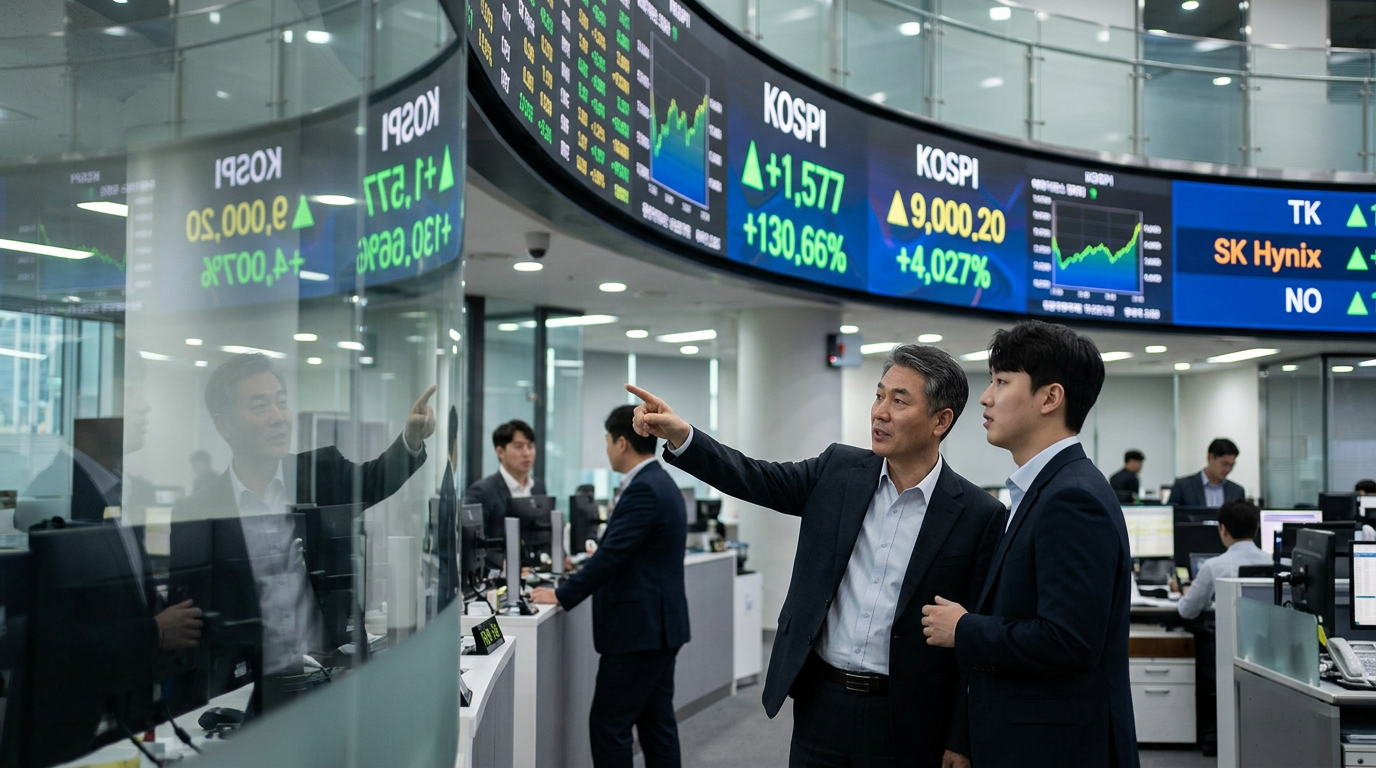
The KOSPI has gained roughly 115% from the end of last year, making it one of the world’s best-performing equity markets of 2026. It crossed 9,000 for the first time in June. It took just 23 days to go from 8,000 to 9,000. Those are not the kind of numbers that show up in quiet markets.
Here is what makes this different from most runaway rallies. The earnings are real and they are moving faster than the prices.
SK Hynix, the world’s No. 2 memory chipmaker, surpassed Samsung Electronics in market capitalization to become South Korea’s largest listed company for the first time in over 25 years. Its shares have risen roughly 250% since the start of the year. And here is the number that the bulls keep citing: an analyst at KB Financial Group said that SK Hynix’s valuation has actually become cheaper as analysts have raised earnings forecasts faster than the stock price has increased.
Let that sit for a second. A stock that has tripled is trading at a lower multiple than it did at the start of the year because forward earnings estimates moved that much faster.
Samsung Electronics and SK Hynix together represent roughly 42% of the KOSPI benchmark. That concentration is a legitimate risk. When Broadcom issued disappointing guidance in early June, the KOSPI triggered its first circuit breaker of that month, with SK Hynix falling 7.7% in a single session before bouncing back 16% the next day. This market amplifies every shift in U.S. chip sentiment. You need to understand that before you size any position.
Beyond the two chip giants, something broader is happening that most of the coverage misses. Investors are also piling into shipbuilding, defense, power equipment, and even the K-culture trade, helping make the rally more reflective of Korea’s wider industrial base. The market is not a pure semiconductor bet. It just looks like one because Samsung and SK Hynix generate all the headlines.
The governance story is also real. Rising earnings expectations and the South Korean government’s commercial law revisions are fueling views that the so-called Korea discount is starting to fade. For years, Korean companies traded at depressed multiples relative to global peers because of weak shareholder protections. That discount is being compressed in real time.
Daishin Securities raised its 2026 target for the KOSPI to 11,500 from 8,800, citing upward revisions to earnings estimates for semiconductor companies. That is not a rounding error in a price target. That is a full re-rating of the market’s fundamental value.
The catch is concentration. On the day the KOSPI broke 9,000 in mid-June, just 102 stocks advanced while 771 fell. The index climbed on the back of two names. That makes the downside look a lot choppier than the upside chart suggests.
The relevant tickers for U.S.-based exposure: EWY for South Korea, TSM if you want the Taiwan side of the same semiconductor trade. Companies like SK Hynix and Samsung, which together represent roughly 50% of the MSCI Korea Index, have delivered record earnings driven by AI-related demand for memory and compute infrastructure.
Worth watching as Q2 earnings roll in globally: if U.S. hyperscaler capex guidance disappoints in any way, the KOSPI will be the first place the pain shows up. That is the asymmetry here. The upside is real. So is the speed of the reversal when global chip sentiment shifts.