
There’s a company growing revenue 23% year over year, beating earnings estimates by more than 20%, raising full-year guidance, and posting operating margin expansion of roughly 500 basis points in a single quarter. Its stock is down about 29% in 2026.
That company is Intuitive Surgical (ISRG). And the disconnect is hard to explain away.
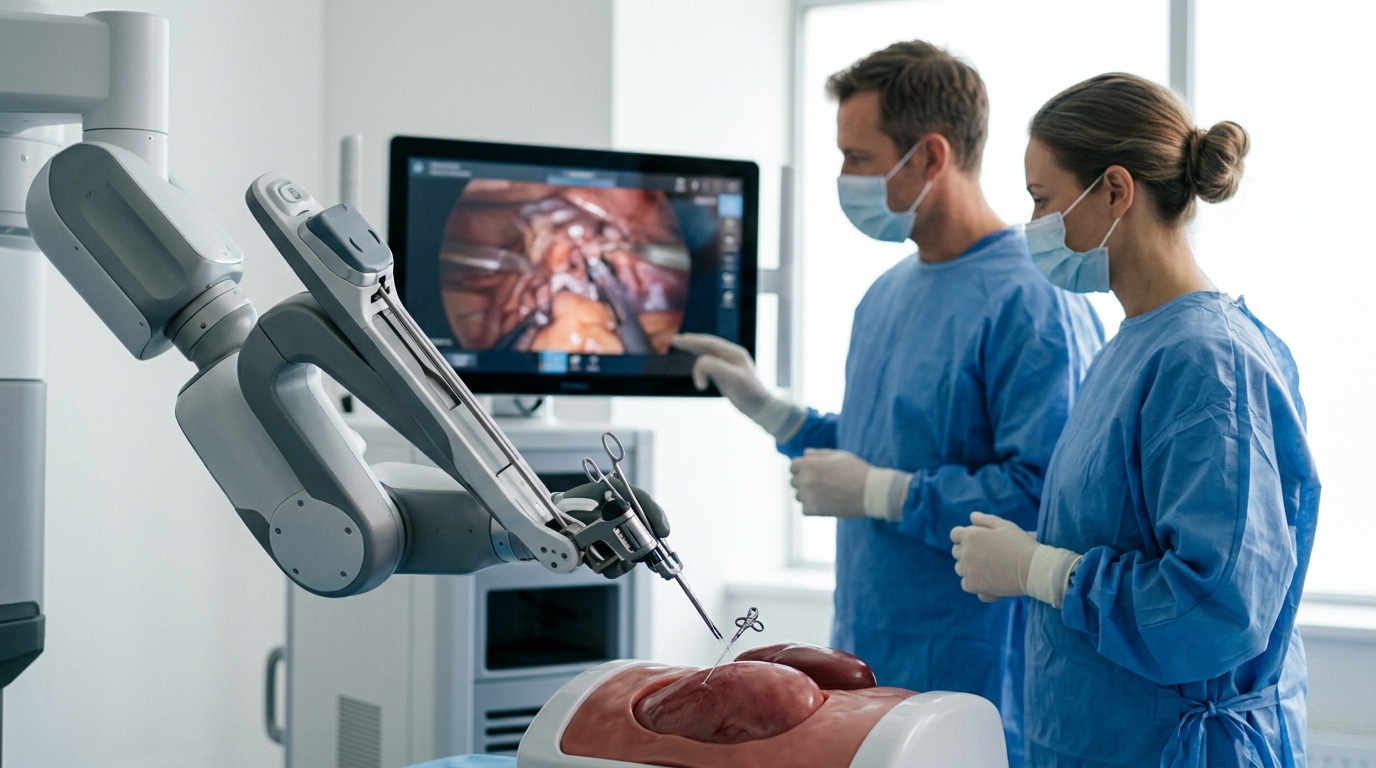
Most investors know Intuitive as the maker of the da Vinci surgical robot. That framing undersells it. The company is effectively the operating system for minimally invasive surgery — a platform with recurring revenue, high switching costs, and a clinical footprint that took decades to build. You don’t just pull a da Vinci out of an operating room and replace it. The capital investment, the surgeon training, the outcomes data — all of it ties hospitals to the platform in ways that are genuinely sticky.
The Numbers Behind the Selloff
Q1 2026 results were hard to argue with. Revenue came in at $2.77 billion, a 23% increase year over year that beat the Street’s consensus estimate of $2.62 billion by roughly 6%. Total procedures grew about 17% globally. The da Vinci 5, the company’s newest flagship system, had 232 units placed in the quarter alone. Ion procedures — the lung biopsy platform — surged 39% to 43,000 cases. The single-port SP platform grew 68% year over year.
The margin story was even better. GAAP income from operations was $855 million in Q1, while non-GAAP income from operations was $1.08 billion (up about 40% year over year). On a non-GAAP basis, operating margin expanded to about 39% from about 34% a year ago. Recurring revenue — instruments, accessories, services, and operating lease revenue — accounted for 86% of total revenue. That’s not a one-quarter bounce. That’s a business model compounding.
Slight tangent, but worth noting: some analysts have pointed to higher da Vinci 5 utilization versus prior generations, but the company’s quarterly filing shows overall da Vinci utilization (procedures per system per year) was up 3% year over year in Q1. Hospitals that upgrade don’t just use the robot more — they use it in new procedures. The FDA has cleared da Vinci 5 for certain cardiac procedures in the U.S., expanding the clinical footprint in a major surgical area. That’s not priced in yet.
Why Is the Stock Down?
A few things weighed on ISRG in 2026. China remains a headwind — tender activity is low, domestic competition is increasing, and pricing pressure from policy changes has slowed procedure growth below the corporate average. That’s a real risk, not a rounding error. China had been a meaningful growth contributor, and its absence is felt in the forward model.
GLP-1 drugs created an unexpected wrinkle, too. U.S. da Vinci bariatric procedures declined approximately 10% in Q1, as weight-loss medications reduce the patient pool for certain surgeries. That’s a secular shift that likely continues.
And the broader market in 2026 hasn’t been kind to premium-multiple healthcare names. When investors rotate toward AI infrastructure and high-momentum tech, companies like ISRG tend to get left behind even when the fundamentals are accelerating.
The Case for Now
Management raised full-year 2026 guidance for worldwide da Vinci procedure growth to approximately 13.5% to 15.5%. Beyond that, the exact EPS forecasts and specific fair-value targets cited here vary by source and change frequently, so treat any single number with caution.
The company carries no long-term debt and continues to generate high-margin recurring revenue. As of the end of 2025, Intuitive said more than 20 million patients worldwide had been operated on using da Vinci surgical systems. The switching cost moat is as wide as it’s ever been.
Is it cheap? Not by traditional metrics — it never has been. But the gap between the stock’s 2026 performance and its underlying business momentum may be the most interesting thing in the medical device space right now. The market is giving you a roughly 29% discount on one of the most durable recurring-revenue platforms in all of healthcare. That kind of divergence rarely lasts forever.
Q2 earnings will be the next real test. Watch procedure volume growth and any update on da Vinci 5 adoption outside the U.S., particularly in Europe where the company plans to bring its Italy, Spain, and Portugal distribution businesses in-house as part of a deal expected to close in 2026. If those numbers come in strong, the stock has a lot of catching up to do.