Something unusual happened to Broadcom last week. The stock was getting hit. Then Apple showed up with a $30 billion-plus commitment and the whole technical picture shifted overnight.
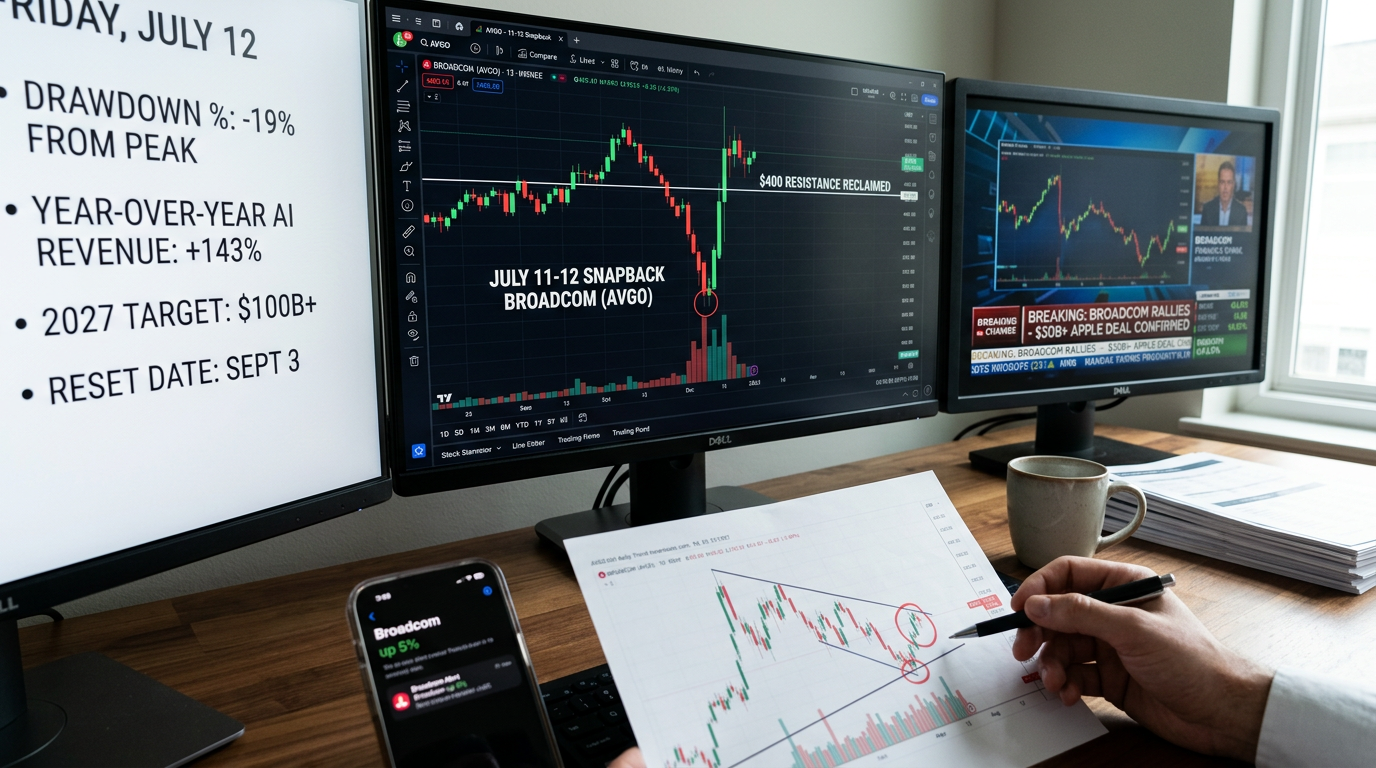
Here is where things stand as of July 12. AVGO is trading around $400, off its 52-week high of $495. That is roughly a 19% drawdown from peak. The 52-week range runs from $269.58 to $495. The selloff was triggered by a Q2 earnings report in early June that, while strong in absolute terms, missed slightly on revenue and came in just below already-elevated expectations. In a stock priced for perfection, small misses can produce large moves.
The market cap sits at approximately $186 billion. The P/E ratio is around 98 based on the latest available data, which underscores the same point: this is not a cheap stock on traditional metrics. It is a stock priced on the assumption that the custom AI silicon cycle is multi-year, large, and still accelerating.
What the Numbers Actually Show
Let’s look at the Q2 results that caused the drawdown. Broadcom reported fiscal Q2 2026 revenue of $22.187 billion, up 48% year over year. The numbers were strong. The reaction was not about the numbers, exactly. It was about the gap between what was delivered and what was priced in.
Broadcom also reported Q2 semiconductor revenue from AI of $10.8 billion, up 143% year over year. CEO Hock Tan guided Q3 revenue to approximately $29.4 billion and guided Q3 AI semiconductor revenue to $16 billion. That $16 billion AI figure was below the average analyst estimate reported by Bloomberg of about $17.2 billion.
One more data point worth sitting with: Tan reiterated the company’s target of AI semiconductor revenue in excess of $100 billion in fiscal 2027. He did not raise that target. That unchanged guidance disappointed investors who had been expecting an upgrade.
The Apple Deal Changes the Calculus
On July 8, Apple and Broadcom announced an expanded agreement running through 2031. Apple said the new agreement is expected to exceed $30 billion and will support production of more than 15 billion U.S.-made chips. The agreement covers advanced radio frequency components, including Broadcom’s FBAR filters, and Apple said Broadcom will expand and modernize its Fort Collins, Colorado facility with a $1.5 billion capital expenditure investment.
The immediate market reaction was a stabilization in AVGO price action. Call volume ran above normal levels. Some commentary has circulated about higher potential price levels for AVGO, but specific price targets and firm-by-firm rating counts vary by data source and change frequently, so treat those as directional rather than definitive.
Slight tangent worth noting: Broadcom, Apollo, and Blackstone also launched the AI XPV Platform with an initial $35 billion capital solution. The platform is designed to enable more than 20 gigawatts of compute capacity through 2028 for leading frontier AI labs, including Anthropic and OpenAI.
The XPU Customer Base Is the Core Story
Broadcom designs custom AI accelerators, called XPUs, for hyperscalers rather than selling general-purpose GPUs. Broadcom has said it has six major XPU customers, including Google and Meta, and it has discussed work supporting frontier AI labs including Anthropic and OpenAI. Some customer identities beyond those examples have not been fully publicly disclosed by Broadcom, so any complete customer list should be treated as provisional.
Q1 AI revenue was $8.4 billion, up 106% year over year. Q2 came in at $10.8 billion, up 143%. The Q3 guide of $16 billion would represent over 200% year over year growth if achieved. That is the number September 3 will benchmark.
Analysts project strong EPS growth for Broadcom in fiscal 2026, and that expectation is a major underpinning of the bull case.
Where the Risk Lives
The bear case is real and worth understanding. Macquarie downgraded AVGO to Neutral and set a $437 price target, citing Google’s effort to insource more chip design work and bring MediaTek into its supply chain. If Google reduces its reliance on Broadcom-designed AI silicon over time, that represents meaningful revenue risk given Google’s importance to Broadcom’s AI business.
The other risk is simpler: expectations. Broadcom’s reiterated fiscal 2027 target of AI semiconductor revenue in excess of $100 billion is bold but has not been raised. If AI capex softens, customers insource faster, or supply chain constraints persist, multiple compression could outweigh the underlying revenue growth.
Technical Structure
AVGO has been building a base in the $395 to $415 zone since the Apple deal news. Multiple technical analysts have flagged a potential breakout forming above the near-term resistance band, and some mainstream market commentary has pointed to options market positioning as consistent with the possibility of upside.
Average daily volume and indicator readings (like RSI) can shift quickly and depend on the specific lookback window and data provider, but the basic message is unchanged: price action looks more like consolidation than panic.
Scenario Modeling
Bull Case: Q3 AI semiconductor revenue meets or beats the $16 billion guide on September 3. Management raises the 2027 AI semiconductor revenue target above $100 billion for the first time. Apple deal visibility and the Anthropic-backed financing platform drive renewed institutional buying. Stock recovers to the $450 to $500 range.
Base Case: Q3 revenue meets guidance, AI semiconductor revenue lands at $16 billion, and the 2027 target remains in excess of $100 billion. The stock grinds higher from current levels but does not materially close the gap to its prior high. AVGO trades in a $400 to $440 band through the summer into the September 3 report.
Bear Case: Q3 AI semiconductor revenue falls short of $16 billion. Concerns about customer insourcing materially reduce the 2027 XPU pipeline. The $100 billion-plus target is revised lower. Stock retests the $310 to $340 range that multiple technical models have identified as the next major support zone.
Active Trader Framework
There are two distinct events driving positioning in AVGO right now. The first is the Apple deal, which provides near-term stabilization and removes one overhang that had been pressuring the stock. The second is September 3, which is when this entire story either accelerates or stalls.
The Q3 AI guide of $16 billion is the most important number to track between now and September. Any data points that surface in the coming weeks about hyperscaler AI capex trends, custom chip order flows, or competitor wins or losses will be directionally important. Google’s chip strategy in particular deserves ongoing attention.
For active traders, the current $395 to $415 band is a decision zone. A sustained close above $420 with above-average volume would strengthen the technical case for a recovery toward $450 to $470. A break below $385 would suggest the consolidation has not yet found its floor.
The fiscal 2027 AI semiconductor revenue target of in excess of $100 billion is the thesis anchor. Watch whether management validates, expands, or quietly walks it back on September 3. That answer shapes the stock’s trajectory for the rest of the year.
For informational and educational purposes only. Not investment advice. Trading involves risk, including loss of principal.