Hey there, bargain hunter.
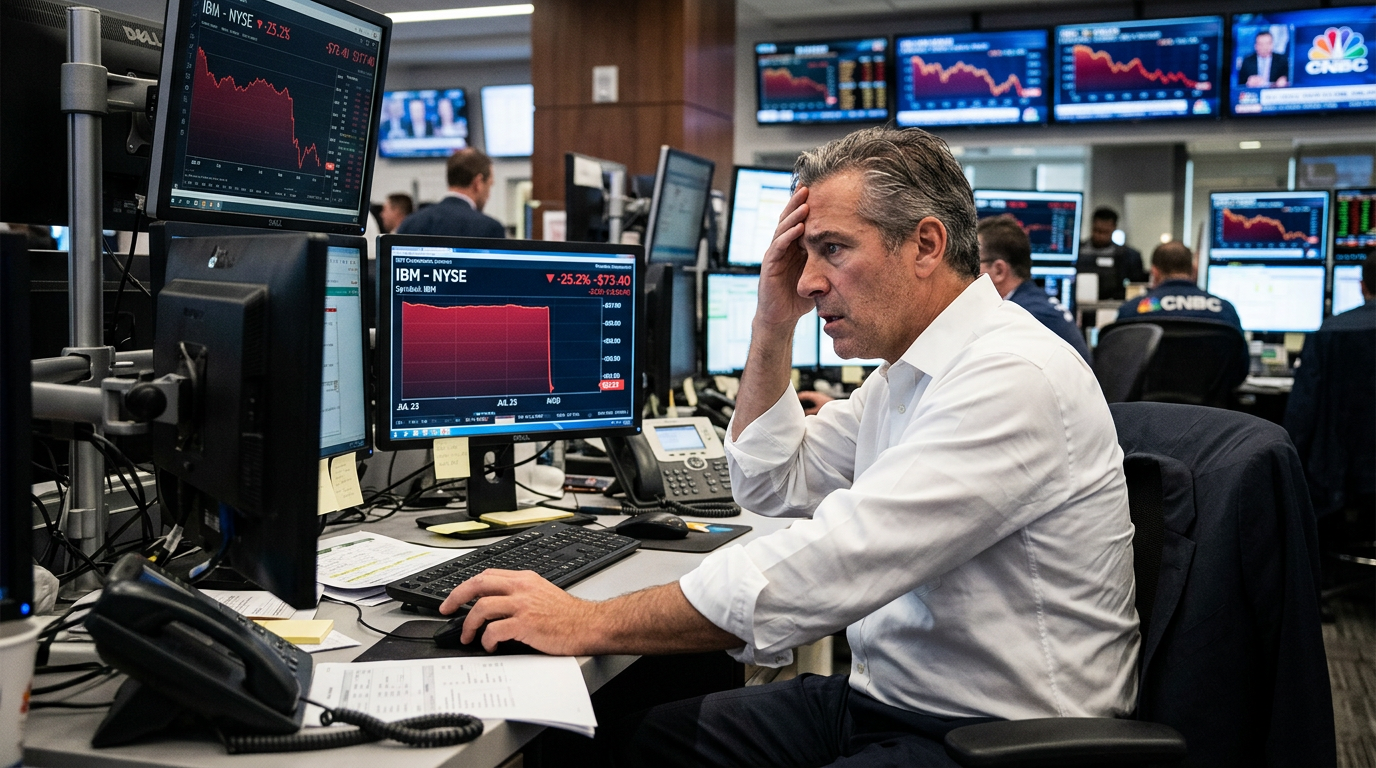
Something happened Tuesday that genuinely stopped traders in their tracks. IBM — the 115-year-old technology institution — just had its single worst trading day since at least 1968. Not since the Carter administration. The stock fell 25.2% in one session, closing near $217, after CEO Arvind Krishna sent investors an unscheduled letter that essentially said: the quarter was worse than we thought.
That is the short version. The longer version is more interesting, and a lot more complicated.
What Actually Happened
IBM pre-announced eight days before its scheduled July 22 earnings call. The preliminary numbers were not catastrophic on paper: revenue of $17.2 billion versus the $17.86 billion consensus, and adjusted EPS of $2.93 versus the $3.01 estimate. A roughly 3.7% revenue miss. A modest shortfall by most standards.
The market did not treat it modestly.
About $48 billion in market value vanished in a single session — a sharp valuation reset for a mega-cap legacy tech name in recent memory. That gap tells you what actually happened: investors were not reacting to one weak quarter. They were resetting the entire forward earnings story.
The reason matters. Krishna’s letter pointed to a late-June spending shift. Enterprise clients, apparently spooked by AI hardware supply constraints and anticipated price increases, redirected their capital budgets toward servers, storage, and memory chips instead of IBM software and infrastructure. Several large software deals that IBM expected to close in June simply did not close. The company also cited AI-driven cybersecurity concerns and said customers were distracted by emergent AI threats.
The infrastructure division bore the brunt, sliding roughly 7%. Software, which had grown 11% in Q1, decelerated sharply.
The Business, Quickly
IBM operates across three main pillars: Software (the high-margin engine), Consulting (the services arm), and Infrastructure (mainframe-dominated). The Software segment was the reason investors had been paying a premium valuation. Red Hat — IBM’s $34 billion acquisition — underpins the hybrid cloud story. Watsonx is the generative AI platform IBM has been pushing into enterprise workflows. The generative AI book of business had reportedly crossed $12.5 billion heading into this quarter. None of that changed on July 14. But confidence in the trajectory did.
Here is the subtle problem. IBM had been climbing higher precisely because investors believed the software flywheel was self-sustaining. Q1 was a clean beat. Software up 11%. EPS ahead of estimates. The stock ran higher earlier this year. A company at a premium forward earnings multiple does not get to miss without consequences. The math punishes it asymmetrically.
The Numbers That Matter Now
- Q2 Revenue: $17.2 billion (consensus: $17.86 billion)
- Q2 Adjusted EPS: $2.93 (consensus: $3.01)
- Market cap erased: approximately $48 billion
- Free cash flow year-to-date: $4.8 billion (per IBM)
- IBM closing price July 14: $217.07
Free cash flow is the number to watch. IBM’s full-year FCF guidance had implied a big second half. Reaching that now requires strong H2 execution. IBM is normally stronger in the second half, so it is possible. But the margin for error is thinner than it was a week ago.
What the Street Is Saying
The analyst community is split. HSBC downgraded IBM to Reduce with a price target of $191, arguing the valuation had been stretched relative to the sector median even before the warning. Goldman Sachs flagged the results as validating a software bear case, noting the mainframe shortfall reflects client demand shifting toward near-term hardware purchases — a dynamic it says is consistent with commentary from Dell and HP. BofA trimmed its price target to $280 from $330 but maintained a Buy rating, arguing IBM remains well positioned once execution issues clear. Wall Street’s consensus price target sits near $295, implying meaningful upside from Tuesday’s close — one of the widest dislocations in large-cap technology right now.
Slight tangent, but it matters: IBM was not the only software name under pressure this week. The crash sent shockwaves through Microsoft, ServiceNow, and others. If enterprise clients are re-prioritizing toward AI hardware and away from software, the implications extend well beyond one company’s quarterly miss.
Timing Problem or Something Deeper
This is the debate. Krishna’s framing was that the deals are delayed, not lost. Late-June hardware hoarding by enterprise clients is a one-quarter event, not a structural shift. If that is true, Q3 should see a catch-up in software bookings. IBM’s installed base of enterprise customers remains enormous. Red Hat is still growing. Quantum computing remains a long-term differentiator — IBM has deployed more than 90 quantum systems and signed more than $1.1 billion in contracts since 2017.
But if enterprise AI spending is genuinely rotating away from traditional software vendors and toward infrastructure buildout for the long term, IBM’s software premium story gets a lot messier. That is the fear the market is sitting with right now.
Bull / Base / Bear
Bull: The deals were timing-driven. Q3 guidance holds. Software re-accelerates. IBM at a lower forward earnings multiple is cheap relative to its own history and the sector. FCF yield becomes attractive around $210. IBM is a Dividend Aristocrat with nearly three decades of consecutive increases — patient income investors find a compelling entry point. Consensus price target implies meaningful upside.
Base: IBM maintains full-year guidance on July 22 but acknowledges software growth will be lower in 2026 than originally expected. Stock finds a floor between $200 and $220. Slow recovery over 12 to 18 months as deals close and AI consulting bookings build.
Bear: July 22 brings a full-year guidance cut. Software growth does not recover in Q3. The enterprise AI spending shift toward hardware is stickier than management expects. HSBC’s $191 target proves prescient. IBM trades as a value trap for the remainder of 2026.
The Cheap Investor Scorecard
- Forward P/E: below S&P 500 — check
- Free cash flow generation: strong, but H2 execution required — conditional
- Dividend Aristocrat with nearly three decades of consecutive increases — check
- Software deal pipeline: unresolved until July 22 call — watch
- Quantum computing position: real but early-stage revenue — long-term watch
- Red Hat organic growth vs. acquired growth quality: key question for July 22
- Watsonx generative AI consulting bookings: need updated figure from July 22
- Full-year FCF guidance maintained or cut: single most important data point July 22
- Q3 guidance tone: sets the floor for the recovery thesis
- AI-driven cybersecurity concerns: temporary pause or something deeper?
July 22 at 5 p.m. ET is not just an earnings call. It is the moment IBM either validates the timing excuse or confirms investors were right to reset the entire growth story. Watch free cash flow guidance first. Everything else follows from that.
Not investment advice. Do your own research.