
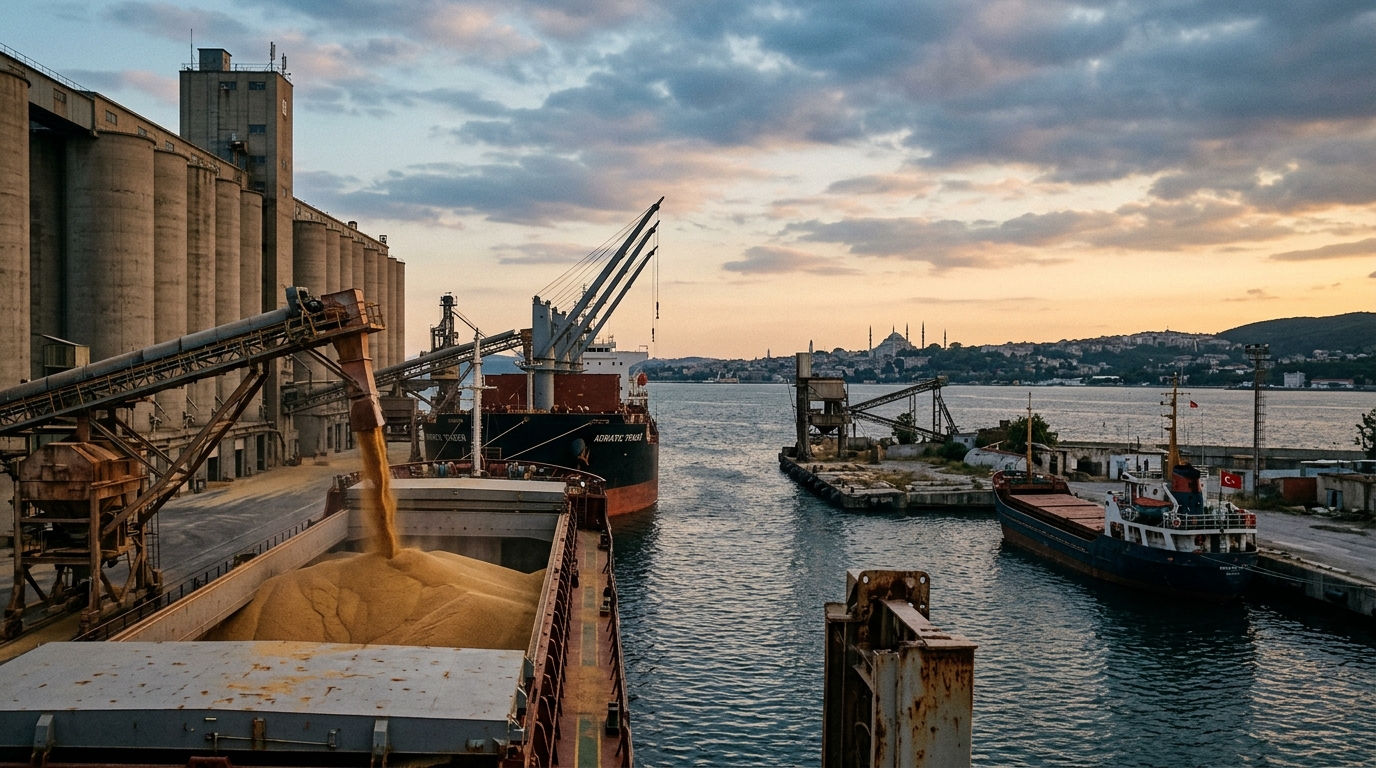
Chicago wheat climbed to its highest level since July 2023 through August, remaining up more than 16% for the month, its strongest monthly performance since February 2022. The question landing on every agricultural investment committee this morning is not whether the rally happened. It is whether what caused it is permanent.
What the Bull Case Actually Rests On
The physical damage at Novorossiysk is not a rumor. Three of Russia’s largest grain terminals halted operations after being damaged in a massive overnight drone attack. The combined annual capacity of the three terminals is about 26.1 million metric tons, a figure Reuters reported as typically accounting for well over half of Russia’s wheat exports. And the repair timeline is not measured in days. NKHP, one of the three terminals, said repairs could take up to four months.
That timing matters because of when the hit landed. The interruption has come during the August-to-December period, when Russian grain exports are typically at their highest. Expectations that all the missed shipments can be made up later are overly optimistic, according to SovEcon managing director Andrei Sizov, particularly because of winter storms and the seasonal freezing of rivers and the Sea of Azov. Russia’s August wheat exports are tracking near 2.2 million metric tons, according to SovEcon, less than half last year’s level.
Ukraine’s side of the ledger looks similarly impaired. Ukraine’s agricultural shipments could fall by more than half this season, with total exports estimated at 29.6 million tons against an earlier forecast of 64.4 million tons, and wheat exports alone could plunge 53% to 8.3 million million tons. Ukraine’s agriculture minister has already signaled the damage will reach into next season: the country plans to reduce the area planted with winter wheat for the 2027 harvest as export difficulties and high logistics costs pressure farmers.
The Bear Case Is Named Turkey
Turkish Foreign Minister Hakan Fidan said this morning that Ankara has prepared a plan to ensure the safe passage of grain vessels through the Black Sea and is in talks with Ukraine and Russia on its implementation. The most-traded wheat contract on CBOT fell 0.29% on the news. That is exactly the reflex that should give bulls pause.
Markets have a conditioned response to Black Sea diplomacy: buy the fear, fade the deal. For much of the war, traders repeatedly learned that grain continued moving despite missile strikes and political threats, which conditioned markets to fade geopolitical rallies quickly. Turkey brokered the original Black Sea Grain Initiative in 2022 and the United Nations says the initiative ultimately enabled the safe export of nearly 33 million tons of grain and other foodstuffs from Ukrainian ports. A second version of that agreement, even a partial one, would immediately reframe the premium embedded in Chicago wheat.
Negotiations are proceeding intensively, but the concept and timeline for the new mechanism remain unknown, with the outcome expected to be determined in the coming weeks. That uncertainty is precisely where the trade sits right now.
What Investors Are Missing
The infrastructure question separates this disruption from every previous Black Sea scare. Renewed Russian attacks, damage to export infrastructure, and severe Ukrainian shipping bottlenecks are increasingly shifting the market from pricing a temporary disruption toward a potential structural reduction in Black Sea supply. A corridor agreement can protect ships in transit. It cannot rebuild a collapsed loading gallery or restore a damaged silo in four weeks.
That distinction is critical for how ADM and Bunge get valued from here. A Turkish corridor deal would knock the war premium out of wheat futures, but it would not restore physical throughput at Novorossiysk. Changing trade routes can increase freight costs, widen regional grain spreads and create urgent demand for alternative storage, processing and export infrastructure, conditions directly relevant to global grain merchants such as ADM and Bunge. The real bull case for processors is not the headline price of wheat. It is the sustained dislocation of trade flows that forces importers to source from non-Black Sea origins, widening the margins for anyone positioned outside the conflict zone.
Stocks to Watch
ADM raised its 2026 adjusted earnings guidance to $5.15 to $5.60 per share. Its North American and European grain origination network is the direct alternative to Black Sea flows. A multi-month Novorossiysk outage extends that advantage into Q1 2027 regardless of diplomatic announcements.
Bunge (BG) completed its Viterra acquisition in July 2025, and management has said its ocean freight fleet has roughly doubled, giving it more ability to react to disruptions and redirect flows to high-demand regions. Management has also flagged Black Sea geopolitical risk as a key watch item because escalation could tighten global wheat supply and change merchandising dynamics. Bunge entered this crisis better positioned than in any previous disruption.
Chicago wheat futures themselves remain the clearest expression of the debate. Escalating attacks around Black Sea export corridors have sharply raised the probability of prolonged supply constraints, forcing importers to diversify origins and pay up for secure flows. Whether that premium survives the next two weeks of Turkey-brokered talks is the position every manager in agricultural equities is forced to take today.