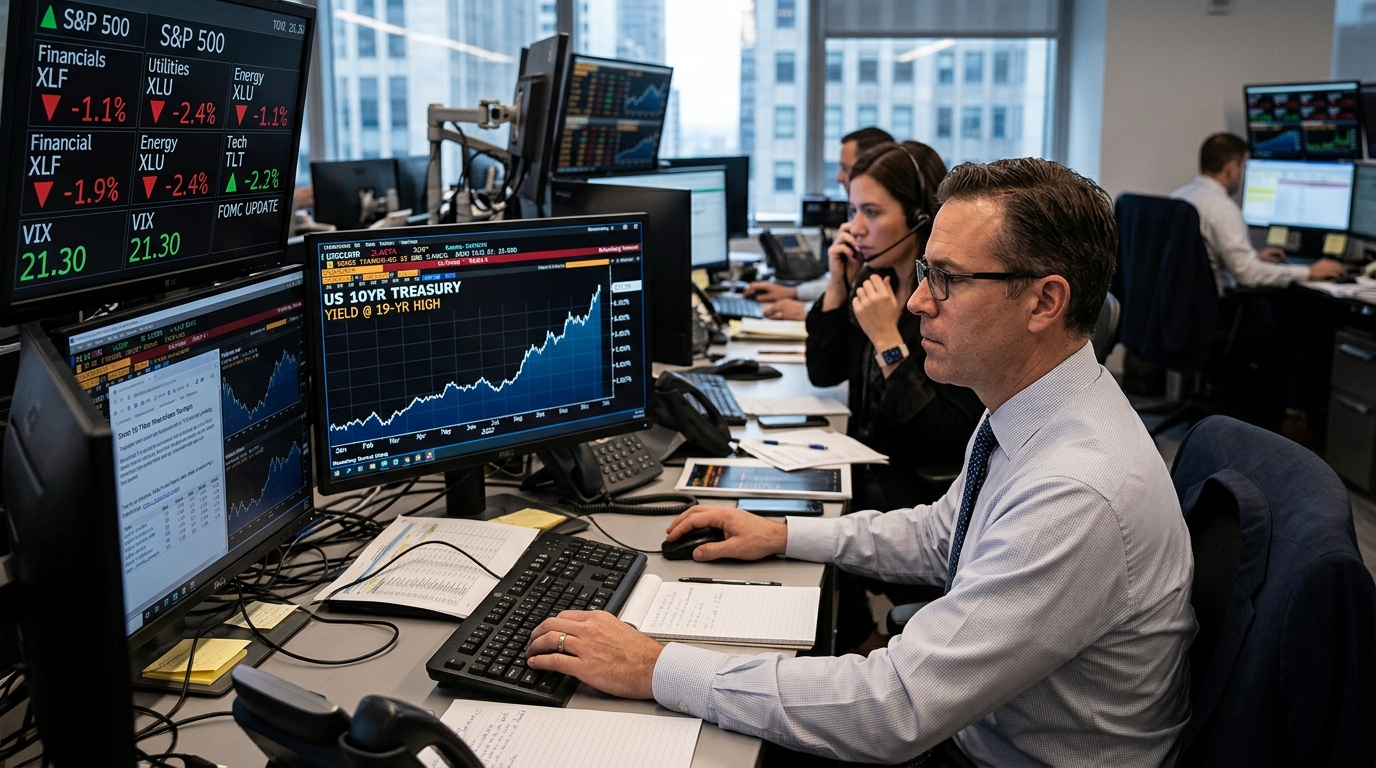
The benchmark 10-year Treasury yield climbed to its highest level since 2007 on Tuesday as a sell-off in U.S. government debt deepened ahead of the Federal Reserve’s interest-rate decision. The 10-year yield jumped more than 6 basis points to about 5.03% in early Tuesday trading, extending a rise that has been building since the start of September. The yield on the longer-dated 30-year Treasury bond was also higher, around the mid-5% range. The 2-year, by contrast, sits in the mid-4% range, leaving the 10-2 spread only modestly positive. The curve is steepening, and that spread is the first number traders need on their screens this morning.
The macro backdrop driving this is not subtle. The consumer price index rose a seasonally adjusted 0.4% for the month, putting the 12-month increase at 3.4%, the Bureau of Labor Statistics reported Friday. Both readings were broadly in line with consensus expectations. Core CPI rose 0.3% for the month. That core firmness was the trigger. In the minutes following the report, market-implied odds of a Fed rate hike rose sharply. Layered on top, oil prices have pushed back above $100 per barrel in Brent, fueled by escalating tensions in the Middle East, hardening the inflation argument bond investors are pricing across the long end.
What Warsh Does Next
The September 2026 FOMC meeting takes place September 15 through 16, with the rate decision and policy statement due Wednesday. Fed Chair Kevin Warsh has said the Fed has “work to do” on inflation and remains ready to act as needed, while Fed Governor Christopher Waller recently said he would be inclined to vote to keep the benchmark rate at its current range of 3.50% to 3.75% if incoming data supports it. That internal division matters for the long end. If Warsh hikes and signals more to come, the 30-year has room to run higher still. If the committee holds but the statement reads hawkish, the curve likely flattens back and the 10-year drifts. Neither outcome is obviously bond-friendly right now.
In June, the Fed’s Summary of Economic Projections pointed to a median expectation for the federal funds rate around 3.8% at the end of 2026, implying roughly one quarter-point increase from the current range. But following several data points, futures traders have increasingly been leaning toward more tightening by year’s end. The market is no longer trading one meeting at a time.
Where the Rotation Is Going
A 5-handle risk-free rate is not a theoretical headwind. It is an immediate revaluation problem for anything priced on future cash flows. When risk-free paper pays around 5%, paying thirty times earnings for growth stocks becomes a very difficult proposition for institutional funds. The SPDR S&P 500 ETF was trading around 758 recently. Rate-sensitive corners took the sharper hit: D.R. Horton has been down materially over the past year, and Lennar has also been down sharply over the past year. Homebuilders are not a new short here. They are a sustained one.
The sectors that survive, and arguably benefit, are those with pricing power tied to the same forces lifting yields. Energy has been one of the better-performing groups in the S&P 500 in 2026, helped by rising oil prices, geopolitical escalation, and rotations into commodity-linked assets. WTI in the high-$90s alongside sticky inflation keeps that bid alive.
Financials are a more nuanced call. Banks earn wider net interest margins as short rates stay elevated, but credit quality matters at this stage of a tightening cycle. JPMorgan Chase reported a card net charge-off rate around the mid-3% range in its most recent quarterly results, contained but worth watching if credit tightens. The XLF can work, but it is a stock-picker’s environment inside the sector, not a blanket long.
The Trading Plan
The highest-conviction position entering Wednesday’s decision is staying short rate-sensitive duration: long-dated bond ETFs like TLT face continued pressure unless Warsh surprises with a hold paired with explicitly dovish guidance, which the CPI data makes difficult to justify. On the equity side, energy remains the cleanest expression of the same macro forces lifting yields, and it carries one of the cheaper valuation profiles on the board.
Watch the 5.10% level on the 10-year as the next technical test. A push through there before the Wednesday announcement would signal that the bond market is no longer waiting on the Fed at all. That scenario accelerates the rotation, compresses growth multiples further, and puts the S&P 500’s 750 level back in play as support. Until the Fed speaks, the bond market is running this session.