Boeing rarely gives options traders a clean date to work with. The SPEEA ratification vote does exactly that.
Ballots open September 24 and close October 1, five days before the current contracts expire on October 6. The union’s bargaining teams are recommending a Yes vote. That recommendation matters less than the fact that the Professional unit rejected the first offer 64.25% to 35.75%, while strike authorization passed with 87.82% support. A bargaining team endorsement did not hold in August. There is no structural reason to assume it holds now.
What Changed and What Did Not
Boeing’s revised offer totals 34% in wage funds over four years, with 26% fully guaranteed for every member. A 10% increase is expected to take effect October 2 if ratified, followed by a 4% guaranteed wage increase in March 2027. From 2028 through 2030, annual wage pools are 6% each year, with a guaranteed minimum of 4%. The structural complaint from August, that discretionary pools left too much in management’s hands, has been answered on paper.
What did not come back: the rejected offer included a 3% general wage increase retroactive to February 20, 2026, and 40 restricted stock units worth more than $9,000. Boeing removed both after the August rejection and has not restored them. Some rank-and-file members will notice that gap.
The Stakes If It Goes Wrong
CEO Kelly Ortberg stated the consequence without softening it. “The impact would be significant if we did have a strike,” he said. “Essentially, 777X certification program shuts down until we get the engineers back, and it will have ripple effect even into our production.”
The reason that warning lands harder in September 2026 than it would have a year earlier: a SPEEA strike would not just be about physical assembly. It would directly hit engineering work tied to certification and compliance, including the documentation the FAA must accept before a single 737-10 can legally enter commercial service. Boeing says 737-10 certification flight testing is complete. Engineers are the bottleneck now, not the production floor.
Boeing holds hundreds of orders for the 777X family. Every week of certification delay is a week of revenue that a company carrying roughly $45.9 billion in debt cannot book.
The Options Perspective
Boeing’s 30-day implied volatility was at 33 as of September 17, sitting in the lower half of its 52-week range of 25 to 46. That reading reflects a market that has not fully priced the binary the vote creates. If the deal ratifies, BA likely catches a relief bid; if it fails, the stock faces a re-rating of its 2026 free cash flow guidance, which management has maintained at $1 billion to $3 billion.
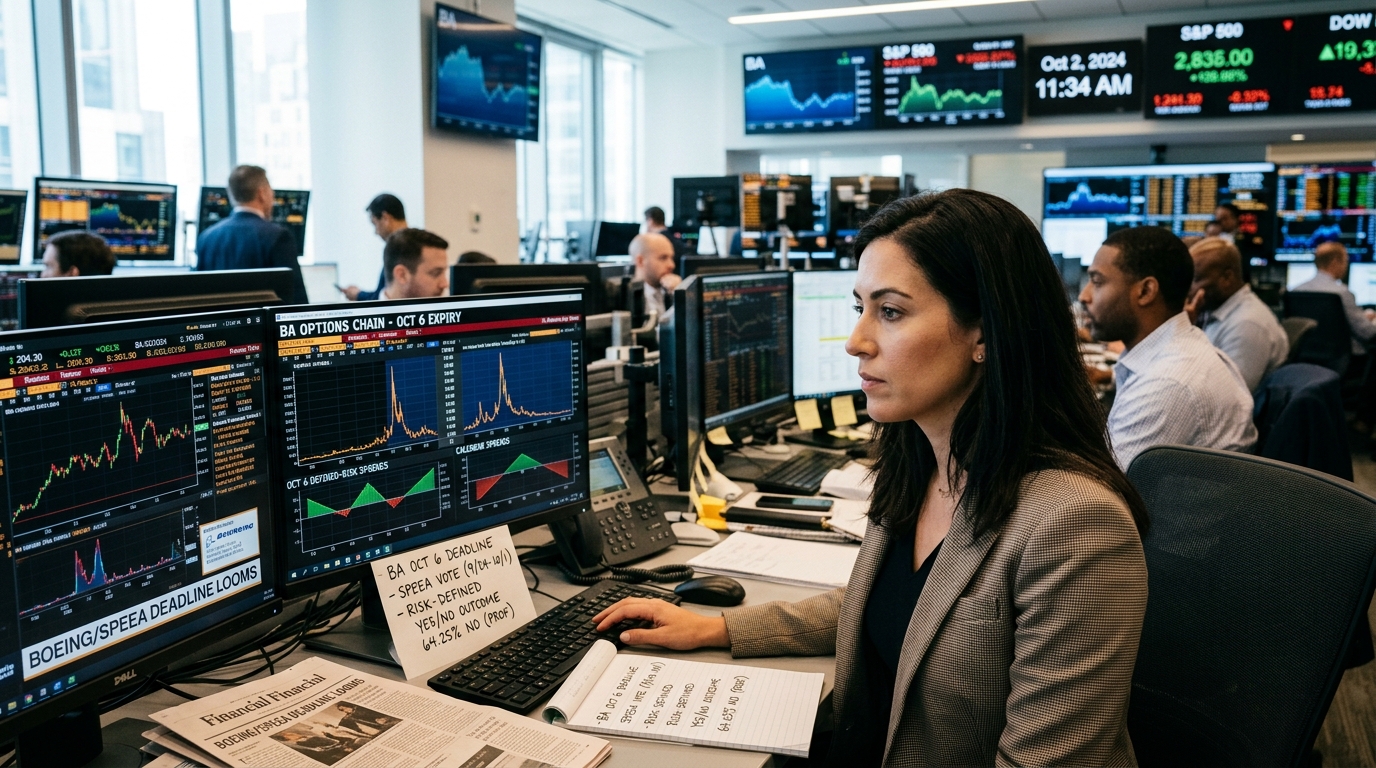
The strategy that fits this moment is a bull call spread expiring in mid-October, sized to risk a defined premium against the relief scenario while leaving loss capped at the debit paid if the vote fails. BA was trading in the $195 to $199 range on September 19, well off its 52-week high, which compresses the cost of near-the-money spreads. With IV in the middle of its annual range and a hard date on the calendar, debit spreads are not expensive. Buying premium into a known binary at mid-range IV is a structurally cleaner entry than chasing implied volatility after the fact.
The Beast Verdict
The thesis invalidates quickly if the Technical unit, which rejected the first offer 71.87% to 28.13% and has historically voted differently from the Professional unit, breaks against the recommendation again. Position sizing should reflect that possibility. Watch for any SPEEA communication in the days before September 24 signaling rank-and-file resistance; a surge in member commentary against the deal would be the clearest early warning.
The opportunity is not in predicting the vote. It is in recognizing that Boeing has handed traders a rare, dated binary, and that the options market has not yet adjusted around it. A defined-risk debit spread lets you express a view, collect if the relief trade materializes, and walk away with a known loss if it does not. That is what asymmetric positioning is supposed to look like.