
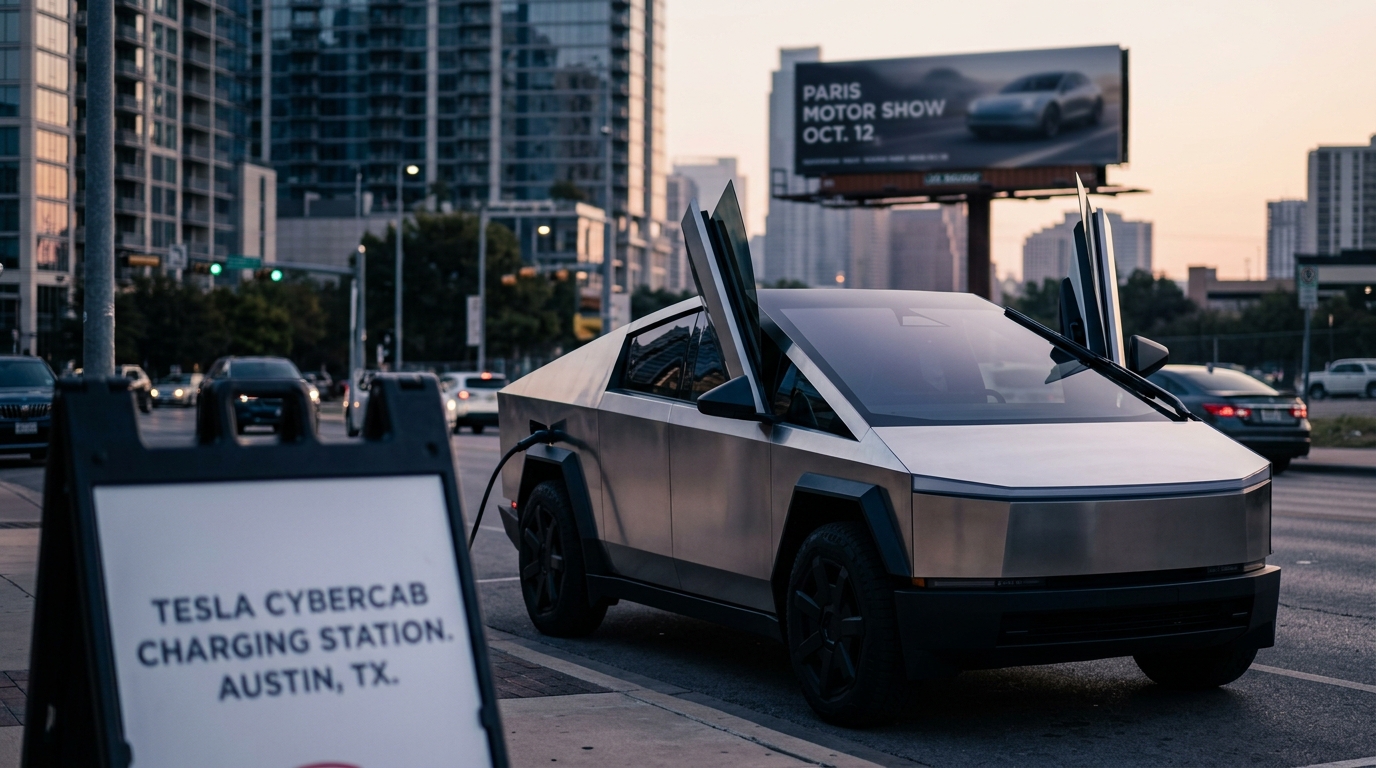
Here is the uncomfortable question for Tesla investors watching the Paris Motor Show open on Monday, October 12: does a car on a display stand in France matter more, or less, than 300 driverless vehicles charging rides in Texas?
Both happened in the same week. Tesla’s official Robotaxi account announced that the company now has “300+ Cybercabs serving Austin” just one month after launch, calling it “an 8x increase in 30 days.” Hours later, Tesla AI chief Ashok Elluswamy added a two-word tease: Cybercabs are “everywhere in Austin now. Dallas soon.” And the vehicle itself is in transit to Europe, set to occupy Stand C25 at the Mondial de l’Auto running October 12 to 18 at Paris Expo Porte de Versailles.
The combination is more than a scheduling coincidence. Tesla needs the U.S. numbers to justify the European ambition, and it needs the European platform to make the U.S. numbers legible to a global investor base that still treats the Cybercab as a promise rather than a product.
What the Austin data actually says
When public Cybercab rides began in Austin in early September, Texas registration records showed dozens of Cybercabs cleared for commercial service. That count climbed to 169 by late September, according to the Texas Department of Motor Vehicles public lookup.
Tesla’s own disclosure now puts the in-service figure higher. The 300-plus claim is the first time Tesla has put an official serving-Austin count this high in public. In the same period, Texas registration records for Tesla Robotaxi, LLC show the authorized Cybercab count rising from 169 to 319 after a batch of 150 new Cybercab entries appeared in the state’s automated-vehicle registry.
The scale still trails Waymo significantly. TechCrunch reported on September 1, 2026 that Waymo’s fleet had grown to more than 4,000 vehicles. Waymo has also said it has reached about 500,000 paid rides per week, but the company has not publicly tied that weekly rides figure to “15 U.S. metros” in the way this draft implies.
But Waymo’s fleet is built on lidar-equipped hardware that costs multiples more per unit. Tesla’s bet is that a purpose-built, lower-cost vehicle plus a camera-only autonomy stack will scale faster per dollar than Waymo’s lidar-equipped fleet. An 8x fleet expansion in a single month is one data point in that argument’s favor, though one month is not a trend.
Dallas is the next stress test. Reports and social posts continue to point to a growing staging footprint in the area, but the specific claim that roughly 300 Cybercabs have been spotted at a Dallas hub, and that Tesla is running fully driverless Dallas tests with no occupants inside the vehicles, is not something Tesla has confirmed publicly.
What Paris does and does not prove
According to show organizers, the Cybercab heading to Paris is from Tesla’s operational Robotaxi fleet in the United States, rather than a prototype or static concept. That framing matters. Sending a working vehicle rather than a show car is a deliberate signal to European policymakers and consumers. Putting Cybercab alongside mainstream European vehicles gives Tesla access to consumers, industry executives, and policymakers as it tries to turn autonomous transportation into a larger part of its growth story.
What Paris will not provide is a ride. Although attendees won’t be able to ride in the Cybercab, which has no steering wheel or foot pedals, it is the first time the vehicle will be shown in Europe.
What also remains unclear is timing on any EU-wide authorization pathway for a steering wheel-less robotaxi. This draft’s “decision now expected in December” is not supported by any official EU or Tesla timeline that has been publicly documented. A possible European commercial launch would still be a 2027-or-later question.
The thesis and its risks
The investment case here is straightforward: Tesla’s long-term autonomous strategy positions the company as a competitor not just to other automakers but to ride-hailing platforms and mobility services. The Q3 delivery beat reinforced the traditional business: Tesla reported 486,532 vehicles delivered in Q3 2026, slightly below year-ago levels but surpassing the company-compiled consensus of around 461,974 deliveries. Reports at the time said the stock rose roughly 4% to 5% on the news.
The risk is execution speed. Regulatory approval in Europe is genuinely uncertain, and Waymo has spent years building the operational record that regulators trust. Tesla is compressing that timeline by deploying at scale in Texas first and using the data as evidence. Whether that approach convinces Brussels before 2027 is the number investors should watch alongside every new entry that appears in a Texas DMV lookup.
The Paris show is a billboard. The Austin fleet is the proof. Right now, only one of those is open for rides.