
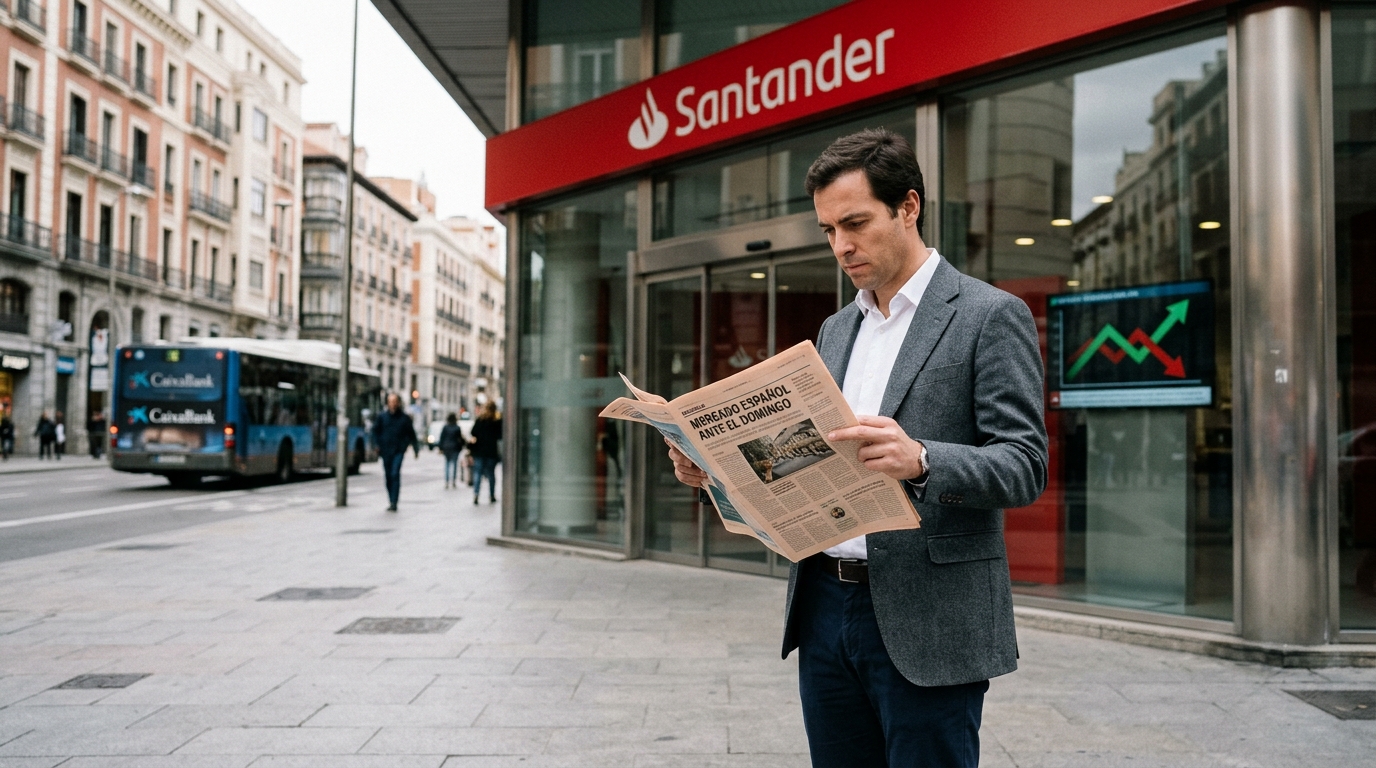
The IBEX 35 is trading around 19,235 on Friday morning, up roughly 1% on the session, with the banking sector leading the advance. Every component of the index opened the session on positive ground, with Santander up 2.6% at the bell. The market is not waiting for Sunday. It is already placing a bet. The question for options traders heading into the weekend is whether that bet is priced correctly, and what the payout looks like if the polls are wrong.
What Is Actually on the Line
The Spanish government approved a royal decree-law this week to extend the windfall tax on banks throughout 2027, with parliamentary ratification required via the standing body that operates when Parliament is dissolved. The levy reaches a 7% rate for lenders whose annual volumes surpass €5 billion, mainly affecting Santander, BBVA, and CaixaBank. That is not an abstraction: at stake is an estimated additional €1.4 billion the government expects to raise from the extension, and the Spanish tax agency’s monthly collection report shows €1,350.737 million collected from the tax between January and September 2026.
The PP opposed the levy and criticised the intervention; a PP economy ministry would likely let the levy lapse after 2027 rather than seek further extensions. Feijóo himself has said he will not tax banks more heavily than other businesses. While a complete abolition appears unlikely, Jefferies said the levy’s design could be revisited under a more market-friendly administration, which could be particularly beneficial for CaixaBank.
Between 2023 and 2025, the six listed Spanish banks paid a combined €4.032 billion under successive levies, with CaixaBank absorbing €1.477 billion, 81% more than BBVA and 62% more than Santander. Barclays estimates that eliminating the tax would lift CaixaBank’s annual earnings per share by roughly 9%. That is the number driving the pre-election rally, and it is also the number that evaporates if Sunday goes wrong.
The Poll Position
A majority requires 176 seats; recent forecasts generally give PP and Vox a combined majority, though the exact seat range varies by model. Politico’s Poll of Polls has PP at 32%, PSOE at 29%, and Vox at 18%. Prediction markets are more emphatic: Kalshi pricing has shown Alberto Núñez Feijóo as the next prime minister at roughly the high-80s percent, depending on the specific market and timestamp.
That conviction is the trap. Because the polls have been so consistent, much of the headline result is already priced in, so the edge lies in the details of the policy that follows. And there is a real tail risk: a strong Vox would make a PP-led government less stable and could lead to coalition withdrawal, as happened in 2024 when Vox left several regional governments over disputes including migration policy. A hung parliament, or one where Vox extracts concessions that dilute the pro-bank agenda, is not priced at all.
The Options Opportunity
When Sánchez called the snap election on October 5, Santander rose around 4.5% in a single session, a demonstration of how quickly traders price in political change. A confirmed PP-Vox majority on Monday morning could produce a similar move; a messy result or surprise PSOE strength could easily reverse this week’s gains.
The asymmetry here sits in CaixaBank call options expiring in December. CaixaBank, Sabadell, and Unicaja are among the most exposed to the levy because of their domestic focus, and CaixaBank shares have risen sharply since early 2022. A further catalyst: the Spanish state, through the FROB, owns about an 18% stake in the bank, and Feijóo has said it would be put up for sale under a PP administration. That is a double catalyst in a single name.
A bull call spread on CaixaBank captures the upside if Sunday delivers the expected result while capping the premium at risk. Buying the December 12 call and selling the December 14 call defines the trade. Maximum loss is the net premium paid; maximum gain activates if CaixaBank trades to 14 euros or above on the Monday open, consistent with a full levy-removal reaction on top of the privatisation signal.
What Would Break the Thesis
Three things end this trade badly. First, a PSOE overperformance that denies PP-Vox the 176 seats they need. The CIS state poll has at times put Socialists first, and late polling shifts are real. Second, Vox demanding non-economic concessions that fracture the coalition before it legislates on the tax. Vox’s populist instincts toward big banks make it a less reliable ally on this specific issue. Third, the courts: the banking sector is running a parallel legal offensive against the levy, which means the tax’s fate is not entirely political even if PP wins.
The Beast Verdict
Sunday’s Spanish vote is one of the cleanest binary catalysts available in European markets right now. Banks are the most direct expression of the policy divide between the two blocs, CaixaBank is the name most exposed to the levy, and the defined-risk structure of a bull call spread means the downside is known before the ballot boxes open. Size appropriately: this is a weekend event trade, not a core position. By Monday’s open in Madrid, the answer will already be on the board.