August 29, 2026
Bonus Content: Sell the Fear on TSN, Not the Stock
Editor’s Note: See the following from our friend Josh Baylin. Josh is one of the greatest tech investors in America. For years, he helped manage $200 million at SAC Capital (the elite fund run by Steve Cohen, who owns the NY Mets). He purchased two $60,000 Nvidia supercomputers to run his own quant fund. And he even broke tech stories at Bloomberg for many years. But what he’s sharing next could be the biggest call of his career…
What Sam Altman’s launching next could be 500 times bigger than ChatGPT, unlock an industry worth over $1 million per American, and send one small group of stocks soaring as this news spreads.
Click here to learn about the stocks tied to Sam Altman’s Next Venture.
At test sites across America, even the cleaning staff could go to prison if they told you what they’ve seen.
That’s because, at these sites, Sam Altman’s next venture is officially live.
It’s a new use for AI that may sound “disturbing” to some.
But like it or not… it’s already working 10,000 times faster than many of the smartest human scientists in the world.
It’s backed by Jeff Bezos, Peter Thiel, and Elon Musk (who calls the underlying tech “the most disruptive force in history”).
And it threatens to destabilize one of the world’s largest (and most-disliked) industries… saving millions of innocent people in the process.
To learn about this before the average investor is reading all about it in the news…
Click here to learn what’s happening – and to see the critical stocks to own as this takes off.
Regards,
Josh Baylin
Analyst, Stansberry Research
P.S. What I’m sharing with you today is the same investing blueprint that would have turned $1,000 into $3 million… and even $5.8 million in the past. Click here to see how getting in early on Sam Altman’s next big move could be the best decision you make all year.
Sell the Fear on TSN, Not the Stock
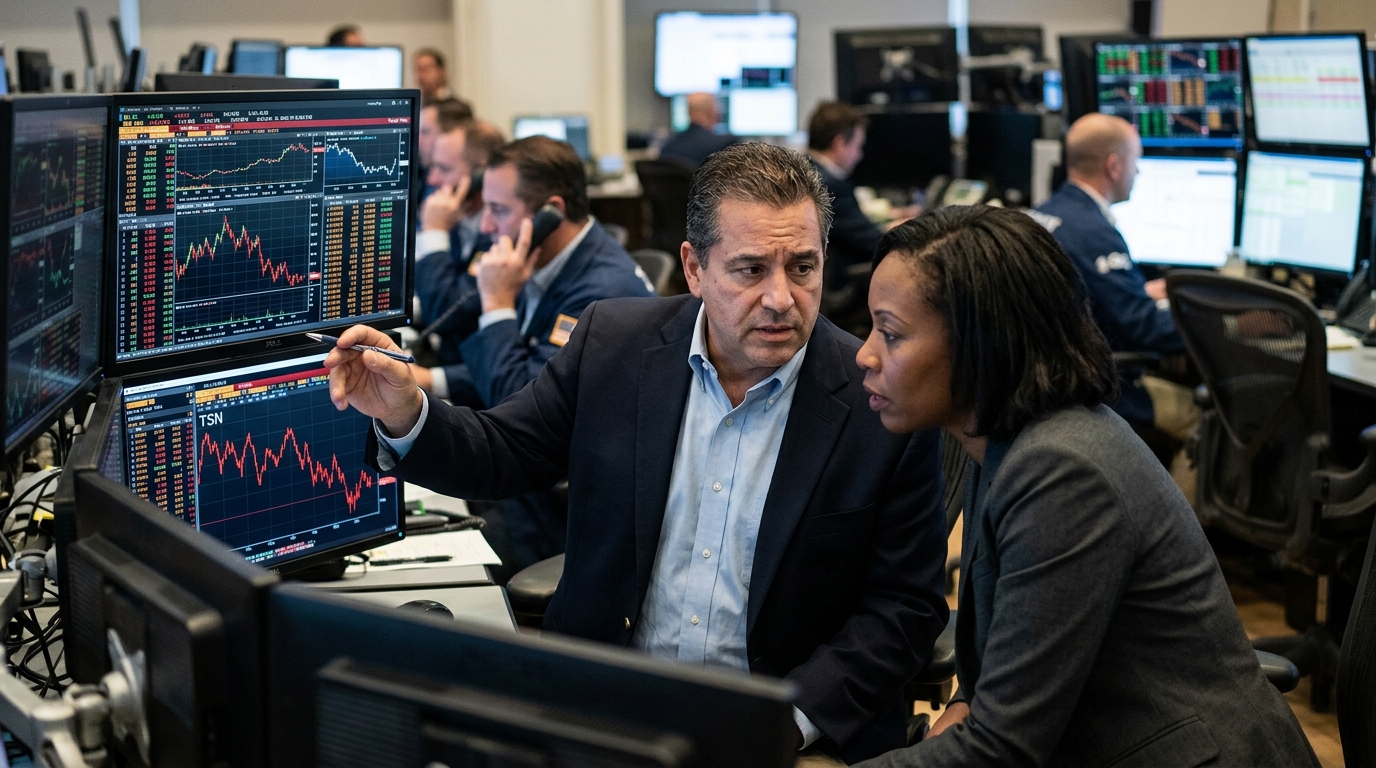
Before Friday’s Truth Social post from President Trump, Tyson Foods was already one of the most structurally damaged large-cap protein companies in the market. The executive order threat adds political risk on top of an operating disaster. That combination is what options traders should be pricing, and right now, it may be creating more opportunity than danger, if you approach it correctly.
What Changed Friday
Trump vowed to issue a legal order allowing farmers and ranchers to process their own meat, and posted on Truth Social that he was “authorizing legal documents to be drawn” to give them the right to process their own food. Four companies, Cargill, Tyson Foods, JBS USA, and National Beef Packing, control about 85% of U.S. meat processing. Those are the targets. Tyson Foods and JBS shares fell in premarket trading on the announcement.
Under current federal law, ranchers are permitted to slaughter and process their own animals but are barred from selling that meat unless they meet strict safety and sanitation requirements. The details of how Trump plans to alter those rules remain unclear. That ambiguity is the crux of this trade. The order has not been signed. Its actual scope is undefined. The Meat Institute said it is waiting to see the details and warned that “expanding processing opportunities does not come at the expense of food safety.”
The Business Was Already Broken
Strip away Friday’s headlines and what you have is a company in serious structural trouble. Tyson warned on August 3 that losses in its beef business would widen, forecasting an adjusted operating loss of $500 million to $650 million in fiscal 2026, compared with a previous forecast of $350 million to $500 million. That guidance revision landed alongside plant closures.
Tyson announced on August 13, 2026 that it will end operations at its facility in Joslin, Illinois, and its case-ready facility in Eagle Mountain, Utah, and is pursuing a sale of its Pasco, Washington facility. All told, these moves represent Tyson shrinking its beef footprint meaningfully, but it is not supported to claim they amount to roughly a third of its former beef-processing capacity.
Cattle supplies shrank to a 75-year low after a prolonged drought burned up grazing lands in the western U.S., compounded by Washington suspending imports from Mexico to keep out the flesh-eating pest New World screwworm. Rebuilding a herd takes years of heifer retention under favorable conditions, conditions that have only recently begun to appear in limited fashion.
Options Perspective
Friday’s political shock injected fear premium into TSN options. That is the inflection point worth examining. When a stock is already limping, TSN closed at $58.40 on August 20, 2026, and a binary political event lands without defined scope or timeline, implied volatility spikes. That premium spike can be sold or used to reduce the cost of a directional position.
The thesis here is not that Trump’s order will destroy Tyson. Expanded on-farm processing rights face the same practical barriers that have long limited small operators: capital costs for compliant facilities, sanitation standards, labor, and scale economics. The real risk is that this headline cycle, with Agriculture Secretary Brooke Rollins promising “big announcements” on Monday including expanding ranchers’ ability to sell across state lines and new backing for smaller processors, keeps pressure on the stock through at least next week.
A bear put spread targeting the next 30 to 45 days captures that window without requiring naked short exposure to a name that could bounce sharply if Monday’s announcements disappoint or get bogged down in regulatory process. Buying a put one strike in-the-money and selling one put two strikes lower limits premium outlay and benefits from elevated IV without relying on volatility to remain elevated. If Tyson stabilizes, you lose only the net debit. If the political pressure compounds the fundamental weakness, the spread pays.
Risk Management
JBS announced the closure of two plants earlier this year and named a new CEO after reporting a $102 million net loss for the second quarter from high beef costs and other nonrecurring expenses. Sector pain is broad. But a resolution on Mexican cattle imports, with USDA reopening the Douglas, Arizona port of entry beginning August 24, 2026 as part of a phased approach, could shift the supply outlook faster than the political noise implies, and a meaningful relief rally would pressure short positions.
Do not size this as a conviction long on a catastrophe. Size it as a defined-risk view on a catalyst-heavy five to six week window. The executive order detail, Monday’s USDA announcements, and Tyson’s next earnings date, which is widely estimated as November 9, 2026 and not yet confirmed by the company, all create a roadmap of inflection points worth monitoring. Stay with the spread, stay defined, and let the political volatility work for you rather than against you.
The Beast Verdict
TSN already carried a $500 million to $650 million beef operating loss into this week. Friday’s executive order threat added a layer of political risk whose real-world implementation remains entirely unclear. That combination has likely inflated near-term put premiums. A bear put spread is the disciplined response: it profits if the political pressure compounds the fundamental slide, costs a defined premium if Tyson stabilizes, and avoids the gap-up risk that naked short sellers will face if Monday’s USDA announcements land softer than feared. Own the risk structure. Do not let the headline own you.