
Dear Income Seeker,
If you’re struggling to find high-probability income trades…
Or think you’ve found them…
Only to be frustrated – and disappointed – with the money you’re bringing in…
You owe it to yourself to check out this website.
Because it will give you the opportunity to get your hands on a little-known 1-hour trading secret… 100% free of charge.
Do your future self a big favor and claim a copy now.
Because at some point soon, it won’t be free.
To better trading,
– Drew Day
Partner
Base Camp Trading
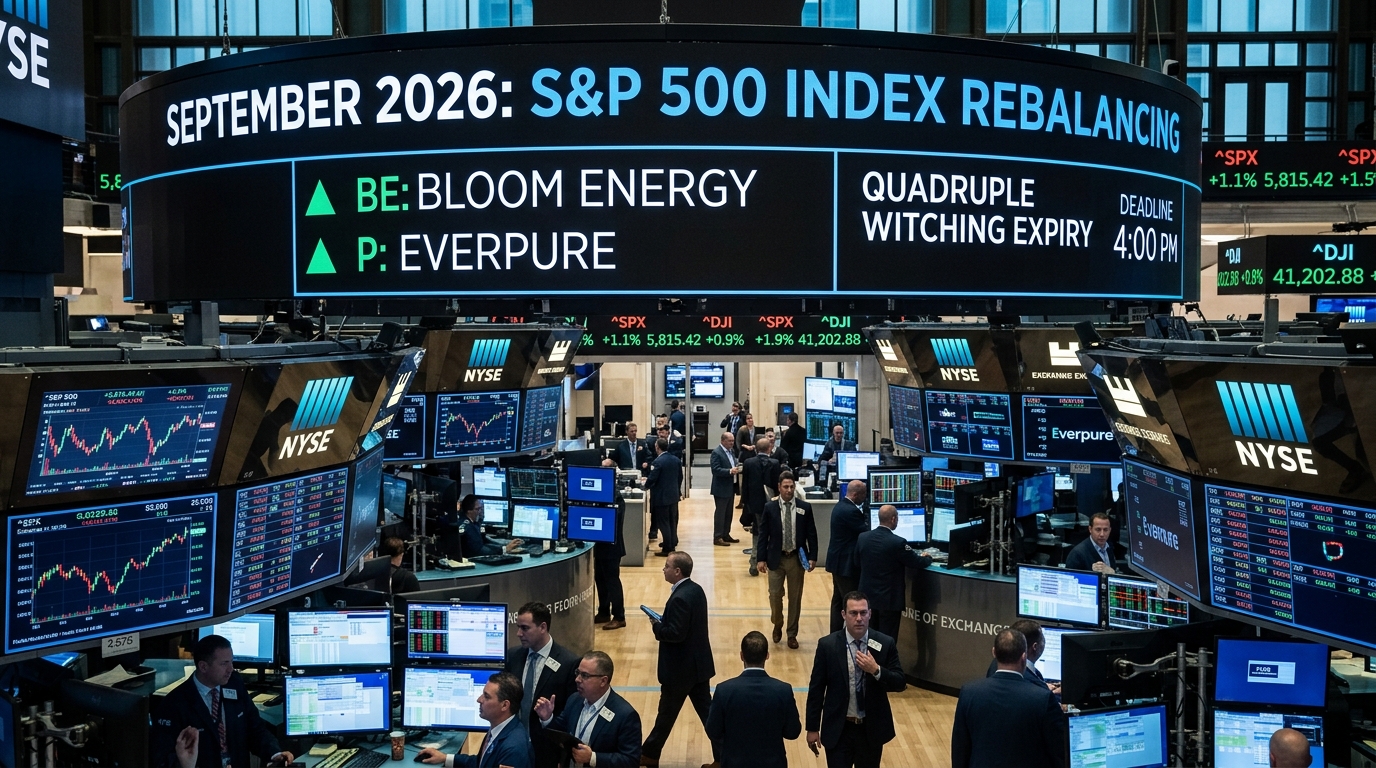
Bloom Energy and Everpure Join the S&P 500 After Quad Witching
There are weeks when the options market hands you a timetable. This is one of them.
The situation in plain English: On September 4, 2026, S&P Dow Jones Indices confirmed that Bloom Energy (BE), Illumina (ILMN), and Everpure (P) will join the S&P 500 effective before the open on Monday, September 21, 2026. The Trade Desk (TTD), Molson Coors (TAP), and Builders FirstSource (BLDR) move to the SmallCap 600 the same morning. Every passive fund that tracks the large-cap index must execute those trades before the bell rings on the 21st. The largest single liquidity event they have to navigate on the way there is quad witching Friday, September 18, 2026, when stock index futures, stock index options, and single-stock options all expire simultaneously.
That convergence is the edge. Index buying does not care about price. It has a deadline. And that deadline falls squarely on the quarter’s highest-volume session.
Why This Trade Stands Out
Most S&P 500 addition plays are straightforward: buy the stock, ride the passive inflow, take profits. This one has an extra layer. The mechanical buying has to be executed into a session already distorted by expiring derivatives. That compresses the timeline, amplifies intraday swings, and inflates the options premiums that traders are paying right now.
The options market has already noticed. In the first full week after the September 4 announcement, Bloom Energy’s options activity and implied volatility jumped sharply across the front end of the chain, with widely reported readings putting implied volatility above 90%.
The most actively traded contract that session was described in market coverage as a 300-strike call expiring that Friday, priced around $4.65 and requiring another 8% gain just to break even at expiry. That tells you something about sentiment: traders are not being cautious about the timeline.
The Story Behind the Trade
Bloom Energy makes solid oxide fuel cell systems for onsite power generation and has become a direct beneficiary of data center expansion. The company has referenced approximately a $20 billion backlog, and in its Q2 2026 materials it raised full-year 2026 non-GAAP operating income guidance to $800 million to $900 million.
Everpure (NYSE: P) is a storage and data management vendor that reported fiscal year 2026 revenue of $3.66 billion, up about 15.6%. It also announced a landmark design win with a second top-five hyperscaler as a customer.
The Trade Desk’s removal tells the other side of the story. TTD’s latest reported quarter showed revenue up 3% year over year, and the company guided next-quarter revenue to at least $650 million. The index committee did not editorialize; it simply noted the change keeps each benchmark aligned with its market-cap range.
Options Perspective and Strategy
The core opportunity is in BE and P, not TTD. Passive outflows from TTD are already baked in. The inflow trades, however, have to land before September 21, and quad witching on the 18th is where volume concentrates.
Elevated implied volatility in BE makes outright long calls expensive relative to historical norms. A bull call spread targeting the September 18 or September 25 expiry controls premium outlay while still capturing directional movement into the rebalance. For Everpure, where IV is typically less extreme, a short-dated long call with a strike 5 to 8% out of the money provides defined risk with direct exposure to the forced-buying window.
The thesis does not require predicting how these companies perform as S&P 500 constituents over the next year. It requires only that a known quantity of passive capital arrives before a known date, into a session already under mechanical pressure. That is the entire argument.
Risk Management
The known risks are real. Both stocks have already moved significantly on the announcement. Much of the passive-buying expectation can get priced in quickly. A risk-off move into quad witching could overwhelm the mechanical bid. Any deterioration in the macro backdrop, a surprise Fed signal or credit event, would hit high-IV, high-momentum names first.
Define risk before the trade begins. Size positions so that losing the entire premium is painful but survivable. The deadline is September 18, 2026. When that session closes, this particular window closes with it.
The Beast Verdict
This week offers a rare combination: a confirmed catalyst, a firm execution deadline, elevated options activity confirming institutional awareness, and a quad witching expiry that concentrates all of it into a single session. Bloom Energy and Everpure are the names to watch. The clock runs out Friday at the close.