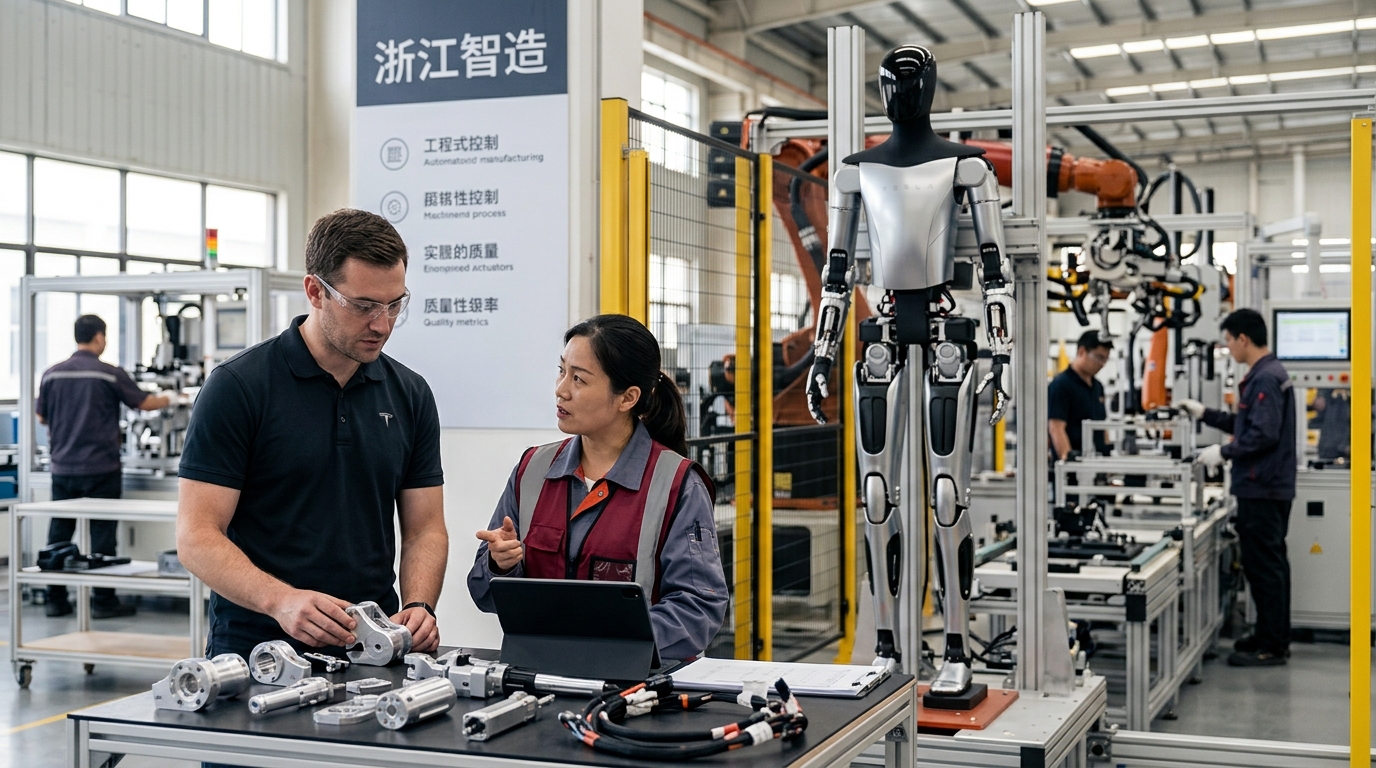
A demo becomes an industry the moment someone places a real purchase order. That moment arrived on September 16, when Tesla’s robotics team landed in Ningbo and launched a new round of production audits for the Optimus humanoid robot, focusing on verifying exclusivity and consistency for mass production, assisting supply chain partners with equipment debugging, and migrating manufacturing capabilities from U.S. factories to Chinese suppliers.
The Chinese companies set to undergo supplier audits include heat-control component manufacturer Zhejiang Sanhua Intelligent Controls, auto parts supplier Ningbo Joyson Electronic, and chassis producer Tuopu Group. Most of them already provide automotive components used in Tesla’s electric cars, and they are all based in eastern China’s Zhejiang province. This is not a coincidence. It is a deliberate supply-chain playbook: take manufacturers who already pass Tesla’s quality bar, flip their production lines from cars to robots, and compress the ramp timeline by years.
Supply chain reports indicate Tesla has placed an initial batch order for approximately 5,000 Optimus units, aiming for a production capacity of 1,000 units per week by late September, with plans to increase output to 2,000 to 2,500 units per week by year-end. Under the current plan, Tesla is said to be targeting roughly 50,000 Optimus robots in 2026, deploying them across its gigafactories worldwide. Ordinary consumers still have no channel to purchase Optimus, indicating the product will remain primarily for internal industrial use in the near term. Internal deployment is not a limitation to bury; it is a margin-protecting strategy. Tesla gets to absorb its own robots’ labor output before committing to external pricing.
Who Actually Wins
Stock markets answered with enthusiasm. Reuters-linked reporting in China said Joyson Electronics hit the daily limit up, while Tuopu Group and Sanhua Intelligent Controls rose 4.36% and 2.70% respectively. These are real moves. They are also, almost certainly, the wrong place to look for the durable value in this story.
The parts suppliers’ gains rest on a fragile logic: that their position in today’s bill of materials is permanent. History suggests otherwise. Supply chain estimates on China-sourced content vary by report, but they generally cluster around roughly two-thirds of the hardware bill of materials, not a clean 70% that can be treated as a settled fact. That dominance reflects cost and manufacturing depth accumulated over decades of automotive production. It does not reflect irreplaceability. Near-shoring is already visible in corporate footprints: Tuopu and Sanhua both list Mexico operations, and Sanhua also lists a Thailand production base. Tesla is quietly building the geographic optionality to reduce single-country exposure even as it deepens the relationships.
The more durable question is about Tesla itself. Tesla designs the core architecture but outsources component manufacturing. That is a structurally powerful position. The AI brain, the software stack, the robot’s task-learning capability: none of that ships with the Sanhua thermal module. Tesla owns the layer of the product that gets smarter over time. The suppliers own the layer that gets commoditized.
The Thesis and Its Limits
Investors who want exposure to humanoid robotics through the Chinese component names are essentially betting that Tesla either cannot or will not vertically integrate, and that competition among robot makers will be fierce enough to keep multiple Zhejiang suppliers certified and growing. Those are reasonable bets at a 12-month horizon. They become shakier at five years.
For Tesla shareholders, the audit week in Ningbo confirms something more significant: Optimus has cleared the hardest organizational hurdle, which is converting an engineering prototype into a repeatable manufacturing program. Reports about the audits say they are meant to support mass production readiness and pave the way for follow-on orders. The business that compounds here is the one that sells the robot’s intelligence, not its joints. That business belongs to Tesla.