The trade-down thesis has been one of the most comfortable ideas in consumer investing for the past two years: when budgets tighten, Americans swap sit-down restaurants for fast food, and fast-food stocks win. Meritage Hospitality Group just punched a large hole in that story.
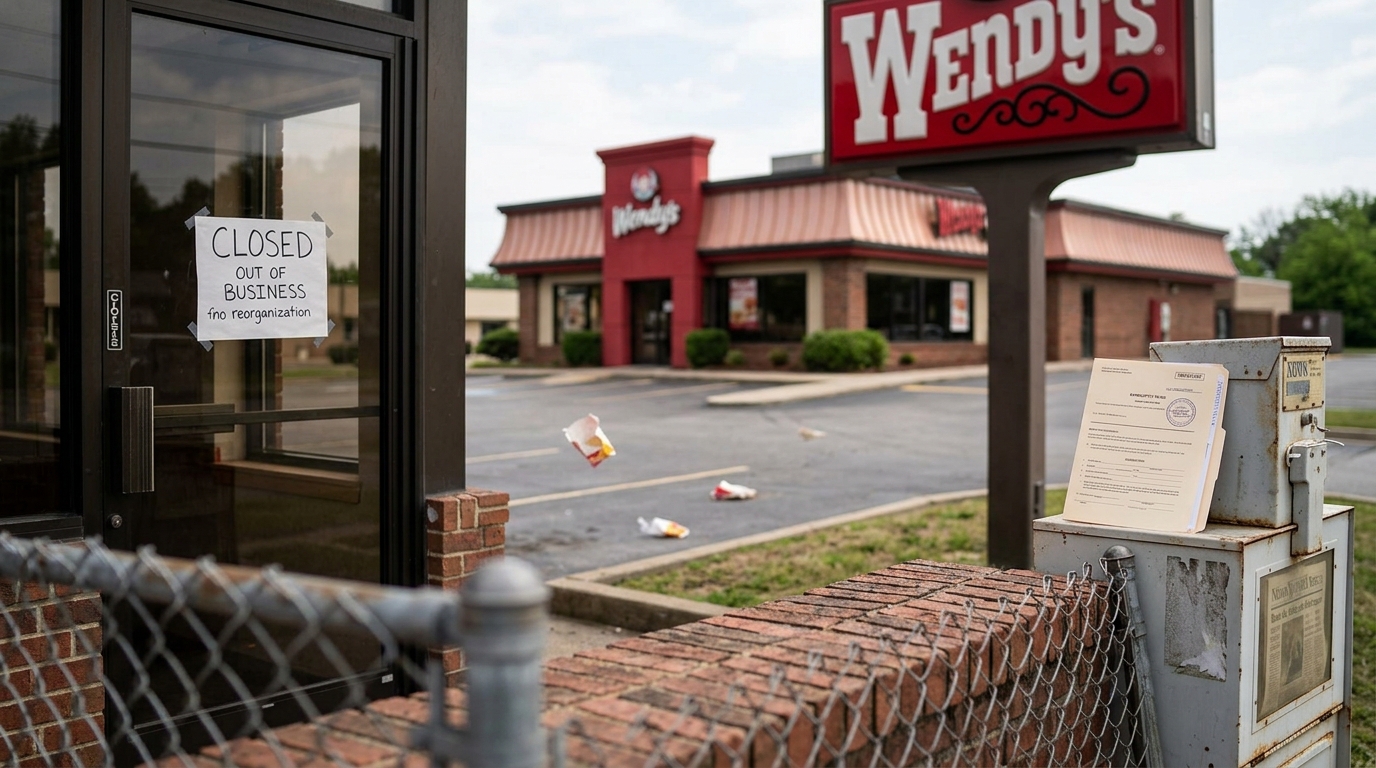
Meritage filed for Chapter 11 bankruptcy protection in the United States Bankruptcy Court for the Western District of Michigan on September 17, 2026, operating 314 Wendy’s restaurants across 15 states. The company has said it employs roughly 9,000 people. This is not a marginal operator. It is one of the largest Wendy’s franchisees in the country, and it collapsed while fast food was supposed to be benefiting from cautious consumer spending.
Meritage has said store-level EBITDA fell sharply in 2025 as higher beef prices collided with heavier reliance on promotional discounting. The company had already closed about 60 locations and opted out of, or altered, the breakfast daypart in a large portion of its underperforming restaurants to try to improve store economics. None of it was enough.
The deeper issue is the brand carrying those restaurants. Wendy’s has reported same-restaurant sales declines for six consecutive quarters, and its stock has fallen by roughly two-thirds over the past three years. U.S. same-restaurant sales fell 7.0% in the second quarter of 2026 compared with a year earlier, while U.S. systemwide sales declined 8.2% and customer traffic remained under pressure. Burger King also overtook Wendy’s to become the country’s second-largest burger chain by U.S. systemwide sales, behind McDonald’s.
That last detail matters for investors holding what they believe are safe, defensive fast-food positions. The trade-down argument treats the sector as a monolith. It is not.
Asset-light global franchisors collect royalties on systemwide sales rather than owning restaurants themselves, which can soften the earnings hit when costs rise or traffic falls at the store level. International diversification adds another layer of insulation, since growth abroad can offset softness at home. That structural advantage is why QSR and Yum! Brands pointed to franchising and international strength in their Q2 2026 results. McDonald’s, despite some U.S. execution stumbles, has responded to the value environment by leaning aggressively into affordability, expanding low-price menus, sharpening combo pricing, and building a more structured all-day value architecture.
The Wendy’s franchisee bankruptcy reveals what happens at the other end of the spectrum: an operator with concentrated domestic exposure, a struggling parent brand, and no royalty buffer when traffic falls. McDonald’s CEO described a bifurcated consumer base, with QSR traffic from lower-income consumers declining nearly double digits, a trend that has persisted for nearly two years. Lower-income diners are not simply trading down to fast food. They are cutting visits entirely, or trading sideways to whatever offers the clearest value per dollar on a given day.
The wealth-building lesson is one of precision. Owning QSR exposure is not the same as owning the trade-down trend. Owning a heavily franchised, globally diversified operator is a materially different bet than owning a domestic brand fighting for traffic with promotions that can compress franchisee margins to near zero. Meritage’s filing is a reminder to examine what you actually own inside a sector, not just which sector you are in.
Review your fast-food and restaurant holdings against three questions: How franchised is the business? How geographically diversified? And how dependent is the parent brand’s royalty stream on the very consumers who are pulling back hardest? The answers will separate the genuine defensive positions from the ones that only looked safe when the trade-down theory fit neatly on a slide.