
September 21, 2026
Xi’s Thursday summit is a near-term yes-or-no on Chinese market access, making GM, Ford, and suppliers a live two-sided options trade.
The US auto industry rarely speaks with one voice. This week it does, and the target is the Oval Office.
The Energy Stock Trump Once Called “A Big Mistake” to Mess With
When a U.S. ally tried to tax ONE American energy company…
Trump didn’t hesitate to issue a direct warning.
Now this same company is generating over $3 billion in operating income…
And partnering with the hottest AI stock on Wall Street.
Out of 23,281 publicly traded stocks, this is the ONLY one that meets all the “unicorn” criteria.
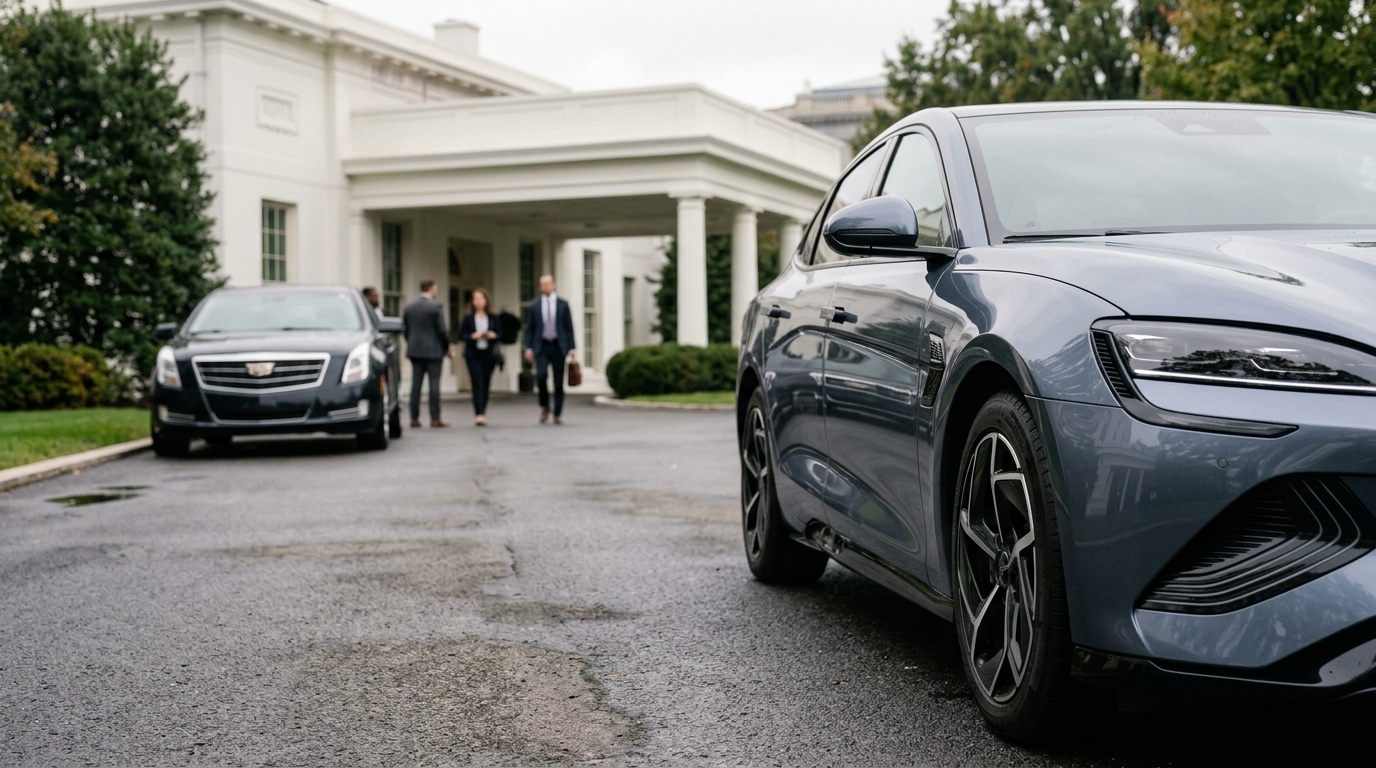
The American automotive industry is urging President Donald Trump to maintain policies that keep the door firmly shut to Chinese automakers seeking to sell, import, or manufacture vehicles inside the US. Signatories include the Alliance for Automotive Innovation, the American Automotive Policy Council, the Motor and Equipment Manufacturers Association, and Autos Drive America, spanning major automakers and suppliers. Six associations on one letter is rare. The reason is obvious.
On September 11, Trump told Fox News he would accept Chinese automakers building manufacturing plants on US soil. Days later, the American auto industry sent a letter asking him to reconsider, with Xi Jinping arriving in Washington with a business delegation that may include BYD and CATL. Reuters reported that Chinese officials have considered BYD for a possible business delegation joining Xi’s summit with Trump, with senior officials reviewing the list.
That makes Thursday’s summit a hard catalyst with a binary outcome for the sector. Either Trump holds the line, or the political ground shifts under GM, Ford, Stellantis, Tesla, Aptiv, Lear, and Magna in a single afternoon.
I Called Black Monday. Now I’m Calling This!
I predicted the 1987 crash six weeks early. I called the fall of the Berlin Wall. I pinpointed the exact bottom in 2009.
I even predicted the SpaceX IPO filing within a week of it happening.
Today, I’ll show you how to get in before the big announcement.
Existing federal rules established under the Biden administration restrict the import and sale of certain connected-vehicle hardware, software, and vehicles with a sufficient nexus to China or Russia, citing national security risks tied to connected-car data systems. Meanwhile, US tariffs on imported Chinese EVs are 100% (up from 25%), and that 100% sits on top of other applicable duties. The trade groups argue those policies are the reason the US, unlike much of Europe and a range of other overseas markets, has avoided a surge of cut-rate Chinese vehicles. Strip them away, and the competitive calculus changes immediately for every domestic OEM and their tier-one suppliers.
The demand side of the BYD threat is not theoretical. Data cited by Reuters and reported by industry outlets show BYD’s domestic China sales were down about 14% year-to-date through August 2026, while overseas sales rose about 86% to roughly 1.16 million vehicles, underscoring how central export markets and tariff regimes have become to the company’s growth. A US foothold would be the crown jewel of that international push, and Hyundai’s CEO told Reuters this week that Chinese cars already sell 30% to 40% below rivals in Italy, Spain, and France.
The trade associations put it plainly: Chinese automakers hold essentially zero US market share today, and allowing them to open a domestic facility would provide a foothold at the expense of manufacturers that have made generational investments here, shifting jobs toward companies owned by the Chinese government.
The Options Opportunity
Thursday sets up a defined-risk trade on the domestic auto complex, specifically GM and F, with a secondary read-through to supplier names like Aptiv and Lear. The thesis is asymmetric. If Trump holds the existing policy, these stocks likely get a relief rally and put buyers lose their premium. If he grants BYD any form of market access, the sell-off across US automakers and their supply chains could be severe and fast.
5 Little-Known Stocks Behind Today’s Defense Tech Shift
Behind the headlines, a major transformation is underway.
Modern warfare is being driven by AI, autonomous systems, and next generation technology. A handful of lesser known companies are helping power this shift.
This report uncovers five stocks quietly playing a critical role in the future of defense.
Given that asymmetry, a put debit spread on GM expiring in late October is the cleanest expression. Buy the at-the-money put, sell a lower-strike put to cap the cost. The spread funds itself with the sold strike and limits maximum loss to the net premium paid. Time decay works against buyers past the catalyst, so choosing an expiry that captures Thursday but doesn’t bleed for weeks of post-summit drift is critical.
The thesis breaks if Trump explicitly and publicly reaffirms the existing Biden-era connected-vehicle rules without modification. It also breaks if the summit produces no automotive language at all, in which case the put spread expires worthless. Position sizing matters: this is a defined-risk bet on a political event, not a fundamental valuation call. Size it accordingly.
The Beast Verdict
Rarely does a geopolitical summit hand options traders this clean a date. Thursday is a live vote on whether the US auto industry’s current competitive moat stays intact. The trade groups have made their position public. Trump’s position is genuinely unclear. That uncertainty, priced into a near-dated put spread on GM or F at a contained premium, is where the risk-reward sits. Monitor any White House statement on connected-vehicle rules between now and Thursday. That language will be the tell.