
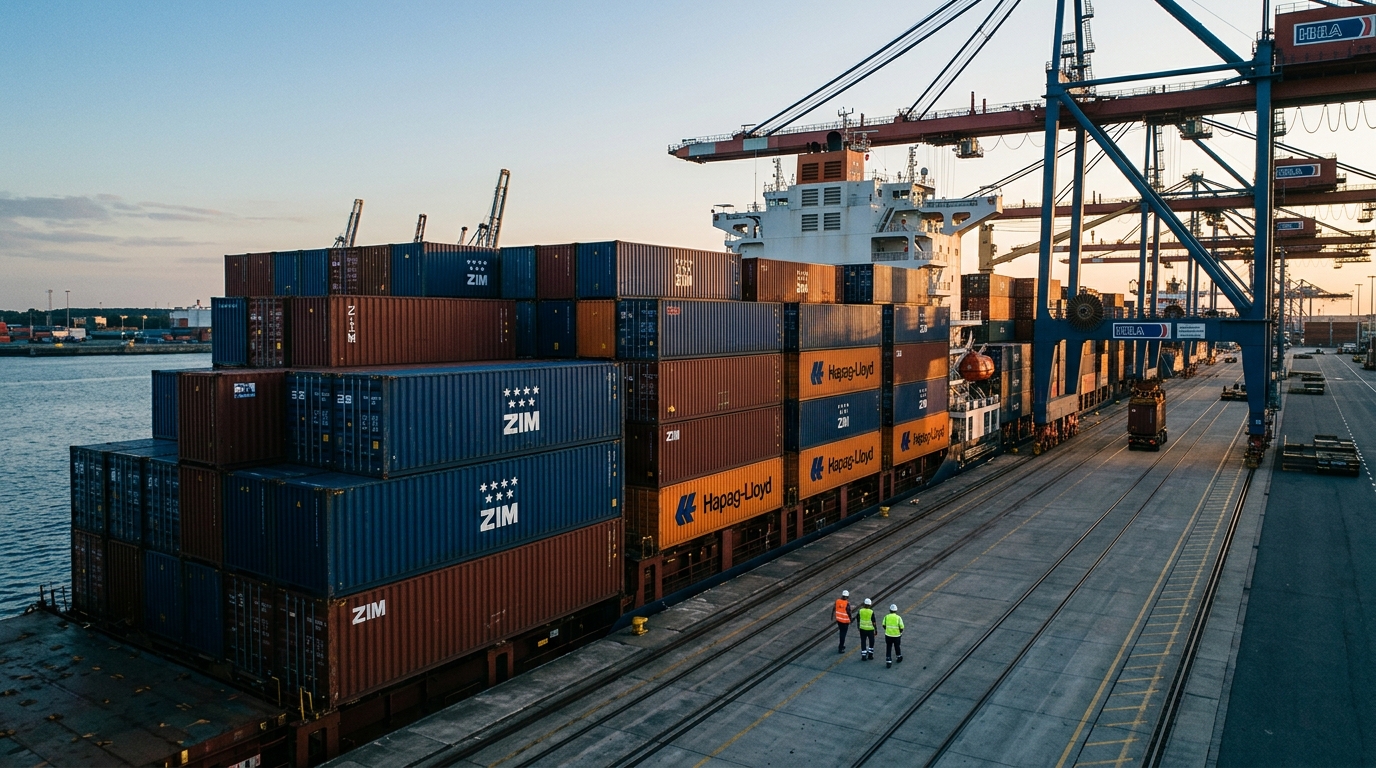
ZIM Integrated Shipping Services is now a materially better business than the one Hapag-Lloyd agreed to buy. The market has barely noticed, and that gap is where the trade lives.
On October 6, ZIM raised its full-year 2026 adjusted EBIT guidance to between $1.4 billion and $1.7 billion, up from a prior range of $700 million to $1.1 billion, while adjusted EBITDA guidance climbed to $2.7 billion to $3.0 billion from $2.0 billion to $2.4 billion. At the midpoint, that represents a 30% increase in adjusted EBITDA and a 72% jump in adjusted EBIT versus guidance issued on August 19. ZIM credited “continued strong market demand and favorable momentum in freight rates,” but did not quantify how much of the change was driven by rates versus volumes.
The Story Behind the Trade
In February, Hapag-Lloyd and ZIM announced a definitive agreement for the German carrier to acquire ZIM for $35 per share in an all-cash transaction. ZIM shareholders approved the merger by 97.36% at a special general meeting held on April 30, 2026. That was the easy part.
Hapag-Lloyd’s $4.2 billion acquisition of ZIM is now in limbo after Israel’s Government Companies Authority ended its review of the original transaction structure, requiring Hapag-Lloyd and its Israeli partner FIMI to advance a materially revised proposal through a new review process. The decision followed the failure of the parties to submit a detailed revised proposal by the set deadline. The GCA stated it would only consider a fully detailed new filing. Hapag-Lloyd has said it intends to resubmit, leaving the merger’s timing and terms subject to fresh regulatory review.
Here is the core asymmetry: a deal priced before a 72% operating-earnings upgrade is now stuck in Israeli regulatory limbo, and ZIM stock closed at $30.26 on October 8, nearly $5 below the $35 buyout price. The options market appears to be treating ZIM as a slow-moving merger arbitrage rather than a company whose fundamentals just shifted sharply higher. The options-volatility and put/call figures in this draft could not be verified from primary, time-stamped market sources, so they have been removed.
Technical and Fundamental Alignment
Higher container freight rates can have an outsized impact on shipping companies because much of their vessel and operating cost base is fixed or contracted, allowing stronger rates to translate quickly into higher operating profit when demand remains firm. ZIM’s asset-light model can amplify this: the 72% EBIT upgrade relative to a 30% EBITDA gain points to operating leverage, with its chartered-fleet approach enabling capacity adjustments as market conditions change. The draft’s specific quarter-to-date percentage gain and the precise $22.20 reference level at deal announcement could not be verified from the materials reviewed, so those figures have been removed.
Options Perspective
The strategy here is a bull call spread, buying a January 2027 $31 call and selling the $35 call against it. The $35 strike maps directly to the buyout price, capping upside at the deal ceiling while reducing premium outlay versus a naked long call. The defined-risk structure is appropriate because the thesis has two distinct resolution paths: either the deal closes near $35 or the upgraded fundamentals alone drive the stock closer to that level ahead of ZIM’s next earnings report, which has been widely estimated for November 19, 2026 but has not been confirmed by the company.
Time decay works against any long options position, but the earnings catalyst and the deal resubmission timeline both fall within the January expiration window, giving the thesis room to develop.
Risk Management
The clearest risk is deal collapse. The deal remains subject to regulatory approvals, including approval related to Israel’s Special State Share, which gives the State of Israel significant consent rights and veto power over certain changes in control. A failed deal removes the $35 floor entirely.
The guidance also does not separate rate strength from volume, making the durability of the earnings upgrade harder to assess. If freight rates reverse before results, the fundamental case weakens.
The Beast Verdict
The edge here is precise: Hapag-Lloyd negotiated a price in February, before ZIM’s operating earnings midpoint moved up by more than $650 million. The deal is stuck in Israeli review, the stock is sitting about $5 below the buyout price, and a bull call spread targeting the $31-$35 range expresses this view with defined, bounded risk and a catalyst timeline that resolves within the trade window.