
Dear Reader,
The Trump administration has been pumping massive cash into small resource companies lately…
Companies vital to national security.
As you can imagine, these “government targeted” stocks have soared in value.
Just look at the results:
Trilogy Metals – up 388% in 8 days.
MP Materials – up 216% in 4 months.
Lithium Americas – tripled in 3 weeks.
And America’s Economist, Dr. Mark Skousen, says it’s about to happen again.
Keep in mind… Skousen knows the President personally after Trump spoke at his FreedomFest conference.
And he’s also developed close relationships with Senators Rand Paul, Mike Lee, and others.

He’s learned what’s important to them.
And one thing they’ve made clear.
The current administration will take stakes in companies they deem important to national security.
Now, Dr. Skousen says he believes it will happen again.
This time with a much smaller company.
And in anticipation, he’s purchased 10,000 shares of his own.
Here’s why…
This company is the only domestic producer capable of delivering one strategic mineral America can’t do without.
That’s why Tesla just signed a binding agreement to purchase 75,000 metric tons from this company.
And it’s why the government has already handed the company grants totaling $130 million.
Dr. Skousen believes the U.S. government could take a stake at any moment in the days ahead..
He breaks down the full situation right here – read it before this stock makes headlines.
Good investing,
Rachel Gearhart
Publisher, The Oxford Club
P.S. The last time Mark felt this way about a resource stock, he turned $50,000 into a rare $1.3 million over just three years. Don’t sit on this one.
UnitedHealth’s Star Rating Slide Is Now the Q3 Earnings Story That Matters
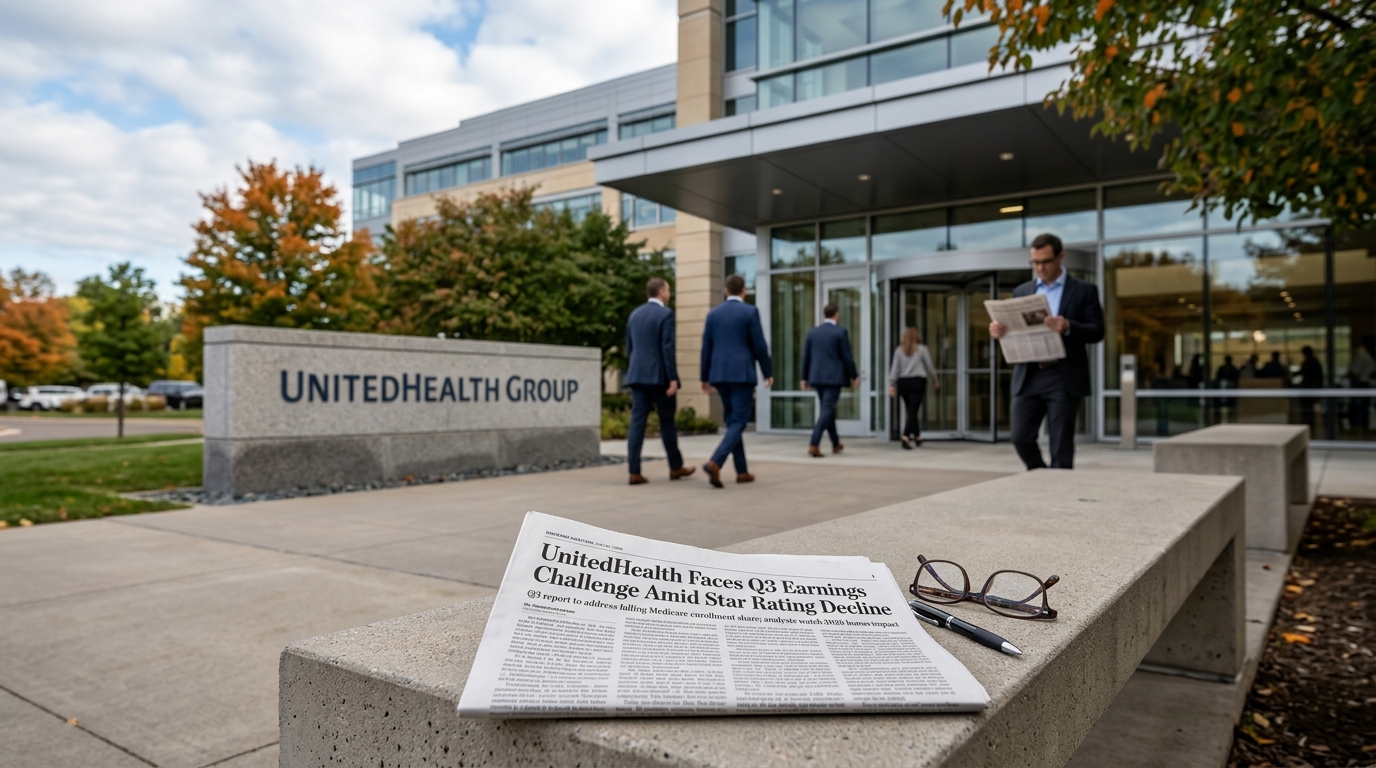
Two things are converging at precisely the wrong time for UnitedHealth. The company reports Q3 results before the market opens Tuesday, October 13, with Wall Street expecting $4.12 per share on roughly $111.38 billion of revenue. And just days before that report, CMS dropped the 2027 Medicare Advantage star ratings that will determine 2028 bonus payments, a release that landed badly for UNH and brilliantly for Humana.
What the Star Ratings Actually Did
CMS published the 2027 Medicare Advantage and Part D Star Ratings on October 8. J.P. Morgan estimates the share of UnitedHealth members in plans rated four stars or higher will fall to about 67% for 2027, from about 81%. The drop matters more because the industry moved the other way. CMS says about 71% of Medicare Advantage prescription drug plan enrollees will be in four-star-or-better contracts for 2027. UnitedHealth went from beating that average to trailing it.
Humana provided the sharpest contrast. Humana said 95% of its Medicare Advantage members are now enrolled in plans rated 4.0 stars or above for 2027. Humana’s stock surged more than 12% after the announcement, while UnitedHealth’s qualifying share fell from 81% to 67%. One caveat worth holding: CMS also changed the scoring, adding two medication-safety measures. Part of the slide may reflect new rules rather than worse care. The bonus effect lands in 2028, not 2027.
UnitedHealth said the ratings were in line with its expectations. Piper Sandler describes UnitedHealth’s star ratings resilience as impressive and underappreciated, noting the stock trades at approximately 14 times conservative consensus 2028 adjusted EPS estimates. That framing is worth testing against Tuesday’s guidance commentary.
The Number Management Has to Defend
The company expects full-year 2026 adjusted net earnings between $19.50 and $20.00 per share. That range was set in July when the stock was trading closer to $430. Since then, UnitedHealth shares have fallen around 18%. The downtrend from July remains intact, though buyers have recently defended the lower Keltner band. A break below $356 would bring April’s unfilled gap into focus, while a sustained move above $408 would materially improve the chart outlook.
TD Cowen expects UnitedHealth to provide initial 2027 EPS guidance following historical precedent. Current consensus EPS for 2027 is up 14% year-over-year, and the firm expects management to anchor in line to below current consensus. That anchoring decision, more than Q3 itself, is what the options market is actually pricing.
Options Perspective: The Implied Move Is Elevated
Options currently price a ±8.0% move for the October 13 report, against a 10-year average move of about ±5.9%. Some options models point to a smaller move, with others running higher. That divergence between pricing sources is itself informative: the market has not settled on a single view.
Given that implied volatility is elevated into the report, a straight long call or put carries meaningful decay risk if the move disappoints in magnitude. A bull call spread targeting a reclaim of $380 to $400 caps premium at risk while still capturing a guidance-driven bounce. The short strike absorbs the post-earnings IV crush rather than fighting it. Conversely, a put debit spread with the long leg near $355 and the short leg at $335 defines risk tightly below the technical support level. If $356 cracks on a guidance cut, that spread pays.
What Would Break the Thesis
The bull case requires management to hold the $19.50 adjusted EPS floor and signal that the star ratings slide is already factored into 2028 planning. The bear case needs either a guidance cut or a medical cost ratio that surprises to the upside, confirming that cost pressures seen across the sector are not yet resolved for UNH. Analyst consensus carries an average 12-month price target of $487.22. The gap between $487 and $356 tells you exactly how much credibility management has already spent.
The Beast Verdict
Tuesday morning is a two-catalyst event: Q3 results and the first public guidance commentary since the star ratings shifted UNH from above-average to below-average in Medicare Advantage quality rankings. Both catalysts are binary, both are priced into an implied move that is running above the historical average, and both resolve before the opening bell. Defined-risk spreads, sized for what you can lose, are the right tool. The trade is not about predicting the number. It is about whether management can convince the market that $356 is a floor, not a ceiling on the way down.