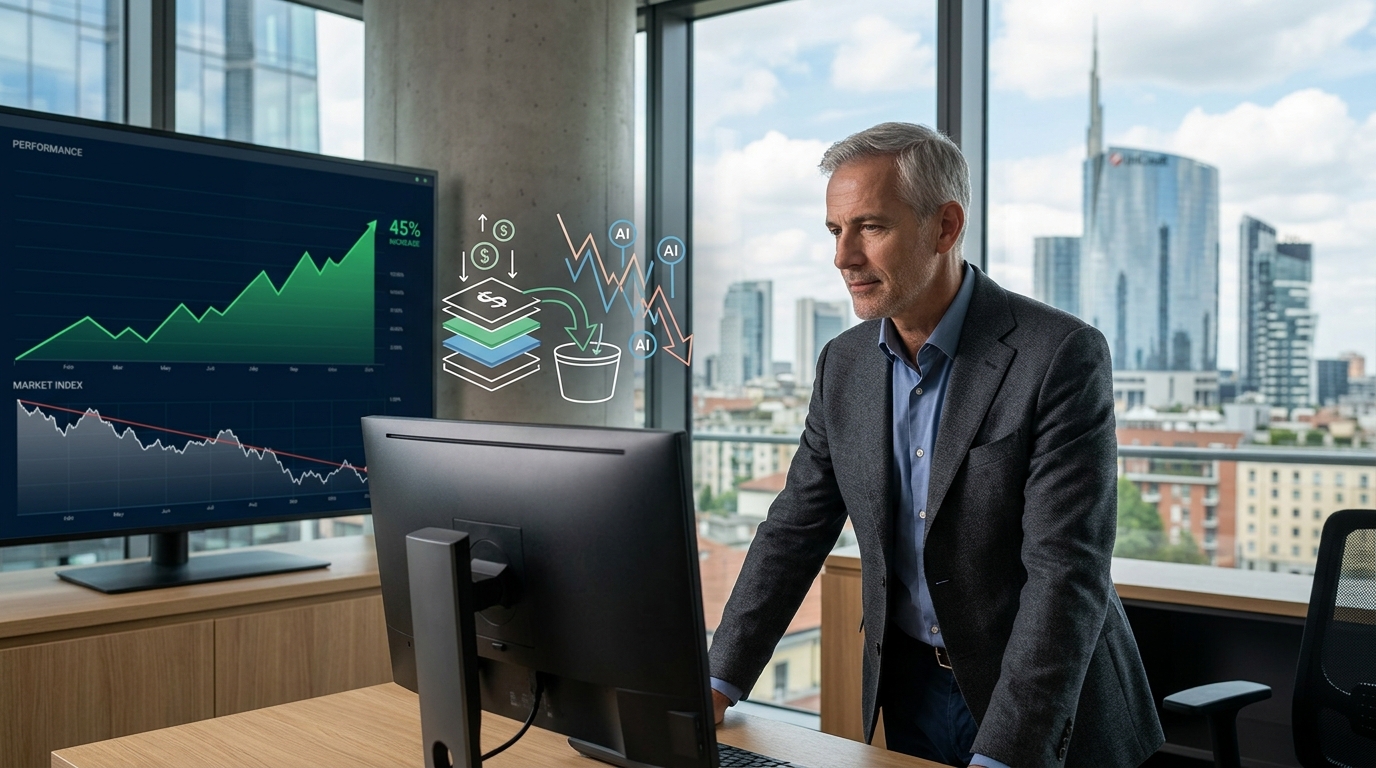
On a day when the Nasdaq recorded its worst session since July, one stock was up 45%. That stock was not a chipmaker, not a cloud giant, not an AI infrastructure play. It was Bending Spoons, a thirteen-year-old company from Milan that acquires struggling digital brands, strips out costs, and runs them on subscriptions.
Bending Spoons announced on October 14, 2026 that Berkshire Hathaway had made a new $330 million investment, taking its total ownership to 4%, following the $600 million it put in at the company’s July 2026 IPO. Berkshire’s cumulative commitment now totals $930 million. The Nasdaq Composite sank about 1.9% on the same day. BSP did the opposite.
What Berkshire Is Actually Buying
Founded with roughly $40,000 in seed capital, Bending Spoons has grown through an aggressive acquisition strategy that more closely resembles private equity than traditional software development. The company acquires established but underperforming digital products, strips out costs, rebuilds the technology, and runs them at scale. Its main businesses today include Airtable, AOL, Brightcove, Eventbrite, Evernote, Tractive, Vimeo, and WeTransfer.
The financial trajectory is the real story. Annual revenue rose from $387 million in 2023 to $1.31 billion in 2025, a compound annual growth rate of 84 percent. In Q2 2026, revenue hit about $704 million, up 126% year-over-year, with operating income of about $240 million. Crucially, the profitability is real: net cash from operating activities was disclosed at $59 million in 2023, $205 million in 2024, and $291 million in 2025. For 2026, the company has disclosed $254 million of net cash from operating activities for the first half.
That cash generation is the engine. The company finances acquisitions through operating cash flow, incremental debt, and, selectively, equity. The pace of new deals depends on its ability to generate operating cash and raise debt on acceptable terms, and it has historically prioritized deploying operating cash toward acquisitions. Berkshire’s equity infusions accelerate that flywheel without requiring the company to sell assets or dilute aggressively.
The Structure of Wednesday’s Deal
Bending Spoons will issue 10 million ordinary shares at $33 per share in a private placement. The company did not state in its announcement what discount that represented to the prior close. Berkshire paid below market, BSP stock closed well above $33. The market is telling you what it thinks the franchise is worth independently of the placement price.
Bending Spoons announced in September an agreement to acquire AI-first workspace provider Miro for $1.355 billion at the enterprise-value level. In its Q2 2026 results materials and call, the company reported $793 million in cash and cash equivalents as of June 30, 2026. The Berkshire money fills the gap between ambition and balance sheet.
Bull Case, Bear Case
The investment is among Berkshire’s latest moves under CEO Greg Abel, who succeeded Warren Buffett on January 1, 2026. Abel is building a track record distinct from Buffett’s. Backing a European digital roll-up at nearly $1 billion fits a thesis about durable subscription cash flows rather than semiconductor cycles, which is precisely what burned everyone else Wednesday.
The bear case is straightforward: valuation. The article’s “nearly 10 times forward sales” figure is not something the company states in its releases, and forward estimates move quickly. That multiple demands flawless integration of a growing portfolio. If Miro or any other large acquisition stalls, the premium compresses fast. The new share issue dilutes existing holders’ percentage ownership, and the securities are unregistered, with U.S. resale limits and customary registration-related provisions.
What to Watch Next
The thesis lives or dies on two numbers: operating cash flow per share and revenue retention across acquired brands. In its IPO filings, Bending Spoons disclosed net revenue retention of 94% in Q1 2026 and a revenue-weighted average subscriber tenure of about 8.6 years. Those figures justify the premium only if they hold as the portfolio scales through Miro and whatever comes next. Q3 results, expected in November, will be the first read on integration progress and the health of the base.
Berkshire does not make two consecutive bets on a company it has doubts about. In Bending Spoons’ October 14, 2026 announcement, co-founder Francesco Patarnello said the acquisition pipeline remains strong, and that Berkshire’s investment will enhance financial flexibility for further deals. That is the clearest signal yet: this is not a passive position. It is a financing partnership. Investors deciding whether to follow Berkshire in should treat it the same way.