
Editor’s Note: On September 24, Elon Musk dropped a bombshell announcement, and nobody noticed. Famed Wall Street investor Louis Navellier saw it – and he says he hasn’t been this excited since he recommended Google in 2004. The full story below…
Few people know this story…
In January 2019, Elon Musk broke ground on a Tesla plant in Shanghai. By the end of the year, it was delivering cars.
That’s how fast he moves. And along the way, he’s minted countless “Teslanaires”… and more than 4,400 SpaceX millionaires.
But what he quietly announced just before noon on September 24 could become his boldest and most lucrative move yet.
It hinges on the fastest-growing part of his SpaceX empire…
And the little-known supplier powering its explosive growth.
Elon has $912 billion riding on it.
That’s how big he thinks this could be.
But here’s why buying SpaceX or even Tesla is NOT the best way to play it
Regards,
Louis Navellier
Senior Investment Analyst, InvestorPlace
P.S. I found this stock using my Stock Grader. This proprietary system cost $9 million to build and maintain. And since 1998, it’s returned 13,126% in back tests. That’s 13X the market. It’s now flashing bullish on this critical SpaceX supplier. Click here to get its name and ticker now.
Moderna’s Cancer Vaccine Gets Its Day of Reckoning in Madrid
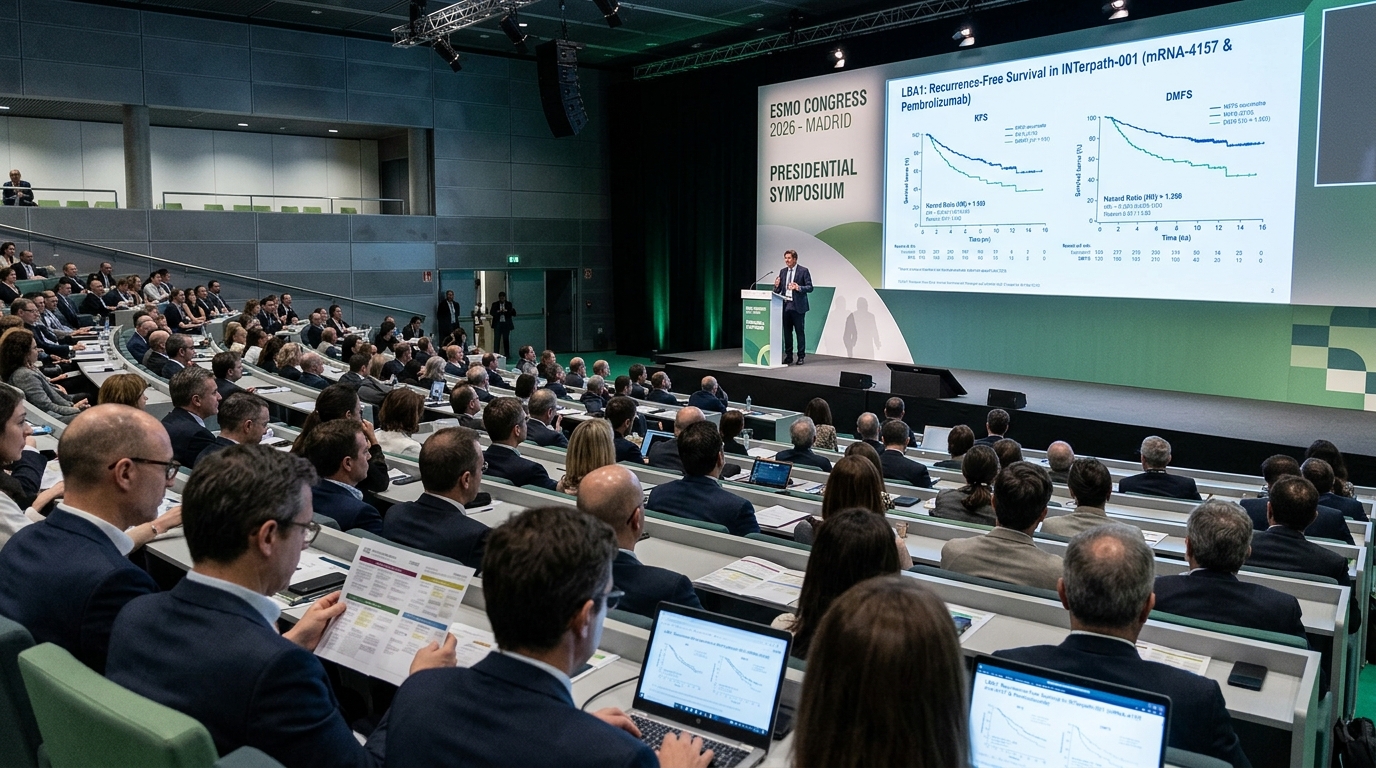
On Saturday October 24, at ESMO 2026 in Madrid, Merck and Moderna will present the full dataset from INTerpath-001 as LBA1 in the Presidential Symposium. The trial met both its recurrence-free survival primary endpoint and the key distant metastasis-free survival secondary endpoint in resected stage IIB-IV melanoma, but the complete results, including the actual hazard ratios, have not yet been made public. Full data arrive Saturday in Madrid.
That gap between a topline headline and a real number is the entire trade.
Why This Trade Stands Out
Moderna’s August 19 topline announcement sent the stock up 177% in a single session, the largest single-day gain in the company’s history. The stock has since posted roughly a 639% year-to-date gain, trading in a 52-week range of $22.28 to $242.29. That is not a momentum trade. That is an equity market repricing an entire company’s future on a press release that contained no hazard ratio, no confidence interval, no p-value, no absolute RFS or DMFS separation, no median follow-up, and no adverse-event table.
Saturday closes that gap. The question for options traders is whether the stock has priced in a result it has not yet seen.
The Numbers the Market Is Waiting For
Analysts have framed the upcoming hazard ratio as the fulcrum. In client notes after the topline release, Citi suggested an RFS hazard ratio at or below 0.65 would represent a clear win, while a materially higher number would likely be read as more modest benefit than the stock implies. Separately, UBS analyst Michael Yee has cited a broad expectation around a hazard ratio of 0.65, corresponding to a 35% reduction in recurrence risk.
The Phase 2b KEYNOTE-942 benchmark that the market is implicitly anchored to is a Phase 2b figure, not a Phase 3 one. The five-year update produced a hazard ratio of 0.51, roughly halving recurrence or death. Moderna has described a 20% risk reduction as the program’s clinical benchmark. A Phase 3 result that lands anywhere in the wide corridor between those two numbers will still require interpretation, and a roughly 6-fold higher stock price leaves almost no room for an in-line read to be celebrated.
Options Perspective
The available options chain reflects elevated implied volatility around the event, and the market charges more to insure against a decline. With a precise, publicly dated catalyst five days out, the options market has had time to price the event, which means debit strategies are more expensive than they were when MRNA was still below $100.
That dynamic is not unique to biotech. The post-earnings volatility crush can punish long-premium traders even when the underlying beats consensus.
The asymmetric play here is a put debit spread rather than a long call. The bull case is already embedded in the share price; a weaker-than-consensus hazard ratio or a safety surprise sends the stock back toward levels it traded before the August surge. Buying a near-term put and selling a lower-strike put to offset premium caps the cost and defines the risk, while targeting the downside that most longs are not pricing. The consensus 12-month analyst price target from 30 analysts sits at $121.15, more than 44% below the current share price. That is the market’s own structural tension, sitting in plain sight.
What Would Invalidate the Thesis
A hazard ratio at or below 0.65 paired with a clean safety profile would likely extend the rally and punish the put spread. The companies have said they plan to present full trial data at ESMO and engage with regulators on potential submissions, so a strong readout also opens a credible path toward a future FDA filing, which itself would be a new catalyst, not a resolution of this one.
The Beast Verdict
Moderna walking into Saturday’s presentation with a stock around $218 is one of the most consequential binary moments in biotech this year. The October 24 ESMO presentation carries binary risk, where hazard ratios and survival curves could either validate the rally or sharply compress the multiple. The defined-risk put spread acknowledges the science is real while betting the price has gotten ahead of the evidence. Keep the position sized to what you can afford to lose entirely, because if those hazard ratios land at 0.60, the bulls were right all along. Saturday in Madrid will settle it.