
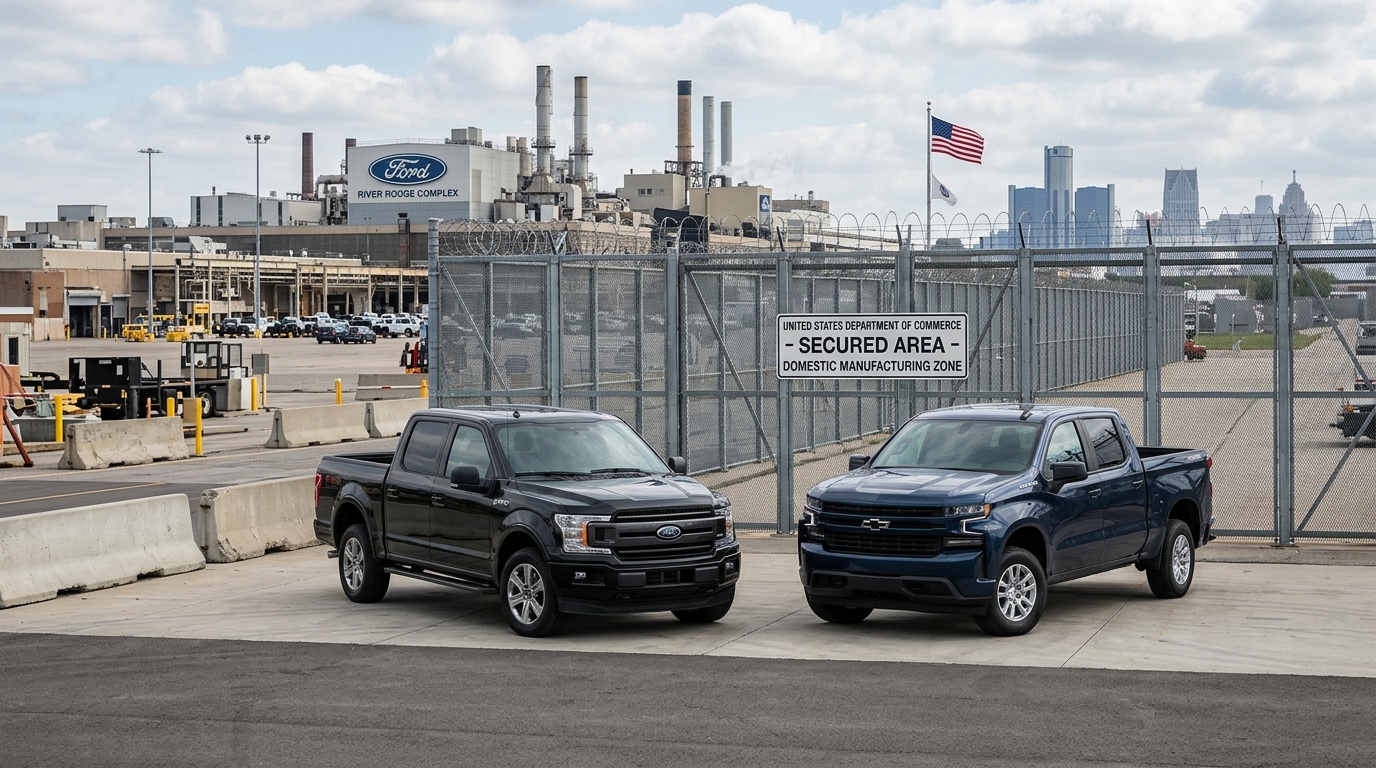
Washington is about to hand General Motors and Ford something neither company could build for itself: a permanent legal wall around the American car market.
Lawmakers are closing in on a deal to restrict Chinese connected vehicles and connected-vehicle technology in the U.S., with bipartisan support focused on getting a bill to President Donald Trump before the current Congress ends.
What the Bill Actually Does
The leading vehicle-focused proposal is the Connected Vehicle Security Act of 2026. As drafted, it would prohibit the importation, manufacture, sale, resale, or introduction into interstate commerce in the United States of certain connected vehicles and related software and hardware associated with foreign adversaries.
A Senate committee advanced the bill on July 22, 2026. Separately, federal rules are already in place: the Commerce Department finalized a connected-vehicle supply-chain rule in January 2025 that restricts certain connected vehicles and related hardware/software linked to China or Russia on a model-year phase-in timeline. A new law would matter because it could make restrictions harder to reverse.
The sticking point has included how to treat automakers with significant Chinese shareholders. Mercedes-Benz has Chinese ownership exposure: it is nearly 10% owned by China’s BAIC Motor Corp., and Geely founder Li Shufu also holds nearly 10% of Mercedes’ shares, which can create complications under legislative ownership thresholds. Proposed changes have been discussed to avoid sweeping in companies where ownership is passive and does not confer control.
The Investment Case for Detroit
Chinese automakers could capture about 11% of annual U.S. new-car sales by 2038 if allowed into the market, according to Mobility Global. That is the ceiling this kind of legislation is meant to prevent. For GM and Ford, that is not an abstract number. It represents millions of units at stake in one of the world’s most profitable large auto markets, and the share prices of both companies are reflecting none of that potential relief.
The industry’s national-security framing has been central to the push. The Alliance for Automotive Innovation has urged Congress to pass what it has called a permanent statutory ban on Chinese connected vehicles, hardware, and software, arguing the combination of data access and supply-chain leverage is a risk, and that American manufacturers have already committed heavy capital to domestic production and EV infrastructure.
The structural case here is simple. BYD and Geely are not marginal competitors. They build vehicles that undercut U.S.-branded EVs on price by thousands of dollars and have demonstrated they can take share rapidly when given access to a market. Keeping them out does not solve GM’s or Ford’s execution challenges, but it removes a risk that equity markets have never fully discounted into either stock.
Risks to Monitor
The deal is not signed. Lawmakers have been trying to move this before the current Congress ends and the legislative slate resets in January, which means the window is narrow and any procedural snag could push it past the deadline again. Beyond passage, enforcement is a separate question: Chinese vehicles are already constrained in practice by existing tariffs and by Commerce Department restrictions on connected-vehicle technology, so the bill’s real value lies in making those restrictions more durable and harder for a future administration to unwind.
Daily Wealth Takeaway
Legislation that reshapes competitive dynamics tends to move slowly enough that markets ignore it, then fast enough that investors wish they had paid attention. A permanent Chinese connected-vehicle ban would be one of the most significant pieces of protective trade law U.S. automakers have ever received. At current prices, GM and Ford are not being valued as if that protection is coming. That gap is where the opportunity sits.