The anxious question about Visa, Mastercard and American Express has circulated for years: when AI finally learns to buy things, will it bypass the card rails entirely and settle directly on blockchain or bank-to-bank pipes? On Friday, November 13, 2026, OpenAI answered that question in the most useful way possible for investors who own the networks.
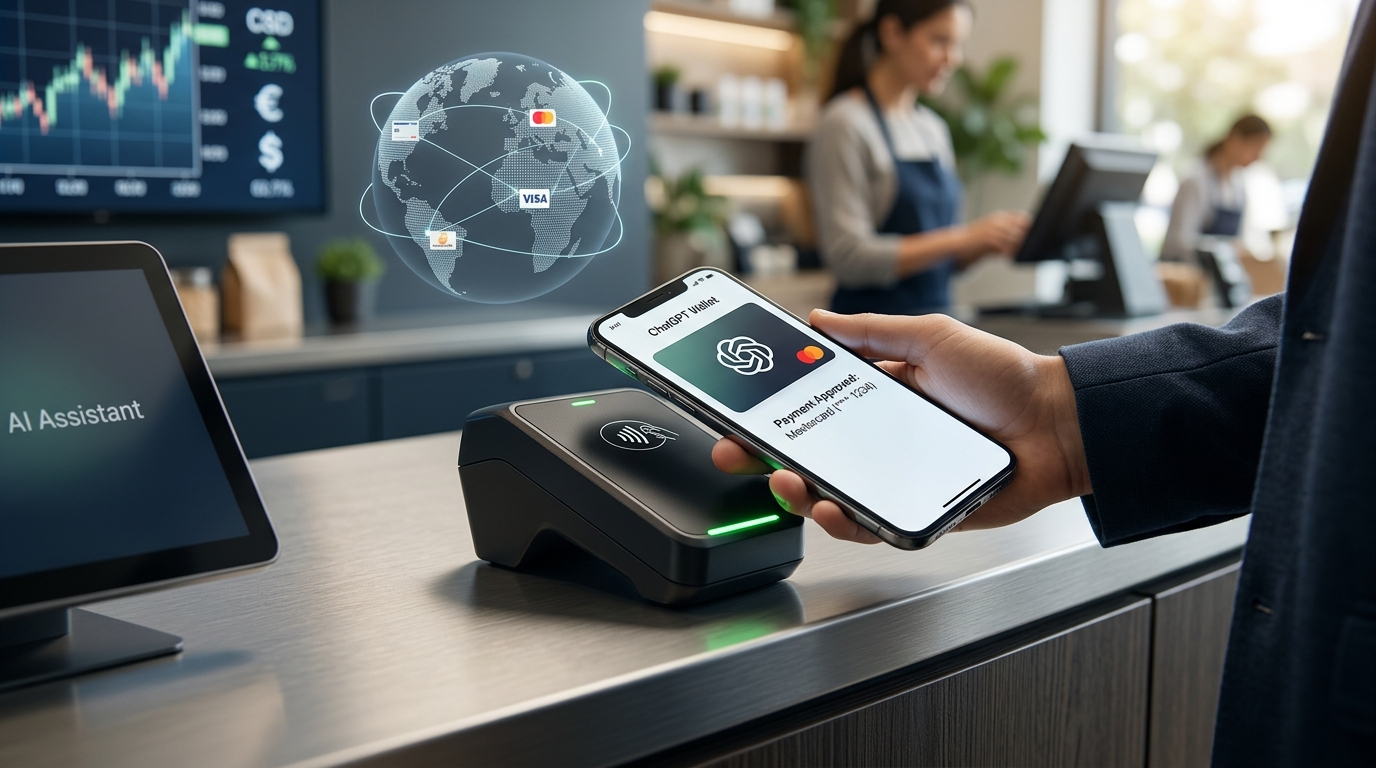
OpenAI launched ChatGPT Wallet on November 13, 2026, allowing AI agents to complete purchases on behalf of users through existing card payment networks, built in partnership with American Express, Mastercard and Visa. The agent never sees the actual card number. OpenAI says ChatGPT Wallet lets agents pay without access to users’ actual card details, and it requires a security check for every purchase. The underlying credential that moves money is a tokenized representation sitting inside network infrastructure the two largest card companies have been building for years.
The Infrastructure Bet Is Already Paying Off
Visa’s developer documentation for Visa Intelligent Commerce describes an agent identifier, and the broader point holds: this is not new technology bolted onto old rails. It is the existing tokenization stack extended for a new class of buyer, which means the economics follow a path the networks already know how to monetize.
Visa has just closed its strongest year of net revenue growth in more than 15 years, excluding the post-pandemic recovery and acquisitions, with fiscal 2026 net revenue coming in at $45.9 billion, up 15%. Two days later, Mastercard posted $9.8 billion of third-quarter net revenue, up 14%. Agentic transactions are not yet large enough to show up as a separate line. Agents will show up in the accounts as higher attach rates on tokens, identity checks and fraud scoring, all things the networks already sell, long before anyone reports an agentic fee line.
Why the Network Position Matters More Than the Launch
The strategic prize is control of the token services provider layer, where identity, authorization and payment credentials converge before an AI agent can transact. That requirement is turning token service providers into one of the most strategically important layers in digital commerce.
OpenAI has cited “1.2B+” weekly active users for ChatGPT, and many of them already use ChatGPT to research purchases and compare prices. OpenAI said it expects users over time to be able to hand purchases fully to an agent by setting parameters such as spending limits, purchase categories or time periods. Every one of those autonomous checkouts, at the scale of a billion-plus user base, runs through a tokenized credential. Visa and Mastercard collect on each one.
OpenAI built ChatGPT Wallet in partnership with American Express, Mastercard and Visa, and OpenAI says it preserves existing card rewards and protections for eligible disputes. That detail matters for American Express in particular, whose cardholders choose the network partly for those rewards. Keeping them intact inside an AI checkout removes one reason a user might opt for a different payment method.
Building Wealth Around This Idea
Visa’s value-added services revenue grew 30% in constant dollars to $14 billion for the year, and the company has guided to growth in the low-to-mid 20s for fiscal 2027. That segment, covering tokenization, identity, and fraud tools, is precisely what agentic commerce consumes. Mastercard’s value-added services and solutions net revenue grew 19% last quarter against 14% for total net revenue, a split that reflects the same dynamic.
Neither stock is cheap by historical standards, and regulatory risk on interchange is real. During fiscal 2026, Visa recorded additional accruals of $1.6 billion to address claims associated with the interchange multidistrict litigation. Investors should size positions accordingly. But the structural argument that AI commerce would eventually route around Visa and Mastercard has weakened materially this week. The largest AI platform on earth just chose to route through them.
Daily Wealth Takeaway
The most durable compounders in technology are rarely the platforms people talk about. They are the infrastructure those platforms depend on. ChatGPT Wallet did not threaten Visa and Mastercard; it confirmed them as the settlement layer for the agentic economy. That confirmation is worth more than any single quarter’s earnings beat.