The chip stocks have been getting all the attention. Meanwhile, one of the most straightforward AI infrastructure plays in the market is sitting near its 52-week low, mostly ignored.
That stock is Vistra Corp. (VST).
Here is the thing about power stocks and AI. Most investors went straight to the nuclear pure-plays when the data center electricity story broke. Constellation Energy got the headlines. Talen got the Amazon deal. But a quieter thesis has been building around Vistra, and it may be more interesting than what is already priced into its better-known peers.
What the Q1 Numbers Said
Vistra reported Q1 2026 revenue of $5.64 billion, a 43% increase year-over-year, and swung to a profit of about $1.03 billion from a loss in the same period last year. Adjusted EBITDA hit roughly $1.49 billion for the quarter. Management reaffirmed full-year 2026 ongoing operations adjusted EBITDA guidance of $6.8 billion to $7.6 billion and ongoing operations adjusted free cash flow before growth of $3.925 billion to $4.725 billion.
Now here is what makes that guidance range actually interesting: it excludes any contribution from the pending Cogentrix acquisition expected to close in the second half of 2026. And it excludes the long-term power purchase agreements signed with Meta tied to more than 2,600 megawatts of nuclear energy and capacity at Vistra’s PJM nuclear plants.
Two potential EBITDA contributors. Neither one is in the guidance range yet.
Why This Is an AI Trade
Hyperscalers have already signed long-duration power purchase agreements with Constellation, Talen, and Vistra, locking in supply from existing reactor operators. That is not speculative. It is contracted revenue.
What is starting to matter more is something the market has been slow to absorb. AI infrastructure increasingly depends on firm, dispatchable, grid-connected power capable of operating continuously at hyperscale loads. Intermittent renewables cannot do that job around the clock. Nuclear can, but only nuclear paired with dispatchable gas backup can do it at the scale hyperscalers actually need.
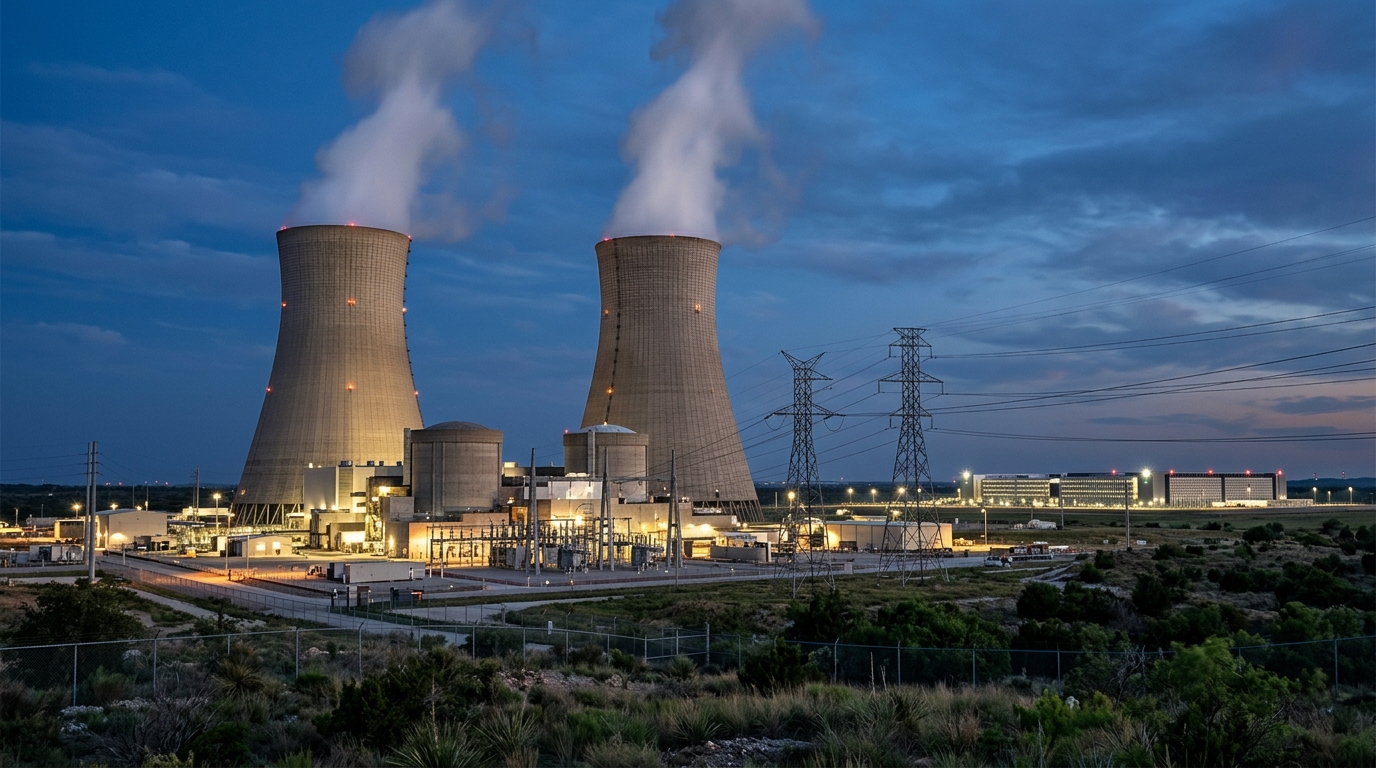
Vistra has both. A roughly 44-gigawatt fleet blending nuclear baseload with natural gas peakers across ERCOT and PJM. That combination is what makes a ~2.6-gigawatt Meta nuclear deal viable in the first place.
Slight tangent, but it matters: the semiconductor selloff that has dominated July headlines pulled investors away from anything AI-adjacent that is not a chip stock. When a sector gets punished hard, stocks sharing the same broad theme but with completely different fundamentals often get caught in the same rotation out. That may be part of what is happening with VST right now.
The Valuation Picture
Wall Street analyst coverage and price targets move constantly, but recent consensus summaries put the average price target in the low-$220s. With the stock in the mid-$100s in mid-July, that still implies material upside versus consensus.
Fitch upgraded Vistra to investment-grade BBB- in March 2026. That upgrade reduces borrowing costs and expands the institutional buyer pool. Those effects take time to show up in price action.
The share price is down roughly 13% over the past month and approximately 2% year-to-date, even after the historically strong Q1 result. The gap between what the business is generating and what the stock reflects is not subtle.
What August 7 Brings
The next earnings date is currently expected around August 7, 2026 (company confirmation pending). Investors will be watching summer power demand trends in Texas and the mid-Atlantic closely. More importantly, any new commercial agreements with data center customers announced between now and then could move the stock before the report even lands.
The Risk Side
Energy price volatility in ERCOT and PJM can swing quarterly results meaningfully. The Cogentrix acquisition still needs to close. Regulatory or policy changes affecting nuclear power credits would directly impact the fleet’s earnings trajectory. And Vistra’s current valuation, at roughly 23x earnings, is already above the broader utility peer group even after the recent pullback.
Those risks are real and visible. But a Meta nuclear PPA outside the guidance range, an August earnings catalyst, an investment-grade credit upgrade, and a stock near a 52-week low is an unusual combination to find in the same name at the same time.
The AI power trade did not end when chip stocks sold off. It just moved somewhere most investors stopped looking.