
Below is an important message from one of our highly valued sponsors. Please read it carefully as they have some special information to share with you.
Dear Reader,
When this man warned of the 2008 crisis two years before it ever happened…
The CIA began circulating his warning among its senior staff.
And his full thesis was so in depth that it appeared in the CIA journal “Studies in Intelligence”.

That information remains classified to this day.
Even still, in 2016 when he went on national television to predict the election of Donald Trump…
Most people tried to dismiss him saying that “Hillary is ahead in every poll”…
But events shaped up just the way he said.
Then in 2019, a full 4 months before the coronavirus hit..
He said that a global pandemic could be the cause of the next financial crisis…and that a crisis of this proportion would happen with “near 100% certainty” within the next few years…
Most people thought he finally lost it.
But we all know what happened next…the world was nearly brought to its knees by this “unforeseen” event.
Now this former advisor to the CIA and the Pentagon is issuing a shocking new warning.
One that has to do with the brewing bubble in AI – and an event set to take place just DAYS from now.
If you have money in the markets, or wealth to protect, then you need to heed his warning.
Because once this crisis hits…it will already be too late.
>>> Click Here to See His New Warning <<<
Regards,
Matt Insley
Publisher, Paradigm Press
Vicor Doubled Q3 Growth Guidance. The Real Trade Is Earnings.
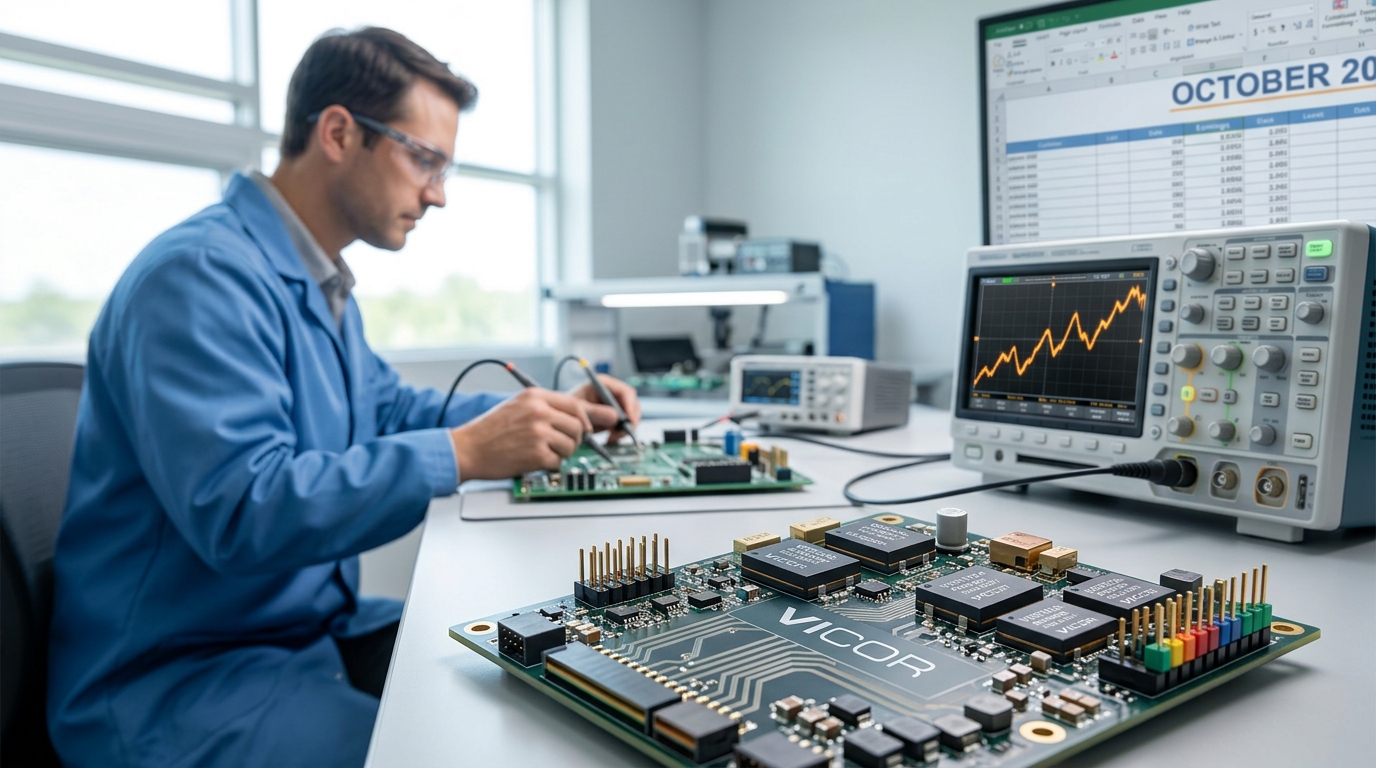
Vicor had already made headlines once this month with its Vertical Power Delivery licensing deal. Monday night, it put a number on what that deal is actually worth.
Vicor increased its third-quarter sequential growth guidance from nearly 10% to more than 20%, citing royalties from its recently announced non-exclusive license to its Vertical Power Delivery technology. The revised guidance reflects the contribution of licensing agreements covering Vicor’s patented power system technology, with four companies, including major OEMs and hyperscale computing operators, having secured licenses. The stock rewarded that disclosure immediately: VICR traded up about 19.7% on September 22 after the guidance raise.
That is the visible part of the move. What matters now is what comes next.
Why the Licensing Model Is Structurally Different
This is not a product refresh or a beat-and-raise quarter built on shipping more units. Investors responded to the structural transition toward a dual-revenue business model combining high-margin product sales with recurring royalty streams. The licensing framework allows third-party suppliers to supply covered power modules to licensed customers while paying royalties to Vicor, addressing multi-source supply requirements for tier-one AI hardware buyers.
In July, management said its guidance rested on conservative assumptions about licensing. A deal came in September instead, moving a new license out of the hypothetical and into the Q3 2026 guidance. The enforcement mechanism is real: in 2025 the International Trade Commission issued a Limited Exclusion Order banning importation into the United States of certain infringing power converter modules and computing systems containing them. Import ban risk, not goodwill, is why hyperscalers are signing.
Royalty revenue from the most recent license agreement is expected to be $5 million in Q3 and $10 million per quarter for the next four quarters. That $40 million annualized royalty run-rate from a single license, against a business that generated $143.4 million in Q2 revenue, is a material number.
The Trade: Long Call Spread into October 20 Earnings
Vicor is expected to report its third-quarter 2026 results on October 20. Based on analyst estimates, Vicor is expected to report EPS of about $0.86 and revenue of about $161.36 million for Q3 2026. Those consensus numbers were built before Monday’s guidance raise, which means the bar is already moving. The earnings report will either confirm the royalty stream is scaling or expose the guidance raise as a one-quarter phenomenon.
With VICR trading near $260 after Tuesday’s surge, implied volatility has almost certainly expanded off the catalyst. That elevated premium argues for a defined-risk structure rather than an outright long call. A bull call spread targeting the $270/$300 range in October expiration captures upside through earnings while capping premium at risk if the stock consolidates into the report or Q3 royalties disappoint relative to the new, higher bar management just set.
Needham maintained a Buy rating for Vicor with a price target of $320 on September 22. Roth Capital maintained a Buy rating and a $375 price target. Craig Hallum has published targets as high as $450. Those targets offer a ceiling reference, but the nearer question is whether the October report confirms the royalty inflection is repeatable.
What Kills the Thesis
Three risks deserve watching. First, the October 20 report could show the Q3 royalty contribution was front-loaded or nonrecurring, collapsing the licensing premium the stock currently carries. Second, Vicor’s assertion of patent enforcement may involve lengthy legal disputes and uncertain outcomes, posing financial and operational risks. A court setback on VPD patents removes the import-ban pressure that motivates hyperscalers to sign. Third, at roughly $12 billion of market value, Vicor trades around 25 times its trailing-twelve-month revenue, a multiple that prices a licensing machine, not a power module company. Any signal that license signings slow after four deals could compress the multiple quickly.
The Beast Verdict
VICR has done the hard work of proving the model exists. This marks the fourth licensing agreement Vicor has secured with a hyperscaler or AI OEM. The question for October 20 is whether the royalty line is a feature of every quarter from here or a sporadic event. A bull call spread lets you take a defined position on that question without giving back gains in premium decay if the stock stalls at current levels. The catalyst is clear. The risk is clear. Size accordingly.