
Editor’s Note: Former tech executive Jeff Brown picked Nvidia in 2016. It’s up 25,155% since. He recommended Bitcoin at $240. It’s up 31,219% since. And he’s been ahead of the curve on Elon Musk’s businesses for over a decade. In fact, he was one of the first to predict SpaceX’s IPO. But today, he says this goes beyond SpaceX. Elon is building something even bigger. And you can get in right now, on the ground floor. Read more…
Dear Reader,
I’m about to do a live demonstration.
Of Elon Musk’s latest genius invention.
It’s an AI agent…
Perhaps the most powerful ever created.
Elon himself believes it could 70X your money… in a short period of time.
Keep in mind, this is NOT like ChatGPT.
It’s not a chatbot.
Or something you download on your phone.
I expect Musk to publicly launch his AI agent any day now…
Potentially by the end of the month.
But I’m going to give you a sneak preview – for free.
It’s critical you see this live demo…
So you understand exactly what Elon created…
And why it’s so valuable. Watch now.
Regards,
Jeff Brown
Founder & CEO, Brownstone Research
P.S. I’ve been ahead of the crowd on Elon Musk, every step of the way.
After the so-called experts said Tesla was going bankrupt, I doubled down.
And the stock is up 1,510% since.
I was one of the first to correctly predict the SpaceX IPO.
And I’ve visited Musk’s facilities across the country.
So I’m uniquely qualified to give this live demonstration of Musk’s new 70X AI agent.
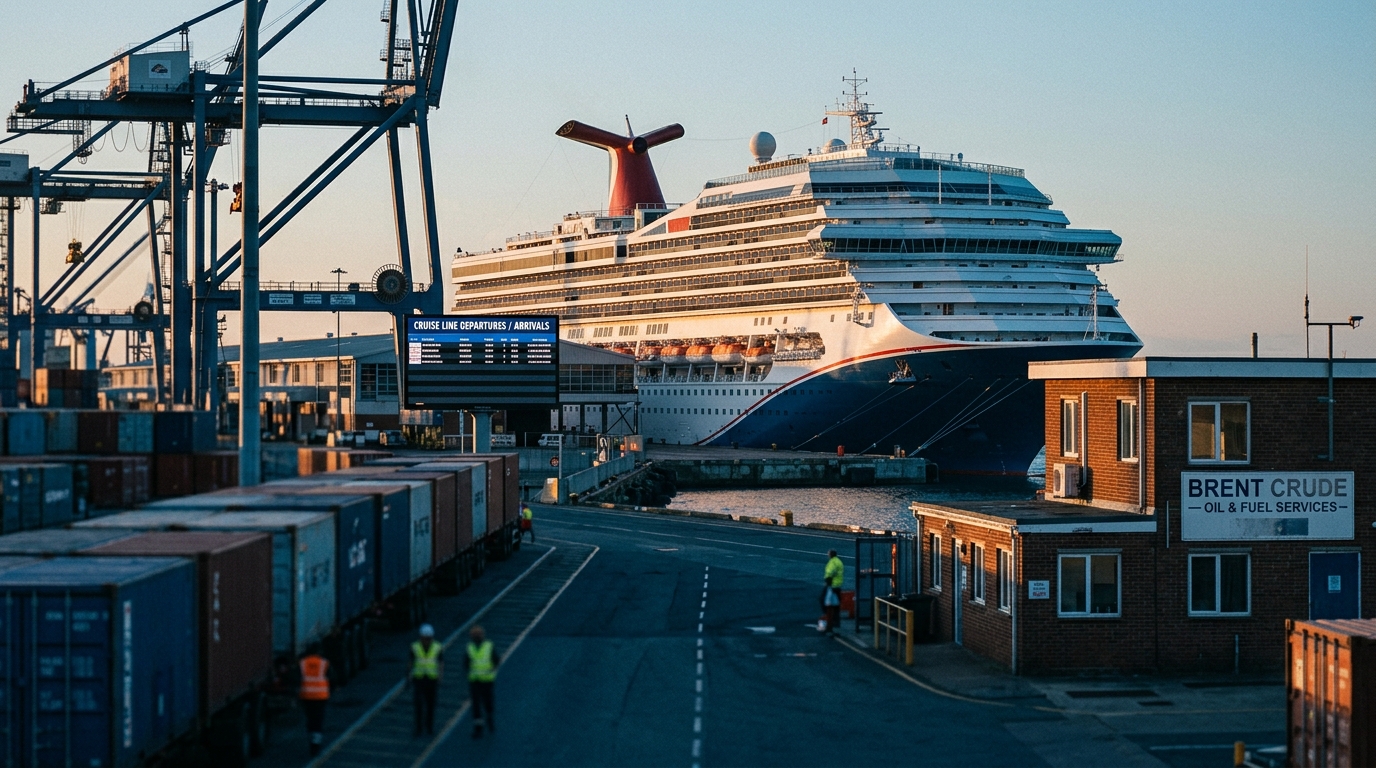
Carnival’s Full-Year Guidance Is the Only Number That Matters Today
Carnival Corporation reports its fiscal third-quarter results before the market opens this morning, and the crowd is watching the wrong number. A Q3 beat on earnings per share would be entirely consistent with a stock that keeps sliding. The full-year guidance revision is where the trade lives.
Why the Quarter Is a Distraction
Analysts expect Carnival to report third-quarter EPS of about $1.35, down from $1.43 in last year’s third quarter. Revenue consensus sits around $8.36 billion, implying growth of roughly 2.6% from the year-ago quarter. Beat both. The stock still faces a structural cost problem that Q3 results cannot resolve.
Carnival has long been described as the only major cruise operator that typically does not hedge fuel. Fuel cost per metric ton is guided at approximately $812 for the third quarter, and the company’s own sensitivity table shows a 10% move in that cost swings adjusted net income by $56 million in a single quarter and $102 million across the remainder of the year. That math was built on a Brent assumption well below where oil trades right now.
The Fuel Problem Has Gotten Worse Since June
Brent climbed above $106 on Monday after President Trump rejected Iran’s latest proposal tied to reopening the Strait of Hormuz, raising concerns that restoration of oil flows through the critical waterway could face further delays. That geopolitical overhang is not going away by noon.
BofA’s September 24 preview notes Brent was roughly 34% higher than at the June earnings call, the same call where management labeled the oil spike transitory. JPMorgan’s September 24 fieldwork estimates Q3 and Q4 fuel expense of $640 million and $580 million, respectively, versus the June guide’s $620 million and implied $510 million. The fourth quarter gap is the one that resets the full-year number.
Barclays, at a $33 target on Overweight, expects Carnival to formally cut fiscal 2026 earnings guidance on current fuel prices even while projecting a stable fourth-quarter yield outlook. That single mechanism helps explain why multiple firms trimmed price targets in mid-to-late September.
Technical and Fundamental Context
Carnival stock sits within a 52-week range of $21.45 to $34.03 and is down about 29% year-to-date in 2026. CCL is trading near the bottom of its 52-week range and below its 200-day simple moving average. That compression of price near a technical floor, combined with a dated catalyst landing today, creates a defined opportunity window.
Customer deposits reached $9.0 billion, about $450 million above the prior-year record, and the company said it was 93% booked for 2026 as of late June. The demand side is not broken. The thesis break would come from Q4 guidance that implies the fuel shock is not transitory, and from management’s silence on whether any hedging is coming for 2027.
Options Perspective
CCL implied volatility sits around 47%, with IV Rank in the middle of its 52-week range. That is not cheap, but it is also not the pinned-to-the-ceiling IV that would make debit spreads prohibitive. The options market has priced in an expected move of roughly 6.5%, which on a stock near $22 translates to roughly $1.40 of room in either direction by expiration.
A bear put spread targeting the $21 to $19 range in October expiration captures the downside scenario where management confirms a full-year guidance cut and offers no hedging reassurance for 2027. Risk is capped to the net debit paid. The thesis is clear: guidance language, not the Q3 EPS headline, drives the next leg.
The bull case exists too. Hedge fund conviction moved in the opposite direction of the stock, with bullish funds rising to 63 from 57 quarter over quarter. If management threads the needle by guiding conservatively but signaling 2027 European bookings remain strong, the stock could snap back hard from a 52-week low toward $24.
The Beast Verdict
Carnival is the cleanest single-day catalyst on the board right now. The Q3 EPS line is priced. What is not priced with precision is the degree of full-year guidance damage and whether management discloses any intention to establish fuel hedges heading into 2027. Fuel is a meaningful slice of Carnival’s cost base, and at current crude levels each $10-per-barrel move in Brent can add well into nine figures of annualized cost without a hedge to offset it. Defined-risk structures on either side of today’s number make sense. Size accordingly, and watch the guidance line, not the headline.