
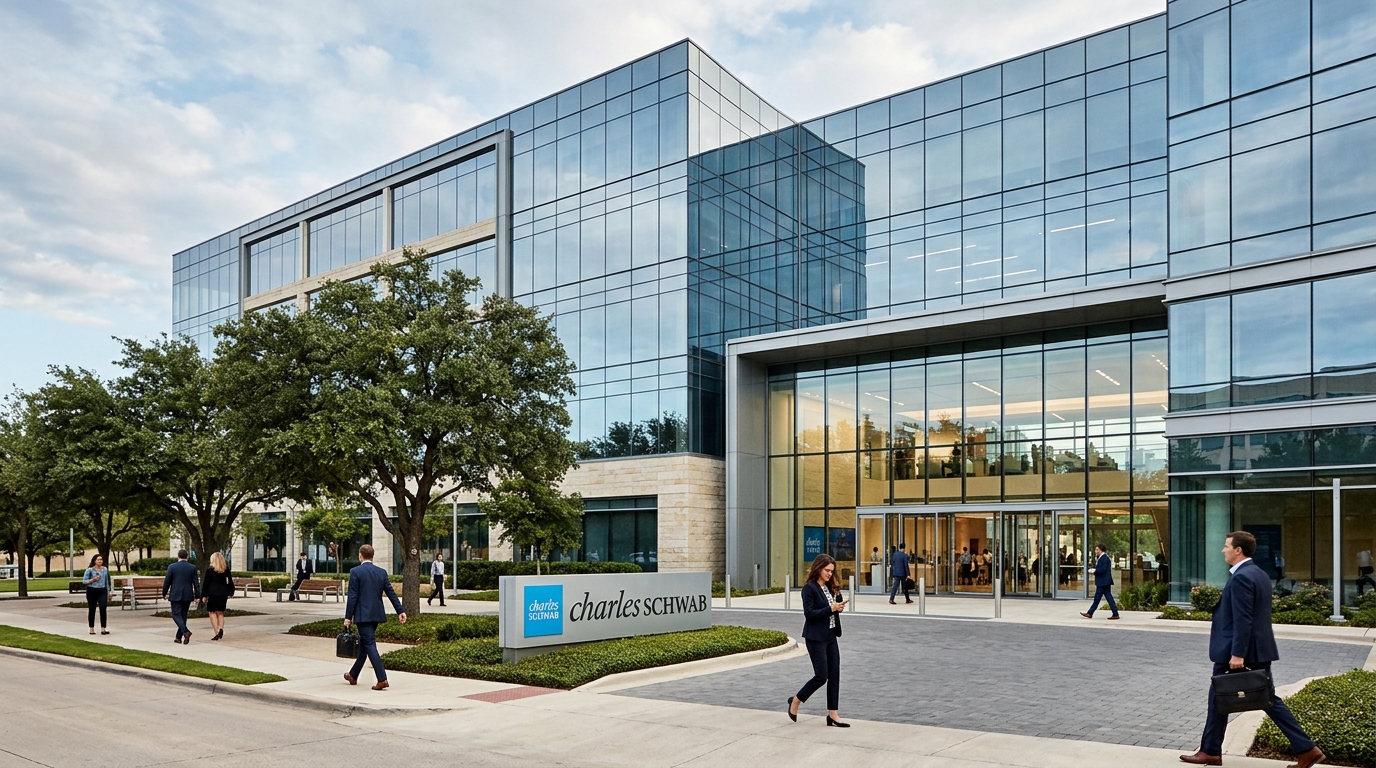
Charles Schwab reported third-quarter 2026 results Thursday that were, by nearly every financial measure, the best in the company’s history. Revenue rose 17% from a year earlier to a record $7.2 billion. Adjusted earnings per share hit $1.69, up 29% year over year and above the $1.66 analyst estimate. Core net new assets reached a record $190.4 billion for the quarter, a 38% increase from Q3 2025. Total client assets ended September at $13.33 trillion, 15% above the same period last year.
The stock fell nearly 4% in premarket trading.
The market’s reaction was not irrational. It was specific. Management guided full-year 2026 revenue and net interest margin growth toward the lower end of ranges provided in the company’s summer update. Three words: lower end of. In a stock that had already run on expectations of continued upside surprises, that language was enough to reset shares, even with the stock still trading around $94 on Friday, October 16, 2026.
What the Numbers Actually Say
Strip out the guidance reaction and this is a formidable quarter. Net interest revenue grew 14% to nearly $3.5 billion, driven by continued demand for secured lending. Bank loan balances reached $72.3 billion, up 35% from a year ago. Pledged Asset Line balances hit $37.3 billion, reflecting 59% growth over the prior year. Trading revenue climbed 16% to $1.2 billion, with daily average trades of 10.7 million, up 44% year over year. The adjusted pre-tax profit margin expanded to 54.8%, about 350 basis points wider than Q3 2025.
The company opened 1.2 million new brokerage accounts in the quarter, pushing the total to 48.6 million. Seventy percent of new retail households were Gen Z or millennials, a metric that matters more in 2030 than today but signals where the asset-gathering tailwind is pointing.
The guidance concern centers on the funding mix. Loans are growing faster than deposits, meaning Schwab is leaning on other funding sources at a moment when rates remain elevated. Net interest margin was 3.04% in Q3, and management expects 25 to 30 basis points of year-over-year expansion in Q4. Looking further out, the company noted that approximately $190 billion of securities currently yielding below 2% will roll off and be redeployed into higher-yielding assets in 2027, a mechanical tailwind that does not require any rate cuts to materialize.
What Could Go Wrong
The hot core CPI data this week, which came in at 0.3% month over month against a 0.2% expectation, revived concerns about rates staying restrictive longer. That is a real headwind for Schwab: higher-for-longer means deposit sorting continues as clients move cash into higher-yielding alternatives, and the pace of NIM expansion slows. The stock currently trades about 19% below its 52-week high of $114.53. Analysts pressed management on deposits and cash sorting even as net new assets surged, which points to a structural tension between headline growth and the underlying funding picture.
The Bottom Line
Schwab reported a genuinely record quarter and was punished for guiding precisely to plan rather than above it. The business model, at $13.33 trillion in client assets with 800 basis points of expected operating leverage for the full year, is compounding at a rate most financial firms would not recognize. The $190 billion bond reinvestment cycle alone provides a clear, quantifiable 2027 earnings driver that the market seems to be discounting today. With the stock still roughly in the mid-$90s and nearly 20% below the 52-week high, the selloff looks like an opportunity driven by language rather than fundamentals.