
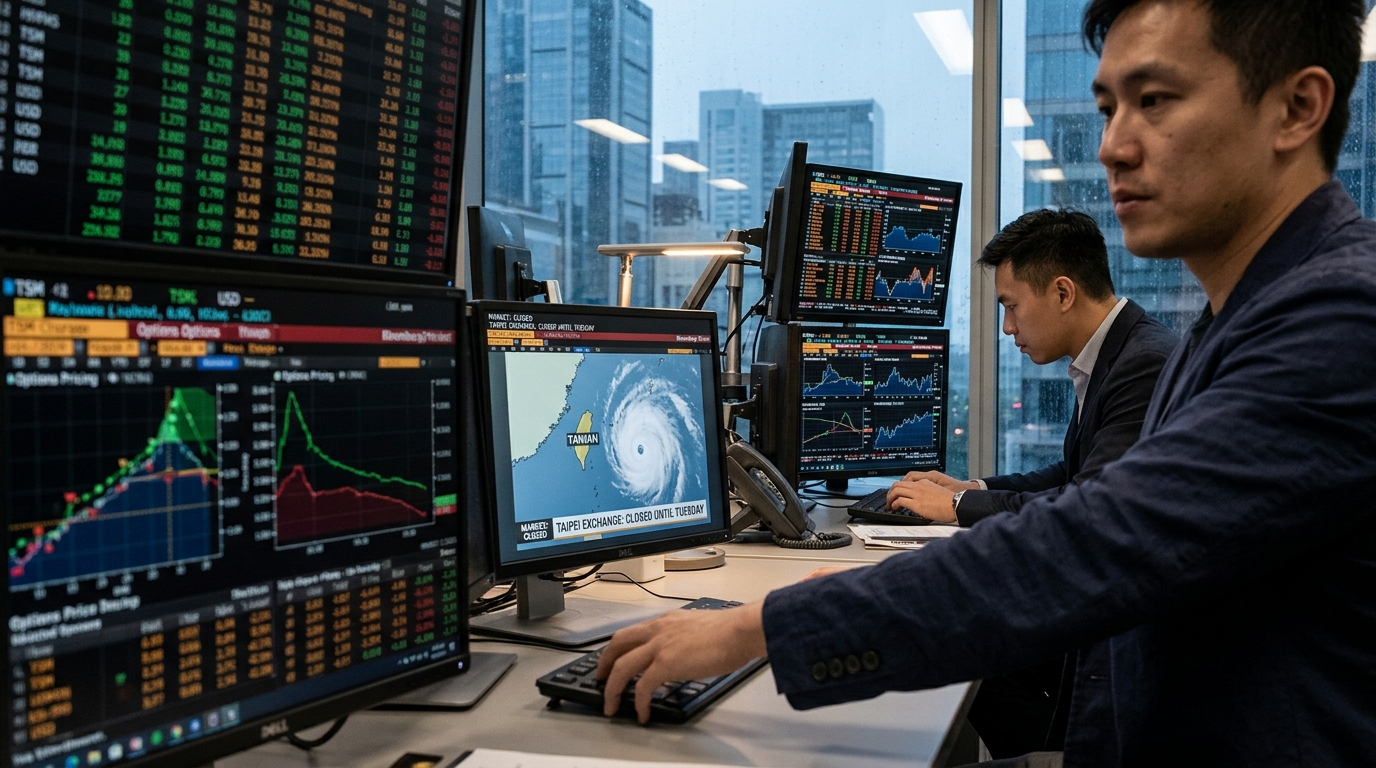
When the world’s fifth-largest stock exchange goes dark for an extended stretch, the hedging demand doesn’t disappear. It migrates. That is exactly what is happening right now with Taiwan, and the distortion it creates in TSM’s options market is the trade.
The Gap in Price Discovery
Taiwan shut its stock market, schools and offices on Friday as Typhoon Champi approached, bringing heavy rain and strong winds that disrupted flights. The exchange is also closed Monday for a holiday, leaving the island with an added trading gap versus others in the region. That means the TAIEX, home to TSMC, Hon Hai, and UMC, sits in pricing limbo until Tuesday morning Taipei time.
Authorities reported Champi produced strong winds and torrential rain as it brushed by the island on Friday, and the storm disrupted travel with hundreds of flights grounded or canceled. Stock market settlements scheduled for Friday will be postponed to the next business day, the Taiwan Stock Exchange has said.
Where the Hedging Goes Instead
Institutional investors running Taiwan semiconductor exposure cannot hedge on the TAIEX this weekend. They can, and will, use TSM on the NYSE. That concentrated demand into a single US-listed proxy is already visible in the options data. On October 22, TSM shares fell 4.5% to $412.35, a move that arrived on volume well above the three-month average as positioning shifted ahead of the closure.
The put skew matters here. When hedging demand flows into a single proxy during a market closure, it tends to bid up near-term puts disproportionately relative to calls. With Taiwan’s market shut Friday and again on Monday, the next two Taiwan sessions get compressed into a narrower window for anyone managing Taiwan-linked risk.
The Thesis and the Strategy
The core argument: TSM options are pricing elevated uncertainty that reflects not just company fundamentals but a structural closure artifact. TSMC reported third-quarter revenue up 50.9% year over year and highlighted continued strong demand for leading-edge process technologies. The business itself is not the source of this week’s volatility premium. The typhoon is. When Taiwan reopens Tuesday and the hedging overhang clears, implied volatility in TSM options has a credible path to mean-revert lower.
That sets up a defined-risk strategy built around selling the elevated volatility premium rather than buying it. A put credit spread expiring in the October 30 or November 6 cycle captures the inflated put skew while keeping risk capped at the width of the strikes minus premium received. Selling the elevated downside volatility while buying a lower put as protection keeps the maximum loss fixed from the moment the trade is placed.
The volatility crush after a catalyst clears is a recurring options dynamic across the semiconductor sector. Implied volatility levels and the post-event mean-reversion trade have played out in closely related chip names when the uncertainty window closes.
Risk Management
The thesis breaks if the typhoon causes material damage to semiconductor fabs or critical infrastructure beyond what current reporting suggests. The key monitorable for investors will be the resumption of trading operations on the Taiwan Stock Exchange and any corporate updates regarding production or logistical continuity as storm impacts clear. Any confirmed fab disruption would sustain or extend the volatility bid rather than allowing it to collapse. Position sizing should reflect that possibility.
Taiwan’s fab concentration is not just a typhoon risk — it is a structural constraint on the entire semiconductor supply chain. The equipment ceiling that governs leading-edge chip production sits with a single supplier shipping fewer than 100 machines a year.
The Beast Verdict
The TAIEX does not reopen until Tuesday. That four-session gap in price discovery forces hedging flow into TSM on the NYSE, inflating its near-term options premium beyond what the underlying business warrants at this moment. The company’s fundamentals are strong. The volatility is situational. A put credit spread on TSM, sized conservatively and expiring after the Taiwan market reopens, offers a well-defined opportunity to be paid for the closure rather than frightened by it. Watch Tuesday’s open in Taipei. That is when the trade either confirms or exits.