Two data points landed on Seoul’s trading desks before 10 a.m. Tuesday, and together they confirm what the AI capital expenditure cycle has been trying to say for months: demand is real, it is measurable, and Korea is one of its clearest financial expressions.
Korea’s economy expanded 1 percent in the third quarter, with preliminary Bank of Korea data showing real GDP rose 1 percent in the July-September period, exceeding the central bank’s own projection of 0.3 percent. That is not a slight beat. The result marked a surprise expansion of more than triple the central bank’s August forecast. The engine was chips: exports rose 2.3 percent from the previous quarter, led by semiconductors, contributing 1.1 percentage points to overall GDP growth, with the BOK estimating that semiconductors accounted for roughly half the economy’s growth in the third quarter.
The income picture is even more striking. Real gross domestic income surged 18.8 percent year-on-year, its fastest increase in nearly 49 years, helped by rising semiconductor prices. That figure is not abstract. It means the terms of trade have shifted dramatically in Korea’s favor, chipmakers are earning more per unit shipped, and that flows directly into corporate earnings for Samsung and SK Hynix.
Exports reached a record $120.94 billion in September, up 83.5 percent from a year earlier, with semiconductor shipments exceeding $60 billion. That monthly figure is the structural backdrop behind Tuesday’s market reaction.
The Market Signal
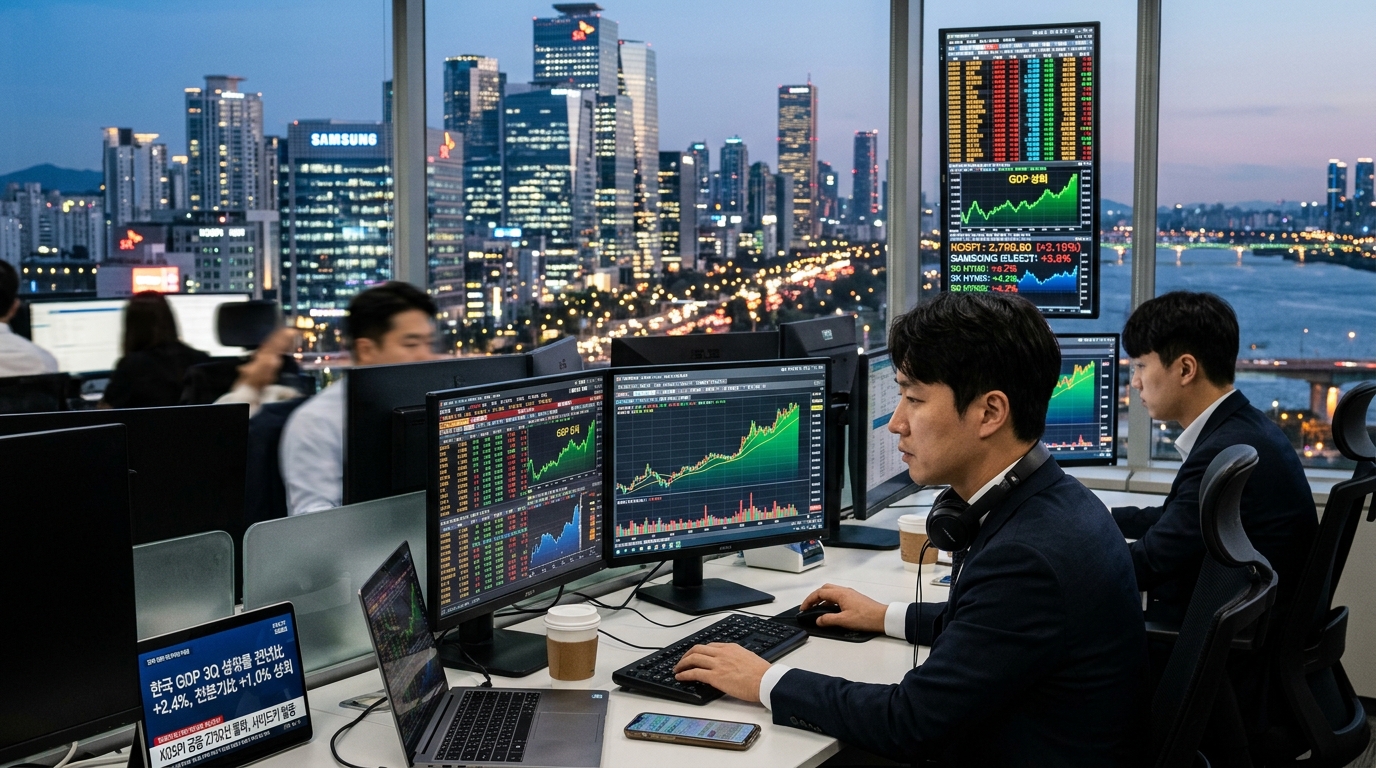
The GDP data alone would have moved the KOSPI. Combined with Anthropic’s Nasdaq listing application, with The Wall Street Journal and other outlets reporting the company could target a valuation of up to $2 trillion and raise as much as $100 billion, the index became a pressure cooker. The KOSPI surged more than 4% during the session, and the Korea Exchange suspended program buy orders for five minutes at 10:13 a.m. due to a move in KOSPI 200 futures that triggered the buy-side sidecar. It was the second buy-side sidecar in six days.
The KOSPI closed at 5,638.34, up 191.18 points or 3.09%, after an intraday high of 5,737.61, a gain of 4.90%. Foreign investors were net buyers of 24.5 billion won, while retail investors were net sellers of 165.9 billion won. Institutions and foreigners bought. Retail sold into them. That is not a panic rally, it is a positioning shift.
The Stocks on the Radar
By 10:35 a.m., SK Hynix had climbed 7.14% to 1.366 million won, while Samsung added 4.93% to 223,500 won. SK Hynix (000660.KS / SKHY) reports Q3 earnings Wednesday. South Korean newspaper Dong-A Ilbo reported the company is considering a special dividend of about 16 trillion won, roughly $12 billion, though the company has said any additional shareholder return measures would be announced with its Oct. 28 results. That adds a second catalyst on top of AI demand. Samsung (005930.KS) follows Thursday, having already estimated a record operating profit at 107.4 trillion won, up 782.5% from a year earlier.
EWY, the iShares MSCI South Korea ETF, is the cleanest single-instrument way to hold the macro thesis without individual stock earnings risk. The won (KRW) strengthening against the dollar is a secondary confirmation signal worth watching: a stronger won reflects capital inflows and affirms the foreign-buying trend already visible in today’s order flow.
The Risk
The last sidecar rally faded within two sessions, and chip earnings land this week. Private consumption posted its weakest performance in four and a half years, signaling that export-driven growth has not yet spread to domestic demand. An index that has tripped two circuit halts in six days is not a calm market. Earnings from SK Hynix and Samsung will either validate the gap-up or erase it. Position size accordingly, and let Wednesday’s SK Hynix call set the tone before adding further exposure.