
Washington is suddenly the biggest risk to the data center complex, and the market is treating it that way. Thursday’s selloff in hyperscaler and neocloud stocks deepened as investors reassessed the mounting risks from the Democratic sweep, with the Nasdaq down more than 5%. The Philadelphia SE Semiconductor index dropped about 12%, with Nvidia, Broadcom, and AMD all taking significant hits.
The stated trigger was political, not fundamental. Sanders said he and Rep. Alexandria Ocasio-Cortez introduced an AI data center moratorium, and that communities voted for local versions of it on Tuesday. Yassamin Ansari wrote that a pause on advanced AI development should be a Day 1 priority for the new Democratic House majority, and Greg Casar, chair of the Congressional Progressive Caucus, amplified the call with an enthusiastic endorsement. Markets heard the chorus and sold first.
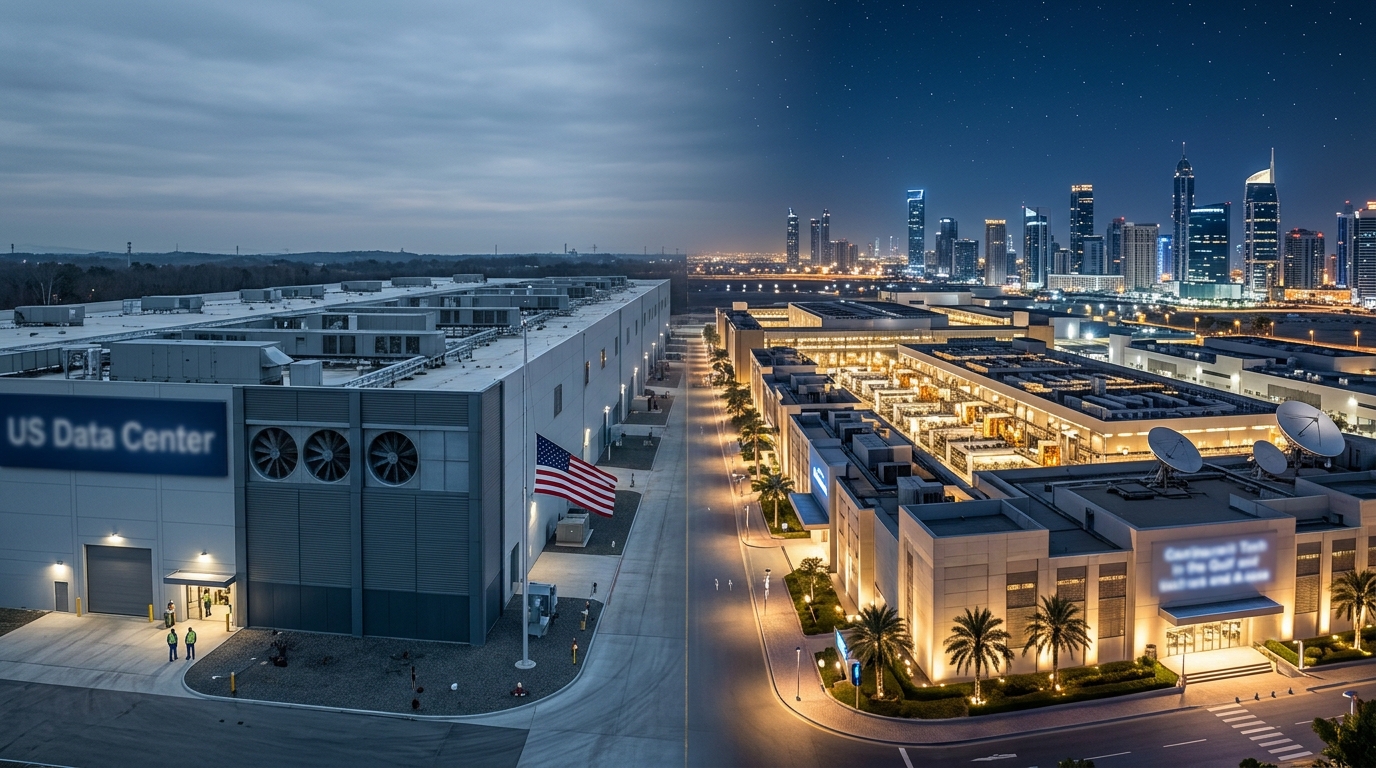
Here is the trade the selloff is missing: turn a project down at the county level and it moves to the next county; turn it down statewide and it moves to the next state; slow it nationally and it gets built in the Gulf and in Asia. A US moratorium does not reduce global demand for AI compute by a single watt. It redirects it.
The Gulf states are the marquee destination, offering cheap electricity, sovereign wealth that erases financing constraints, and a permissive regulatory sandbox. That is not a theoretical argument. The UAE’s Stargate project, a 1GW AI compute cluster backed by G42, OpenAI, Oracle, Cisco, Nvidia, and SoftBank, is already under development, and the Commerce Department has authorized advanced chip exports to G42 in the UAE and Humain in Saudi Arabia equal to up to 35,000 Nvidia Blackwell chips each. Humain, backed by Saudi Arabia’s Public Investment Fund, has described plans to build large-scale AI infrastructure. That pipeline does not care whether Bernie Sanders wins his Senate vote.
UBS estimated that about 30% of expected 2028 US data center additions could face pauses, which is real execution risk for domestic-heavy names like Vertiv and GE Vernova. By midmorning Wednesday, Modine was down about 24%, Sterling Infrastructure about 19%, and Comfort Systems about 16%. Even Vertiv and GE Vernova were each down roughly 11% to 12%. Those moves price in a legislative outcome that is not settled even inside the Democratic caucus, with some members warning a ban could hamper AI development and undermine national security.
Vertiv is one of the domestic-heavy names absorbing the most political risk in this selloff. Vertiv’s underlying demand signals were strong even when the market punished the stock on a revenue timing miss.
The Options Opportunity
The asymmetric angle is on Nvidia directly. The stock is not purely a US permitting story. Nvidia has said it is not assuming any Data Center compute revenue from China in its outlook, so the new risk is slower US building and tougher AI rules, but its Gulf exposure is growing fast. With earnings on November 17, the company is coming off the kind of year-over-year growth that can set a high bar for the stock to bounce following the report.
NVDA’s implied volatility and IV rank move with the tape, but the market cap is about $4.41 trillion. That IV rank is elevated but not extreme, leaving room for a debit spread to work if the thesis resolves on earnings. A bull call spread expiring just after November 17 targets the gap between political fear and operating reality. The moratorium bill has real headwinds inside the caucus; Nvidia’s order book has none.
The invalidation is straightforward: if Democrats unify around the Sanders-AOC bill and pass committee votes quickly, domestic capex forecasts for 2027 would need meaningful cuts and the whole complex re-rates lower. Position size accordingly. This is a defined-risk bet that the market is confusing a noisy political moment with a structural change in where the world wants Nvidia’s chips. It is not. The demand moves. The chips go with it.