
Start with a simple fact about physics.
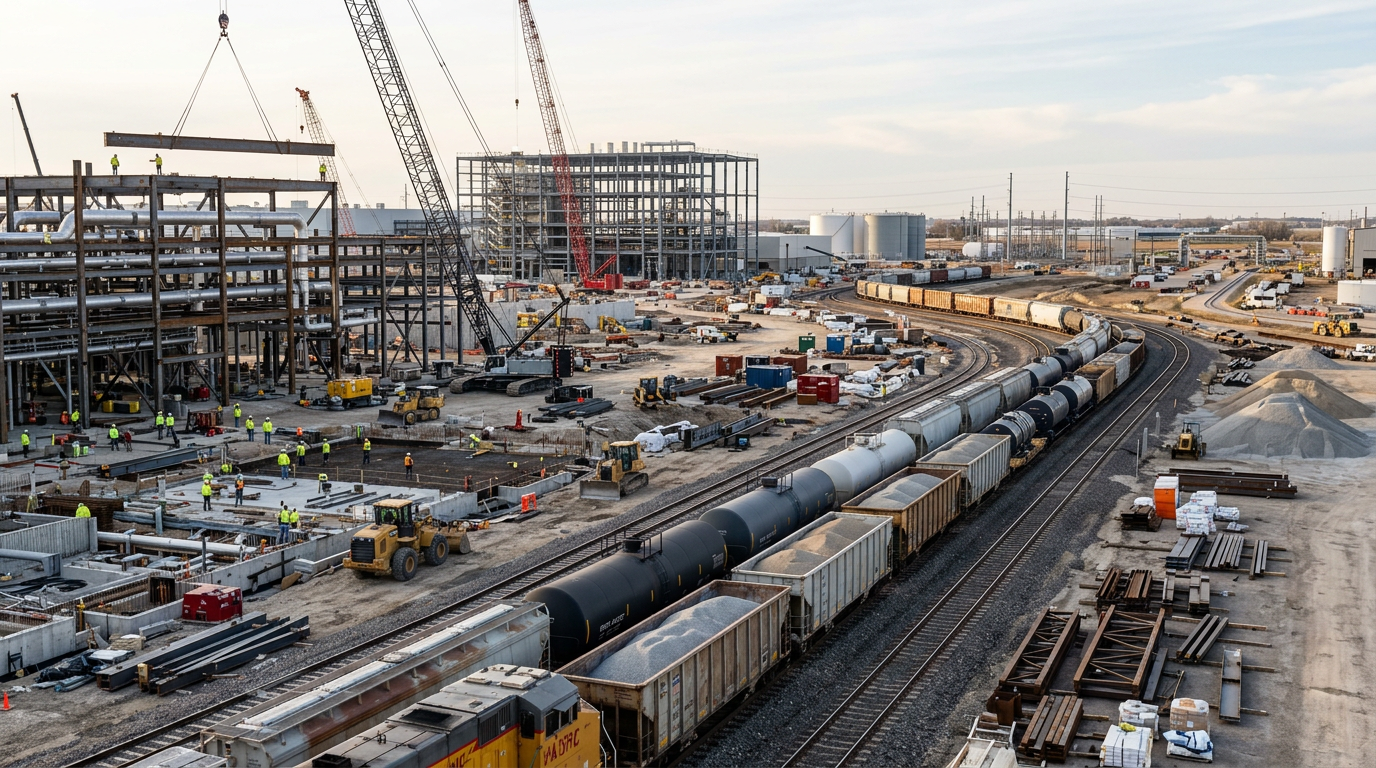
You cannot build a semiconductor fab, a pharmaceutical plant, an AI data center, or a chemical facility without moving enormous volumes of steel, cement, aggregates, specialty gases, and industrial chemicals. That freight has to travel somewhere. And increasingly — as trucks get more expensive and intermodal costs stay competitive — it travels on rail.
Here is where it gets interesting. The companies most investors associate with this industrial reawakening are the Caterpillars, the Nucors, the Eaton Electrics. The obvious plays. The ones CNBC puts on screen the moment someone mentions “reshoring.” But there is a quieter business sitting two steps upstream from all of it, and it has been printing record lease rate gains in near-silence.
What’s interesting is that nobody is talking about the container — they’re talking about what’s in it.
The Freight Signal Most Analysts Are Misreading
Rail chemical shipments, often viewed as a leading indicator of manufacturing activity because chemicals serve as inputs into so many industrial processes, have now increased on a year-over-year basis for five consecutive months. Year-to-date chemical volumes through May reached a record high, supported by expanding manufacturing activity and favorable production economics for U.S. producers.
Fifteen of twenty carload categories posted year-over-year gains in May, matching the breadth of growth seen earlier this year. Total carloads rose 2.5% in May, marking a fifth consecutive year-over-year increase. Through the first five months of 2026, total carloads were at their highest level since 2019.
That’s not a cyclical blip. That’s an economy where the goods sector is quietly coming back online. After years in which growth depended heavily on consumers and services, manufacturing, agriculture, trade, and other freight-intensive sectors began contributing once again. A second engine came back online. While not always visible in the headlines, the shift was visible in freight.
Slight tangent, but it matters: most of the market is still debating whether reshoring is “real.” The freight data stopped debating months ago.
The Construction Multiplier Nobody Is Counting
Here is the second-order effect that Wall Street keeps skipping over.
Every factory being built right now — whether it’s a chip fab, a pharma cleanroom, or an AI data center — requires raw material inputs before it ever produces a single unit of output. The construction phase generates substantial demand for steel, cement, aggregates, and heavy equipment, all traditional rail commodities. CSX’s industrial development pipeline aims for 150,000 to 300,000 new annual carloads by 2027, driven by these projects.
From semiconductors and electric vehicles to data centers and chemicals, many of today’s biggest reshoring projects are massive energy users — and massive freight generators. And data centers and power generation and infrastructure are the real stories of U.S. industrial growth.
This is before the facilities are even operational. Once they run, semiconductor facilities will require specialty chemicals and gases, supporting ongoing freight demand.
That freight doesn’t move itself. It moves in railcars. Specific railcars — tank cars, covered hoppers, gondolas — that cannot simply be repurposed from other uses.
The Supply Side Problem Nobody Priced
This is the part that makes the trade asymmetric.
The North American industry backlog at Q4 2025 was at its lowest level since Q4 2010, with recent railcar production metrics muted compared to the prior two production peaks. In other words: demand for railcars is rising structurally, and the pipeline of new supply is historically thin.
Lessors consistently achieve high fleet management services efficiency, with some operators reporting fleet utilization rates nearing 99%, far surpassing typical industrial asset benchmarks. This tight capacity, coupled with strong railcar remarketing in active secondary markets, allows for significant pricing power during contract renewals, where lease rate changes have been observed to increase by over 20%.
That pricing power isn’t theoretical. It’s already printing in the numbers.
The Company Two Steps From the Catalyst
GATX Corporation doesn’t make headlines. It doesn’t sell AI chips or build data centers. It owns railcars and leases them to the companies that move the raw materials, chemicals, and commodities that feed every industrial project in North America. That’s a different kind of moat — invisible, illiquid, and extremely difficult to replicate quickly.
GATX closed its acquisition of the Wells Fargo rail lease fleet, nearly doubling its North American fleet from 107,000 to about 208,000 cars. That’s not a minor deal. That’s a structural expansion of scale in a market where supply is already constrained.
The results from Q1 2026 tell the story quietly. Rail North America’s utilization for the combined fleet remained high at 98.1% at quarter end, with a first-quarter Lease Price Index of 22.3%. That LPI number — 22.3% — means GATX is renewing leases at prices 22% above what the previous contracts charged. In an asset-leasing business, that is pricing power in its purest form.
Rail North America reported segment profit of $103.9 million in the first quarter of 2026, compared to $88.8 million in the first quarter of 2025. Higher first-quarter segment profit was driven by higher lease revenue and higher gains on asset dispositions.
With a little over two-thirds of the combined fleet repriced in the current favorable lease rate environment, GATX sees meaningful runway to enhance financial performance across the remaining fleet.
That last line deserves a second read. Two-thirds repriced. One-third still rolling at older, lower rates. As those legacy contracts come up for renewal — at 22%+ above expiry — the earnings trajectory compounds automatically. This is operating leverage built into the contract calendar, not dependent on the economy accelerating further.
Why CNBC Isn’t Talking About This
Because it’s boring. Railcar leasing doesn’t have a product launch. It doesn’t have an AI press release. It doesn’t have a charismatic CEO doing interviews. What it has is a fleet that remained solid, reflected by 99.0% fleet utilization at year end and a 91.4% renewal success rate in the fourth quarter of 2025 — figures that look more like a regulated utility than a cyclical freight company.
What Wall Street is missing is the convergence. It’s not just one trend hitting GATX — it’s four simultaneously: the goods-economy recovery, the AI and data center construction wave, the chemical freight surge, and the historically depressed new railcar supply. Through May, total U.S. rail carloads were up 3.4% year over year. On a weekly basis, May rail carloads rose 2.5% annually, extending gains to a fifth consecutive month. The average weekly carload total of roughly 226,500 was the highest for the period since 2018.
And new production isn’t catching up fast. FreightCar America just entered a new multi-year order for 1,900 railcars, with deliveries scheduled through 2028. Second quarter orders totaled approximately 3,000 railcars, representing a commercial inflection point as demand for differentiated, agile manufacturing solutions continues to grow — but those deliveries stretch years out. The gap between demand today and supply available today is the pricing window GATX is quietly exploiting.
The Options Market Angle
GATX is a mid-cap industrial with a market cap around $2.6 billion as of Q1 2026 filings. Options flow in names like this tends to be institutional, not retail-driven, which typically means lower implied volatility and cheaper defined-risk structures relative to the expected move over a multi-quarter thesis.
For traders who believe the lease rate cycle has 12 to 18 more months of repricing runway — given that roughly one-third of the fleet still sits on legacy rates — a defined-risk long structure using longer-dated calls or a bull call spread allows participation in the compounding earnings effect without full capital exposure. The thesis is not dependent on a single quarter; it’s a contract-calendar story. That makes it better suited for longer-dated options than short-duration trades.
Neutral to slightly bullish traders watching for a catalyst might consider a defined-risk position sized around the Q2 2026 earnings release, where the continued LPI and fleet utilization figures will either confirm or interrupt the repricing story.
The Risk That Actually Matters
The honest risk is macro. If the manufacturing recovery stalls — if the ISM rolls back below 50, if chemical shipment growth reverses — lease renewal demand softens. The underlying driver of intermodal growth is increasingly cost pressures in the truckload market shifting freight to rail rather than a broad-based surge in freight. That’s a more fragile foundation than structural reshoring. A sudden demand reversal could compress the pricing power thesis before the remaining fleet gets repriced.
The secondary risk is new supply. If railcar builders accelerate production materially — which the backlog data currently does not suggest — the tight market loosens. But lead times for new railcar manufacturing run 18 to 36 months, and current order books are shallow. That window of constrained supply is the trade.
Forward Outlook
CEO Bob Lyons reported that 98% to 99% utilization is expected by year-end, with North America profits projected to rise by up to $65 million. That guidance was issued before the full Q2 freight acceleration — which showed May intermodal volume up 8.1% and chemical volumes at a record high. If the second-half industrial freight environment stays constructive, the guidance conservatism becomes meaningful upside.
The longer thesis is simpler. Every AI data center being built requires steel and cement to construct it. Every chip fab requires specialty chemicals to operate it. Every pharmaceutical plant requires precursor compounds to supply it. All of that moves on rail. And the company that owns 206,000 of the cars those commodities ride in — with pricing power running 22% above expired rates and a fleet that practically never sits empty — is not Nvidia. It’s not a name anyone is putting on a stock screen today.
That is usually where the better trades live.
- GATX Q1 2026 North America fleet: approximately 206,100 railcars
- Fleet utilization as of Q1 2026: 98.1%
- Lease Price Index renewal rate increase: 22.3% above expiring contracts
- Average lease renewal term: 56 months
- Remaining fleet not yet repriced at current rates: approximately one-third
- North America segment profit Q1 2026: $103.9M vs. $88.8M in Q1 2025
- Industry railcar backlog: lowest level since Q4 2010
- Rail chemical carloads: record year-to-date through May 2026
- Watch: Q2 2026 earnings for LPI, utilization, and disposition gains