
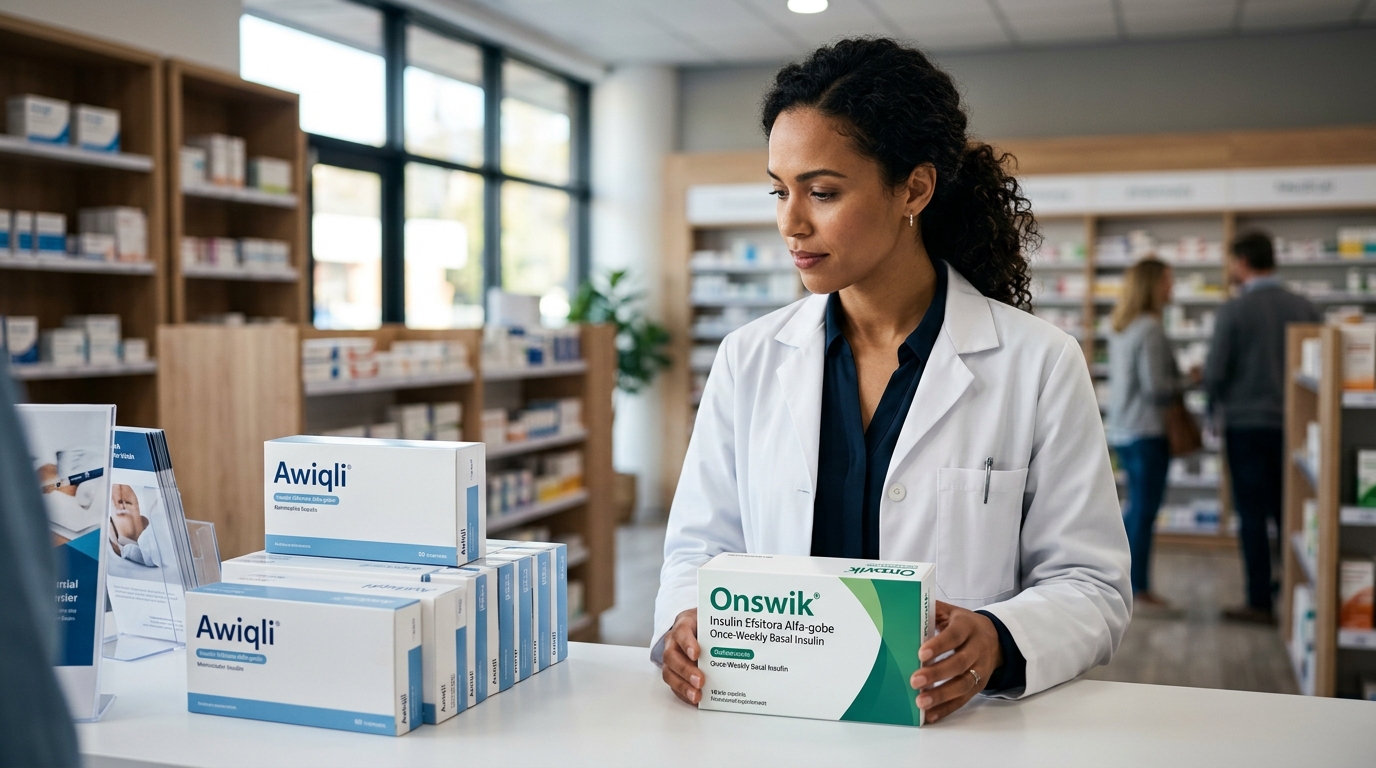
Novo Nordisk spent years fighting to get a once-weekly basal insulin approved in the United States. It finally cleared that hurdle in March 2026, launched Awiqli nationally on August 11, and had 44 days to itself before Eli Lilly arrived. The FDA approved Lilly’s Onswik (insulin efsitora alfa-gobe) on September 24, and the basal insulin market is no longer Novo’s to define.
The core math is simple: Onswik is designed to maintain steady basal insulin levels across a full seven-day dosing interval, reducing basal injections from approximately 365 to 52 per year versus once-daily basal insulin. That is the same patient benefit Awiqli sells. Two products, same promise, same audience, and Lilly already owns the relationship with the prescriber.
Why This Changes the Competitive Picture
Lilly’s incretin dominance matters here. Total incretin revenue grew 67% in Q2 2026, driven by both market expansion and increasing global market share, with Lilly now commanding 60.9% of the US incretin market. That commercial infrastructure, the same sales force calling on endocrinologists and primary care physicians already writing Mounjaro and Zepbound, now has a basal insulin to complete the type 2 diabetes toolkit. Onswik does not need to build physician relationships from scratch. It inherits them.
Novo, by contrast, is playing defense on two fronts simultaneously. The US Awiqli launch comes at an important time for Novo Nordisk as the company looks to diversify its diabetes franchise amid mounting pressure on its core GLP-1 products, with Ozempic and Wegovy facing slower growth, pricing pressure, and intensifying competition from Eli Lilly. Awiqli was supposed to be the diversification answer. Lilly just complicated that calculus.
The Science Behind Onswik
Efsitora is a fusion protein that pairs a novel single-chain insulin variant with a human IgG2 Fc domain, engineered for once-weekly subcutaneous administration. The regulatory case rested on four phase 3 QWINT trials. Those studies showed noninferior A1C lowering versus insulin glargine or insulin degludec across more than 3,400 participants, supporting regulatory approval. Lilly also secured approvals in the EU, Mexico, and Japan before the US cleared it, giving the drug a global track record that should ease payer conversations.
The Risks Are Real
The bear case centers on one clinical finding that cannot be glossed over. Severe hypoglycemic events were higher in the efsitora arm compared with the insulin degludec arm, with about 10% of patients in the efsitora arm experiencing severe hypoglycemia compared with 3% in the degludec arm. That finding, from the QWINT-5 trial in type 1 patients, led directly to a labeling restriction: Onswik is not recommended for patients with type 1 diabetes because of an increased risk of severe hypoglycemia. Novo’s Awiqli carries a similar type 1 limitation in the US. Still, hypoglycemia risk in type 2 patients will be a talking point for clinicians and payers alike, and it gives cautious prescribers a reason to delay switching.
Pricing is another open question. US pricing for Onswik has not been disclosed. Awiqli launched with a $35 monthly patient copay program. How Lilly prices and packages Onswik will shape uptake speed as much as the clinical data does.
What Investors Should Watch
The first signal will be early prescription volume data comparing Onswik and Awiqli in the weeks after Onswik’s commercial launch. Lilly’s sales force advantage is real but not infinite: Novo has a six-week head start on formulary placement, and managed care does not move overnight. Watch for any payer decisions that favor one product on preferred tier status.
Longer term, the more important question is whether weekly basal insulin accelerates the overall market or simply splits it. There are many barriers to insulin use, and a big one is the frequency of injections, a weekly insulin may help overcome some of the initial hesitation people have to starting insulin. If that turns out to be true at scale, both Lilly and Novo benefit. But Lilly enters with a broader diabetes franchise, a stronger prescriber network, and a stock that has already proven it can compound on exactly this kind of sequential market expansion. Onswik is not the whole thesis. It is one more reason the thesis holds.