The earliest sign that a compressor is about to fail is not heat, not vibration, and certainly not a warning light. It is sound, specifically ultrasonic stress waves typically monitored in the tens of kilohertz and up, far above what any technician can hear on a plant walk. That physical fact is quietly reshaping how industrial facilities spend their maintenance budgets.
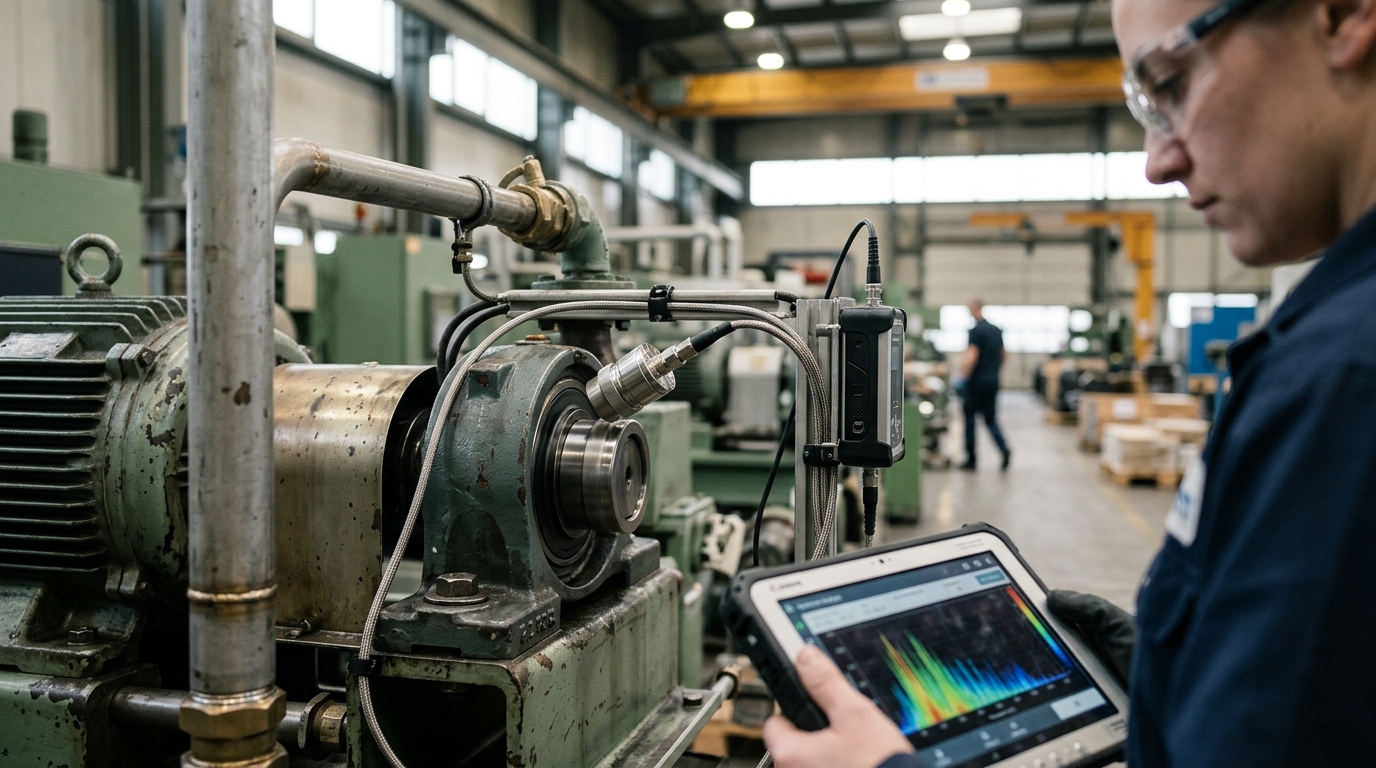
The difference between a manageable repair and a catastrophic failure is often measured in weeks, and the earliest warning signs exist at frequencies the human ear cannot detect. Acoustic emission and ultrasonic monitoring technologies can detect high-frequency stress waves and airborne ultrasound signals, giving plants the ability to identify cracks forming inside metal, compressed air escaping through pinhole orifices, and bearings running dry while the facility operates at full production.
The financial logic is not subtle. In large, asset-intensive plants, a single day of unplanned downtime can cost into the millions of dollars. Against that exposure, sensor hardware is cheap. Sensor costs have generally trended down over the past decade, but the real cost is the integration layer, not the microphone bolted to the gearbox.
Ultrasonic and acoustic sensors detect high-frequency sound waves caused by friction or turbulence, and they can be particularly useful for catching early-stage bearing lubrication issues and air or gas leaks before those problems generate measurable heat or vibration. That chronological advantage matters. But the common claim that modern AI systems predict equipment failures 30 to 90 days in advance with 80 to 97% accuracy is too broad to treat as a general benchmark. In practice, lead times and accuracy vary widely by asset type, failure mode, and data quality.
The business case sharpens when you look at real plant outcomes. Many vendor and operator case studies report meaningful reductions in unplanned downtime and improvements in OEE from condition monitoring and predictive maintenance programs, but the specific pilots cited here are not attributable as written. Rather than pin this to a particular “190-asset” pilot and a specific $2.1 million program with $5 to $8 million of annual value, the safer conclusion is that results can be material and site-specific.
The hidden angle here is not the sensor itself but what happens upstream of the alarm. Acoustic monitoring can pick up changes consistent with bearing deterioration and misalignment-related friction earlier than conventional checks, which means maintenance planners can reserve labor and parts days in advance rather than scrambling for an emergency crew at 2 a.m. Process-industry operators that connect condition monitoring to their maintenance systems often emphasize that the workflow, turning raw signals into actionable diagnostics and work orders, is where the compounding benefits show up.
The market reading this technology is attracting reflects that confidence. One widely cited industry forecast pegs the “acoustic and vibration AI predictive maintenance” segment at about $10.9 billion in 2026, projecting roughly 21% compound annual growth through 2036. That growth rate implies the industry is still early in adoption. Most plants still run legacy inspection intervals written before a single IoT sensor was deployed.
The companies best positioned are not the sensor manufacturers alone. Mass adoption of industrial monitoring is extending beyond vibration and temperature probes to include acoustics, thermal, and electrical signals, and the platform vendors aggregating that data into prioritized work orders hold the stickiest position in the value chain. Siemens, ABB, Honeywell, and Rockwell Automation are all building toward that unified layer. The factories that lock in those platforms first are the ones that convert a sensor investment into a durable cost advantage.