Start with a physics problem, not a stock ticker.
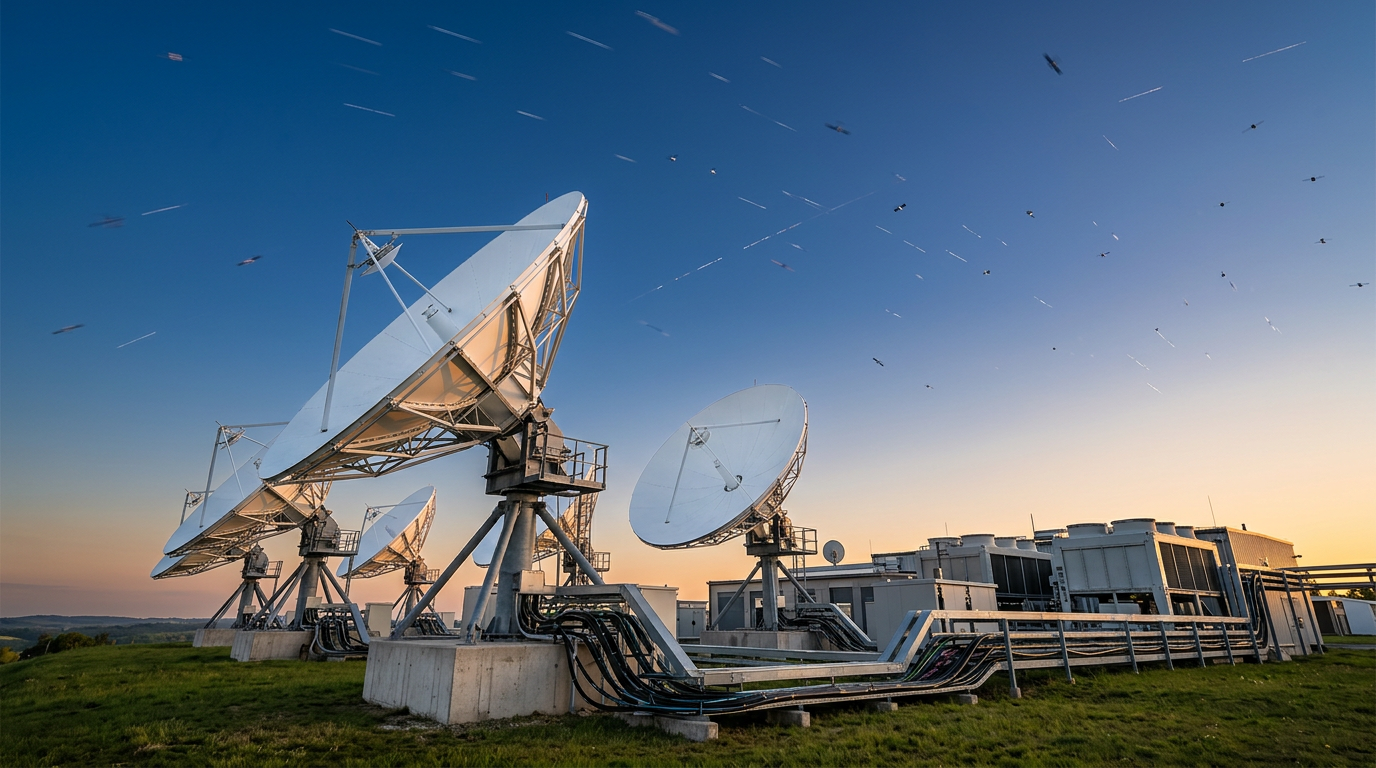
Right now, somewhere over the Pacific, a high-resolution Earth observation satellite is capturing imagery at resolutions measured in centimeters. It is logging agricultural stress data, flagging dark shipping vessels, tracking wildfire perimeters in real time. It generates hundreds of gigabytes per orbital pass. And then — this is the part nobody talks about — it hits a wall. A narrow radio-frequency window. A finite number of ground stations. A congested spectrum that hasn’t meaningfully scaled in years.
That wall has a name. Researchers and engineers call it the downlink deficit. Wall Street hasn’t given it a name yet, because Wall Street is still busy debating which satellite operator wins. That is the wrong question.
Here’s the thing. The question that actually matters is: who handles all that data when it reaches the ground?
The Constellation Race Is Producing a Traffic Jam Nobody Budgeted For
The satellite industry has transformed into a $293 billion market, with most value driven by ground infrastructure, not orbit. Over 15,500 satellites now circle Earth, fueled by a 90% drop in launch costs. That collapse in launch economics, celebrated loudly by every space-economy bull, created a second-order consequence that almost nobody is pricing correctly.
More satellites means more data. More data means more demand for ground infrastructure. And ground infrastructure, unlike satellites, cannot be mass-produced overnight.
Global satellite capacity increased eightfold from 2020 to 2023, reaching 27 terabits per second, and is forecast to increase another tenfold by 2028, to 240 Tbps. That is a staggering curve. And downlinking all of it through limited radio frequency windows to a finite number of ground stations across congested spectrum is increasingly the primary bottleneck.
Slight tangent, but it matters: think about what drove the transformer shortage during the early AI power boom. Everyone focused on the GPU. The transformer — the dumb, heavy, slow-to-manufacture component sitting between the grid and the data center — was the actual constraint. The ground segment is doing the same thing to the space economy right now. It is the transformer of the orbital era.
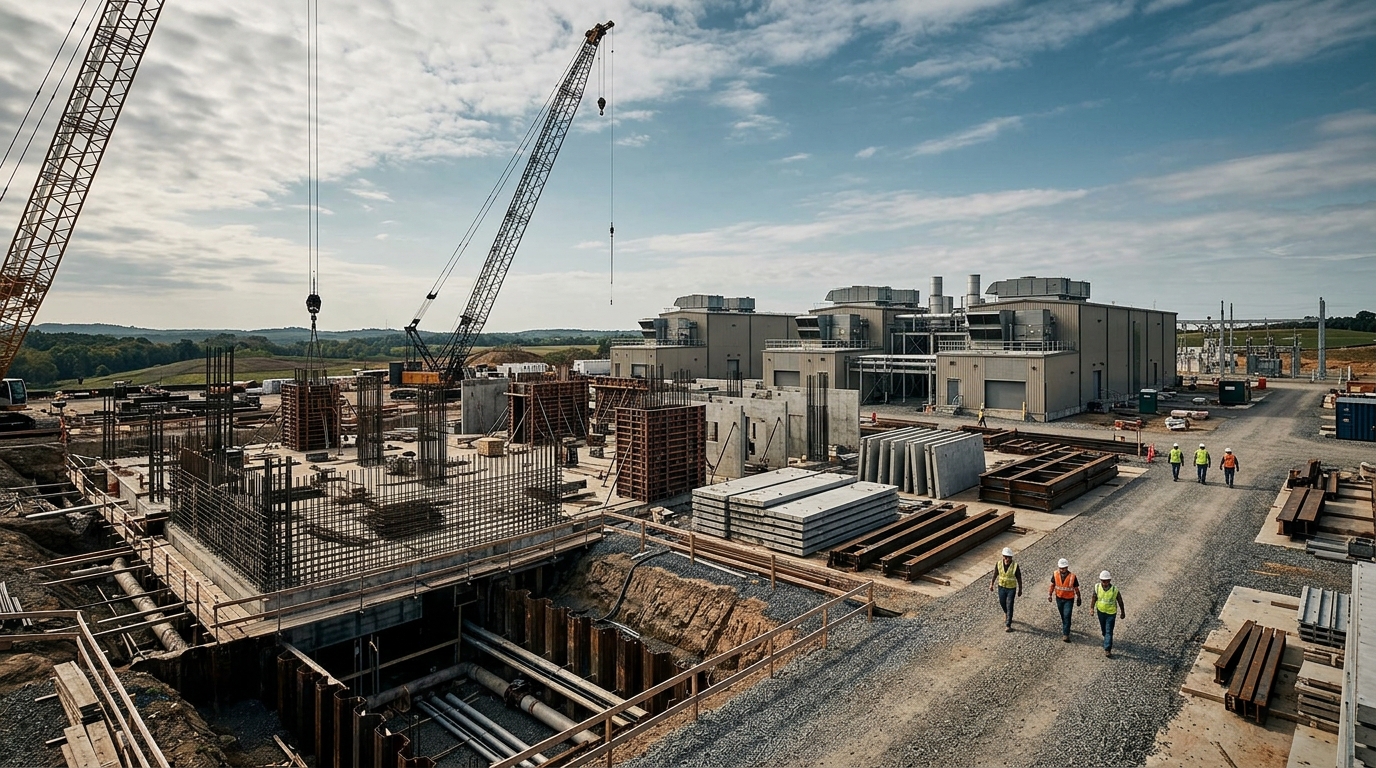
A proliferated constellation with flawless inter-satellite links but insufficient optical ground station infrastructure is nothing more than a localized intranet in the sky — extraordinarily efficient at moving data in circles and incapable of delivering it where it matters. The state has provided the capital to build the space segment, but the operational success of the entire architecture now hinges on terrestrial construction. If commercial operators and defense primes do not solve the space-to-ground optical bottleneck, their mega-constellations will become stranded assets.
That sentence should stop any investor cold.
Who Benefits Three Steps Removed From the Launch Headline
First-order thinking: SpaceX launches more Starlink satellites, SpaceX wins.
Second-order thinking: more constellations require more ground stations, ground station equipment suppliers win.
Third-order thinking: new satellite operators don’t want to build their own ground networks. They want to rent access to someone who already has the launch capability, the satellite buses, the components, the optical communication terminals, and the mission management software — all from one vendor. That is a very different business than a launch company. And almost no one has built it.
Free-space optical communications offer data transmission rates up to 100 times faster than traditional radio frequencies, making them critical for bandwidth-intensive tasks like live Earth observation and military space intelligence tracking. The global Optical Ground Segment is expanding at a compound annual growth rate of 31.3%.
The growth in the satellite optical ground stations market is driven by escalating data volume from modern satellites, the limitations of RF spectrum, and heightened demand for ultra-secure communications. As EO, telecommunications, and satellite broadband providers deploy dense constellations of satellites, the capacity limitations of RF bands are becoming a bottleneck. Optical ground stations offer an elegant solution with gigabit-scale bandwidth, spectrum independence, and minimal regulatory complexity.
And then there is the defense layer, which is where this gets genuinely significant. The Golden Dome program’s official cost estimate has risen to $185 billion. Golden Dome requires prototype technologies by 2028 and relies entirely on the Proliferated Warfighter Space Architecture to provide near-continuous global missile warning and fire-control-quality tracks. The satellites must detect hypersonic glide vehicles, pass tracking data across the optical mesh, and downlink it to shooters on the ground in seconds. If the optical downlink fails due to cloud cover or insufficient ground stations, the kill chain breaks.
The Pentagon is not building this system and then figuring out the ground segment later. The ground segment is the system.
The Company Wall Street Still Reads as a Launch Provider
Now — finally — the company.
Rocket Lab (Nasdaq: RKLB) built its reputation as the reliable small-launch alternative to SpaceX. That framing is no longer accurate. It may never have been the right frame. What Rocket Lab has been quietly assembling is an end-to-end space infrastructure company: launch vehicles, satellite buses, solar power systems, star trackers, reaction wheels, optical communication terminals, space robotics, and mission management. Launch services are one part of Rocket Lab’s vertically integrated business. The company has built an end-to-end, vertically integrated space business thanks to its growing space systems division, which provides satellite components, subsystems, mission management, and constellation management.
Here is where the numbers get interesting.
In Q1 2026, Rocket Lab posted record quarterly revenue of $200.3 million — a 63.5% year-over-year increase — with record GAAP gross margins of 38.2% and a record backlog of $2.2 billion, up 20.2% quarter-over-quarter. The Space Systems segment generated $136.7 million of that revenue versus $63.7 million from the launch segment. Space Systems — not launch — is the majority business. That shift happened quietly while the market was watching the rocket.
The total backlog surged to $2.2 billion, a 108% increase from the previous year. A backlog that has doubled year-over-year is not a launch company metric. It is a systems infrastructure metric.
Rocket Lab completed its acquisition of Mynaric AG, a provider of laser optical communications terminals, during Q1, and entered into a definitive agreement to acquire Motiv Space Systems, a space robotics company. The Mynaric acquisition is the detail most analysts glossed over. Mynaric makes the optical terminals that go on satellites to enable the high-speed laser links that solve the downlink bottleneck. Rocket Lab just bought the component that sits at the center of the ground segment crisis.
Growth was primarily driven by the satellite platforms business, with increasing contribution from SDA Tranche II and Tranche III contracts. The Neutron bull case is not just that demand exists — it is that demand exists at pricing that can support attractive long-term launch economics. This is especially relevant because Neutron is targeting one of the most supply-constrained parts of the launch market. Medium-lift demand is being driven by commercial constellations, national security missions, and customers who want reliable alternatives outside of SpaceX.
Rocket Lab signed its largest contract ever with a confidential customer for its Neutron and Electron rockets through 2029, weeks after landing a $190 million deal for 20 hypersonic test flights.
The company has already sold more launches in the first quarter of 2026 than in all of 2025, bringing its total launch manifest to over 70 contracted missions.
Q2 2026 earnings are scheduled for August 6. Rocket Lab guided Q2 revenue of $225 million to $240 million — a range that exceeded analyst expectations of $205.05 million.
The Structural Case That Isn’t Being Made
Here is what Wall Street is missing about Rocket Lab. It is not the launch cadence. It is not even the Neutron timeline, though that matters.
The actual story is that new satellite operators don’t want to build a bespoke ground segment, hire a large operations team, and integrate multiple vendors just to start commanding spacecraft and moving data. What works for one satellite must work for 10, 50, or 500 — without the ground segment becoming a bottleneck.
Rocket Lab is positioning as the company that eliminates that problem entirely. Build your satellite on our bus. Launch it on our rocket. Manage your constellation on our software. Downlink data through our optical terminals. That is a fundamentally different business model than a launch provider. It is closer to a toll booth on every satellite that goes up — and based on current trajectory, a lot of satellites are going up.
The global space economy reached an estimated $626 billion in 2025, according to aggregated data from the Space Foundation, Euroconsult, and the Satellite Industry Association. That figure represents a 7% year-over-year increase and positions the industry firmly on a trajectory to surpass $1 trillion by 2034.
Ground equipment and services represent approximately $140 billion of that total. Satellite ground stations, VSAT terminals, user equipment, and ground-based space operations form a large but often overlooked segment of the value chain.
That is a $140 billion market that most equity investors cannot name a single mid-cap beneficiary in.
Technical Structure and Decision Framework
At a recent share price around $109, Rocket Lab has seen short-term share price momentum fade with a 30-day share price return down roughly 12%. Despite strong Q1 results and Q2 guidance, the stock has been volatile, reacting to sector-wide selling tied to investor focus on the upcoming SpaceX IPO. That SpaceX IPO overhang is a sentiment dynamic, not a fundamental one. When a competitor goes public, Rocket Lab’s contracts don’t get repriced. Its backlog doesn’t shrink. Its optical terminal orders don’t disappear.
Active traders watching this position should note the August 6 earnings date as the next major inflection event. The stock has moved an average of roughly 7–8% in either direction around earnings over the past two years, but the Q1 reaction — a 34% single-day move at one point during the post-earnings session — signals that the market has not yet found a stable valuation framework for this business.
Key levels to monitor: the $100 area has served as a psychological floor since the Nasdaq-100 inclusion. The prior high near $130 represents the range ceiling where prior sellers re-emerged. A Q2 beat above the high end of guidance, combined with further SDA contract announcements, would be the catalyst to test that ceiling.
VWAP on a 20-day basis has been trending lower from that $130 level. Traders looking for tactical entries are watching for volume-supported stabilization above the $100 zone ahead of the August 6 report. Momentum indicators suggest the stock is in a consolidation, not a breakdown — there’s a difference, and the backlog composition supports that read.
Three Scenarios Into August 6
Bull case: Q2 revenue comes in at or above the high end of guidance ($240 million), Space Systems margins hold above 35% GAAP, and management announces an additional SDA or Golden Dome-adjacent contract. The market reassesses Rocket Lab as a defense infrastructure company, not a launch startup, and the stock rerates toward $140 to $155.
Base case: Revenue lands in the middle of guidance ($230 to $235 million), margins are in line with guidance, and the Neutron development timeline holds with no new significant delays. The stock consolidates in the $105 to $120 range while analysts revise revenue estimates higher for full-year 2026.
Bear case: A Neutron development setback is disclosed, Space Systems margins compress below 30% GAAP due to contract mix, or the SpaceX IPO triggers a broader sector rotation out of smaller space names. The stock revisits the $85 to $92 range, which would represent a meaningful opportunity for longer-duration holders who understand what the backlog actually says about 2027 and beyond.
What Active Traders Should Be Watching Beyond the Stock
A few things worth tracking that aren’t getting screen time: the SDA’s Tranche 2 Transport Layer delivery timeline in late 2026 will function as a real-world stress test for the optical terminal supply chain. If Tranche 2 deploys without major downlink failures, it validates the architecture Rocket Lab has been quietly building components for.
Watch also the Golden Dome procurement disclosures. The downlink deficit will either be resolved or exposed by a handful of near-term milestones. The SDA’s Tranche 2 Transport Layer deliveries in late 2026 and 2027 will reveal whether the optical terminal supply chain can scale beyond Tranche 1 volumes. Rocket Lab, through Mynaric, is a direct link in that supply chain.
The broader point is this. Everyone watching the space economy is focused on the rockets. The rockets are the first-order trade. The satellites are the second-order trade. The infrastructure that connects those satellites to the ground — and makes their data useful — is where the durable, compounding business model actually lives.
That company is already public. It reports on August 6. And right now it’s down 12% from its recent high while its backlog is up over 100% year-over-year.
The market is watching the rocket. The trade is underneath it.
For informational and educational purposes only. Not investment advice. Trading involves risk, including loss of principal.