
Start with a number that should terrify every packaged food CEO on Earth.
America’s obesity rate just fell for the first time in decades. Not a rounding error. From 39.9% in 2022 down to 36.4% in 2026, according to Gallup’s latest National Health and Well-Being Index. And the reason is not a sudden conversion to salads and willpower.
It’s a drug. Actually, it’s a class of drugs that one in nine American adults is now taking, up from one in 33 just two years ago.
GLP-1 agonists, the Ozempic and Wegovy generation of weight-loss medications, are doing something no diet trend has ever managed to do at scale: they’re structurally reducing how much food people eat. Users consume roughly 21% fewer calories. They snack less. They drink less alcohol. They skip breakfast. They leave food on the plate at dinner.
For ConAgra, Kraft Heinz, Mondelez, and every other maker of highly processed food, that is an existential problem. Grocery spending among GLP-1 households has fallen an average of 5.3% within six months of someone starting the medication, according to research cited by the Journal of Market Research, while spending at fast-food restaurants dropped nearly 8%.
That’s the first-order story. The one CNBC covers. The one that’s already priced into Kraft Heinz and McDonald’s and Frito-Lay parent PepsiCo.
Here’s what isn’t priced in.
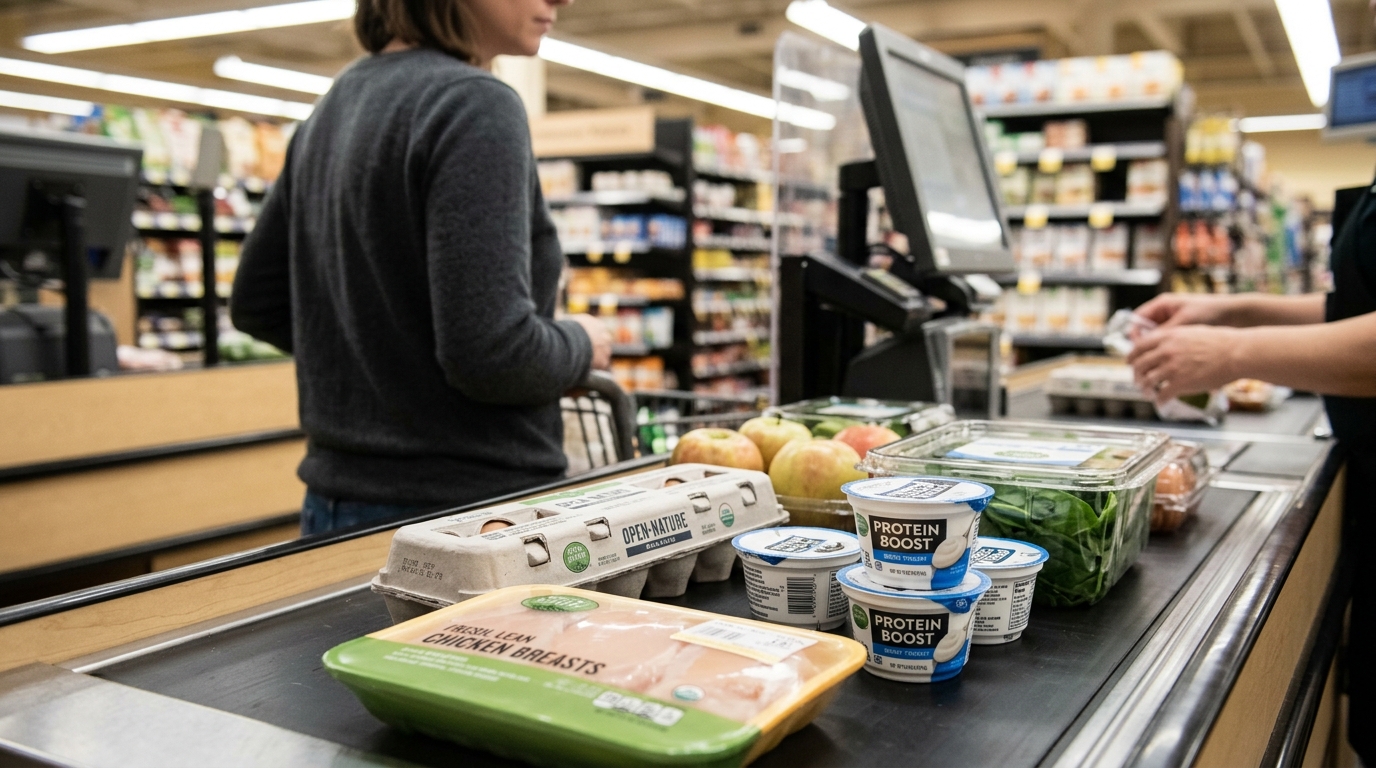
When people eat fewer calories, every calorie matters more. Doctors treating GLP-1 patients are emphatic about this: if you’re going to eat less, prioritize protein. Muscle mass loss is a real side effect of rapid weight reduction, and the clinical guidance is consistent. Eat protein. More of it. Eat it first.
So what happens downstream from that advice?
Whey protein prices are soaring. According to data cited by The Wall Street Journal, the price of whey protein concentrate jumped sharply from the start of 2025 as demand overwhelmed existing supply. The number of food products carrying “GLP-1 Friendly” labels on global online markets rose 37% from 2024, according to Euromonitor. Danone, Coca-Cola, General Mills, Starbucks, McDonald’s, and Shake Shack are all building out protein-forward product lines simultaneously.
Slight tangent, but it matters: this isn’t just about supplements anymore. It’s becoming infrastructure-level demand. When Coca-Cola is racing to expand production capacity for its Fairlife high-protein milk brand, when General Mills is launching Cheerios Protein, when every UK grocery chain from Morrisons to M&S launched a GLP-1-friendly ready-meal range within a single month in early 2026, something structural has shifted in the ingredients market.
The winners in the supplement aisle are obvious. The winner in the ingredient supply chain is not.
That’s where Glanbia comes in.
Most American investors have never heard of it. It’s an Irish company, listed in Dublin, with trailing twelve-month revenues of roughly $3.95 billion. It owns Optimum Nutrition, the gold standard whey protein brand that gymgoers have trusted for decades. It also owns BSN, Isopure, think!, and Amazing Grass. Beyond the branded consumer side, Glanbia is one of the world’s largest manufacturers of dairy-derived nutritional ingredients, meaning it supplies the whey protein concentrate and isolate that goes into products made by food companies that don’t want to build their own ingredient infrastructure.
That dual position, branded consumer products AND bulk ingredient supply, is the part Wall Street is still figuring out.
The stock has more than doubled in a little over a year, making it the top performer in the Stoxx 600 food, beverage and tobacco subgroup in 2026, trading near a record high. Barclays estimates the global protein market has already reached approximately $1.7 trillion, with demand potentially rising 37% over the next five years. The bank’s analyst called Glanbia “a rare example of a company in the food or ingredients space that has been a beneficiary rather than a victim of rising GLP-1 penetration.”
The business itself is targeting 5% to 7% annual organic revenue growth in performance nutrition, 4% to 6% in health and nutrition, with EPS growth of 7% to 11% and 85%-plus cash conversion. A transformation program is targeting more than $60 million in annual savings by 2027, with at least half reinvested for growth. Gross margins have been under some pressure from product mix and input cost timing, but the directional bet here isn’t about next quarter’s EBITDA. It’s about where demand is going for the next five years.
By 2030, J.P. Morgan estimates more than 30 million Americans will be on a GLP-1 treatment, up from roughly 10 million today. Oral pill versions are already arriving in the U.S. in 2026, which means cost drops, access widens, adoption accelerates. And every new patient entering the GLP-1 ecosystem is a consumer who will be told, by their doctor, to increase protein intake.
What’s interesting is that the consensus trade on GLP-1 is still entirely focused on Novo Nordisk and Eli Lilly, the manufacturers. The second-order trade, the companies that supply the ingredients for the food that GLP-1 users are actively being pushed toward, is only beginning to get attention.
The part people skip: Glanbia doesn’t just sell supplements direct to consumers. It sells whey protein concentrate and isolate to other food companies reformulating their products right now. Every Danone protein yogurt, every General Mills protein cereal, every Starbucks protein cold brew that gets reformulated to chase the GLP-1 consumer, those companies need ingredient supply. And the infrastructure to scale that supply takes years to build.
Glanbia has already built it.
The risks here are real and worth naming. Currency headwinds are a genuine drag; Glanbia reports in euros but generates significant U.S. dollar revenue. Whey protein is a commodity at its base, so prolonged price competition could pressure margins. The company is still working through a broader portfolio optimization, having divested SlimFast and Body & Fit while making acquisitions in nutritional premixes. Execution risk is not zero.
But the structural question isn’t about execution. It’s about the macro tailwind.
A class of drugs that suppresses appetite is forcing a global dietary shift toward higher-quality protein. The companies positioned at the intersection of ingredient supply and branded consumer demand, with decades of manufacturing scale and distribution relationships already in place, are in a structurally different position than the packaged food players scrambling to relabel their existing products.
The headline risk in food right now is GLP-1. But the headline opportunity, two layers downstream, looks a lot like Glanbia.
Worth a closer look.