
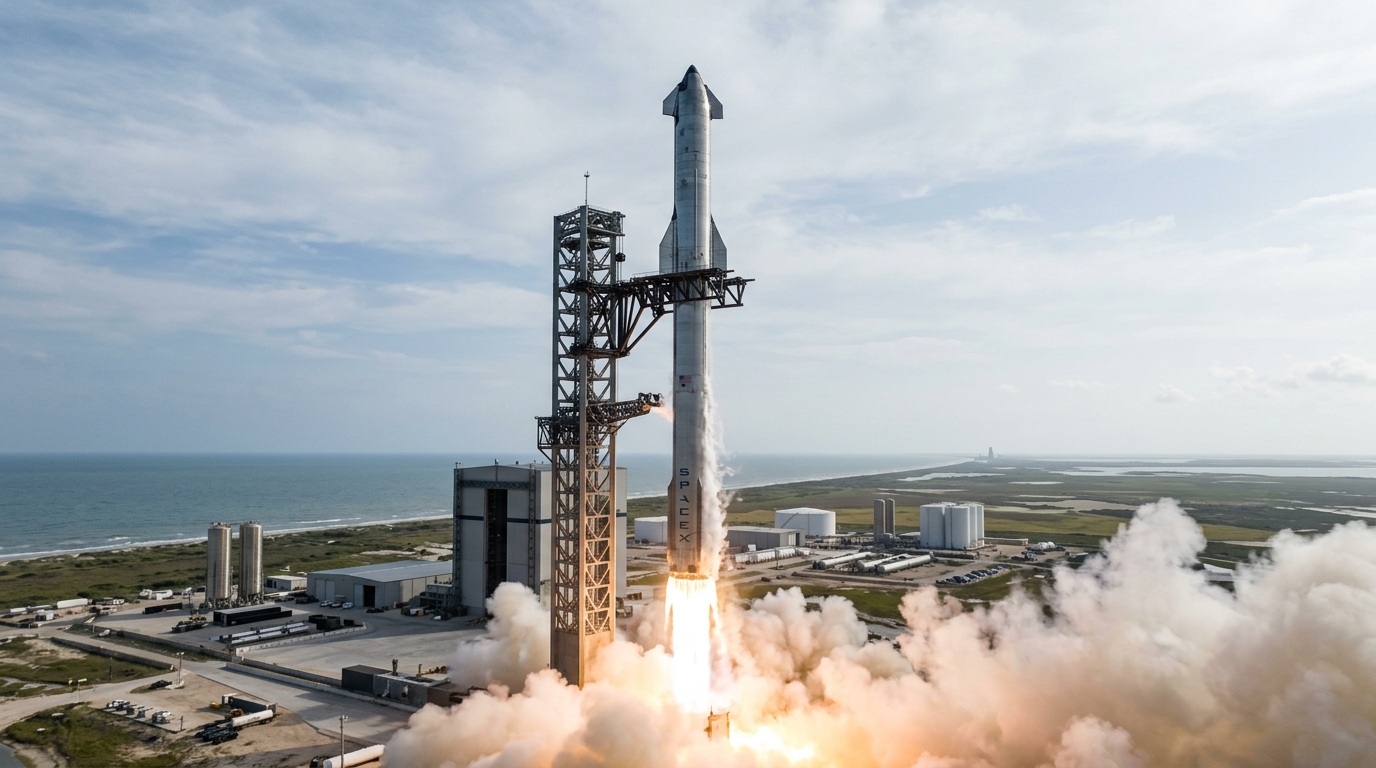
Every stock has a moment where the engineering story and the financial story finally occupy the same sentence. For SpaceX, that moment is September 22, 2026.
Starship Flight 14 is targeted for that date as SpaceX’s first Starship mission intended to reach orbit, deploying 26 Starlink V3 satellites that CFO Bret Johnsen said would make it a revenue-generating flight. The mission is planned to fly at an altitude of approximately 275 km. The ship will aim for six orbits, followed by a deorbit burn, with a splashdown in the Pacific Ocean west of Chile. Five years of test flights led here.
Why This Stock Now
SPCX opened at $144.88 and pushed as high as $153.01 in the most recent session (Wednesday, September 16, 2026), well above its $135 June 2026 IPO price. Some outlets flagged roughly a 6% move in the stock on the day the flight date was confirmed. The market is not waiting for Tuesday to price this in, which creates the central tension for buyers right now.
If successful, this would be the first Starship launch to generate revenue tied directly to payload deployment, even if that revenue is effectively internal. That matters because the Starlink connectivity business already carries the company financially, and V3 satellites are designed to extend that advantage sharply.
The Business
V3 satellites are designed for far higher capacity than prior generations, but specific cost and unit-economics claims vary and SpaceX has not pinned down a simple public rule like “10 times the throughput at three times the manufacturing cost.” The connectivity segment is where SpaceX already makes money. In its second-quarter 2026 filing, SpaceX reported connectivity revenue rising 66% year over year to $4.3 billion, and segment income from operations rising 79% to $1.656 billion.
Starship is how that advantage scales. SpaceX needs Starship to reliably reach orbit, return to Earth, and get quickly reused to fulfill the massive launch cadence promises it made during the IPO process. Flight 14 only tests the first part of that chain, but it is the part that unlocks all the others.
Why Wall Street Is Paying Attention
The average 12-month analyst price target is roughly $222, with a strong majority of analysts rating the stock a buy and only a small minority suggesting a sell. That consensus reflects confidence in the long arc, but also a recognition that near-term volatility is baked in.
Prediction-market pricing has recently implied roughly low-80% odds of Flight 14 launching before September 30. The regulatory path is not “largely cleared” for Flight 14 specifically; the FAA’s widely cited mitigated Finding of No Significant Impact and Record of Decision for Starship operations at Boca Chica dates back to June 2022, and Flight 14 still depends on FAA authorization. The outstanding item is the final launch license from the Office of Commercial Space Transportation.
What’s Driving the Opportunity
The shift Flight 14 represents is structural rather than immediate: 26 V3 satellites reaching operational orbit do not transform SpaceX’s quarterly financials overnight, but Starship crosses a threshold with broader implications. Once an orbital V3 deployment succeeds, every subsequent Starship flight that carries V3 satellites can generate revenue directly.
Musk has talked about very large long-term revenue ambitions, but the specific claim that SpaceX “expects to reach $1 trillion in revenue by 2030, down from 2031” could not be verified in the company’s Q2 2026 materials and is not stated that way in the public earnings release. The safer read is that management signaled rising internal confidence in the Starship and Starlink ramp, without anchoring the story on a single dated trillion-dollar target.
What Could Go Wrong
The space segment is bleeding cash to get here. In Q2 2026, space segment revenue rose 29% year over year to $962 million, but the segment posted a $542 million operating loss, wider than the $369 million loss a year earlier.
Getting to orbit is by no means guaranteed. SpaceX has said it will only command the final burn to enter orbit if the team has confirmed sufficient redundancy on hardware needed for the later deorbit burn. A Flight 14 failure would almost certainly punish the stock, and it could plausibly trade below its IPO price again.
Valuation is the other weight. The claim that “analysts’ 2026 revenue estimates” sit at $38.9 billion and imply “roughly 51 times forward sales” could not be verified from a consistent, broadly sourced consensus set, and the multiple also depends on which market cap and revenue definition you use. The underlying point stands: this multiple demands execution on a timeline with little tolerance for extended delay.
The Bottom Line
SPCX is the strongest single-stock case on the board today, not because Tuesday is a guaranteed win, but because the picture has shifted. The stock has held above its IPO price through a post-IPO slide that took it down to about $104.83, recovered, and is now pushing toward $153 on confirmed flight news. Momentum, catalysts, and institutional conviction are all pointing the same direction. The honest risk is that a failure on September 22 would punish buyers at these levels hard and fast. Investors who can tolerate that binary outcome get the most compelling risk-reward in the market right now. Those who cannot should wait for Wednesday morning.