
Dear Reader,
Imagine finding Tesla before it climbed as high as 3,129%…
Or NVIDIA… before it soared up to 6,271% both in just seven years.
For most people, these would be life changing moments.
But not Matt McCall.
Over the past two decades… he’s tabbed 50 different companies – each of which went on to rise by 1,000% or more at their peak.
Including AMD… which he singled out back in 2009.
By 2026 it rose 25,000% – enough to turn a $5,000 stake into more than $1.28 million.
Now McCall is out with a new stock.
A way to profit from the hottest IPO of the year, Anthropic.
With one big catch.
It has nothing to do with owning shares of this company directly.
Recently, McCall sat down to share his thinking… along with the stock’s name and ticker, free.
Get Matt’s latest pick – free of charge.
Yours in smart speculation,
Stephen Prior, Publisher
Monument Traders Alliance
Verastem’s VS-7375 Gets First Tumor-Response Read Wednesday
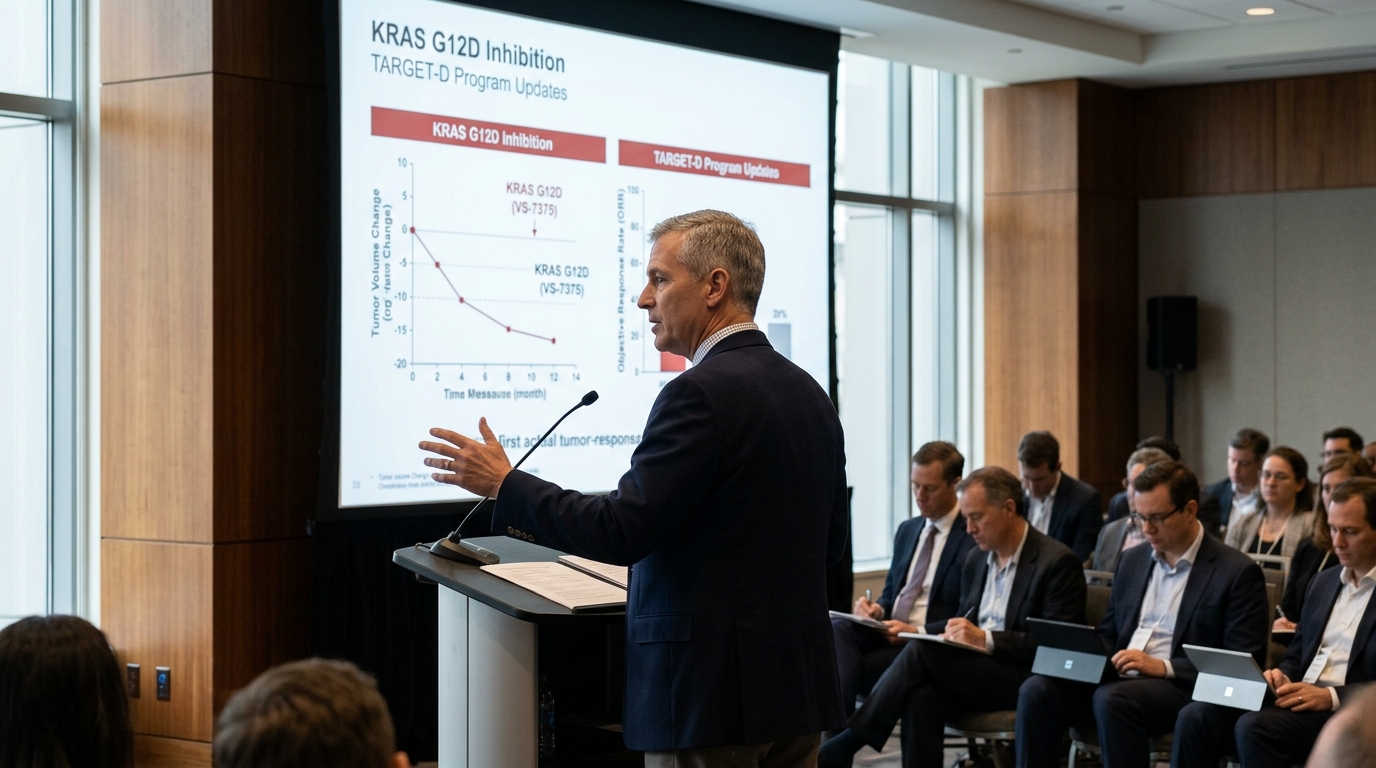
Wednesday at 8:00am ET, Verastem Oncology hosts an investor event to present what the KRAS G12D field has been waiting for: the first actual tumor-response data from VS-7375, its oral KRAS G12D (ON/OFF) inhibitor, in pancreatic, lung, and colorectal cancer from the ongoing TARGET-D clinical development program. Verastem has said it will present initial efficacy and updated safety and tolerability data for VS-7375 in pancreatic, lung, and colorectal cancers from the ongoing TARGET-D clinical development program.
Why the June Data Was Not This Data
The June update moved the stock. It should not have moved it as much as it did, because what Verastem actually showed in June was a tumor marker, not a tumor. With follow-up too short to report a meaningful objective response rate or disease control rate, at 900mg Verastem reported a CA19-9 reduction of more than 50% in 13 of 14 patients, all of whom had a baseline above 37 U/mL and at least one scheduled on-treatment CA19-9 assessment, and all of whom remained on treatment.
CA19-9 falling is correlated with improved outcomes. It is not a confirmed response. With follow-up this short, Verastem could not report a meaningful objective response rate or disease control rate. Wednesday is the first time the market sees whether those CA19-9 declines translated into actual, measurable tumor shrinkage on imaging per RECIST criteria. That gap, between a biomarker signal and a confirmed response rate, is where most biotech disappointments live.
VS-7375 is positioned by the company as a potent and selective oral KRAS G12D dual ON/OFF inhibitor, and it argues the dual inhibition of both ON and OFF states could translate into better in vivo efficacy and durability versus ON-only RAS inhibitors. In the TARGET-D 101 Phase 1/2 study, the company has said monotherapy dose escalation has progressed from 400mg through 900mg once daily without dose-limiting toxicities, and that dose escalation is ongoing at 1200mg once daily. Clean safety at the highest dose tested is real. Response rates Wednesday are a separate matter.
The Competitive Stakes
The backdrop raises both the ceiling and the floor for VS-7375. Revolution Medicines set the bar for KRAS-driven pancreatic cancer in April, reporting that daraxonrasib demonstrated a significant overall survival benefit versus standard-of-care chemotherapy in the Phase 3 RASolute 302 trial, with median overall survival of 13.2 months versus 6.7 months for chemotherapy. Those results were presented in a plenary session at ASCO 2026, and ASCO and FDA summaries describe the survival benefit as statistically significant. That result validated the broader RAS-targeting approach in pancreatic cancer. It also raised expectations for every drug in the field.
Meanwhile, MRTX1133 from Mirati, once the first clinical KRAS G12D inhibitor, had its Phase 1/2 study terminated in early 2025. Verastem is not fighting yesterday’s competition. It is chasing a competitor that already proved the target is real and druggable at the Phase 3 level.
Options Perspective
VSTM closed at $8.38 on October 9 with a market cap of approximately $759 million. Ten analysts polled by S&P Global give VSTM a consensus rating of “Strong Buy” with an average price target of $14.67. BTIG reiterated a Buy and maintained an $18 target on October 8. That spread between current price and analyst targets reflects how much of the VS-7375 thesis is still unpriced.
The options chain ahead of Wednesday supports the binary framing. The $9 calls last traded at $1.27 with open interest of 2,241 contracts, while the $10 calls last traded at $0.90 with open interest of 1,419 contracts, as of October 9. Premium levels suggest the market is pricing a meaningful move without yet committing to direction.
A bull call spread, buying the $9 call and selling the $12 call in the October expiry, defines both the risk and the reward heading into Wednesday’s 8:00am event. The debit paid is the maximum loss. If confirmed response rates in pancreatic cancer approach or exceed what the daraxonrasib program showed before its pivotal trial, the upside is substantial relative to that defined cost. If response rates disappoint relative to the CA19-9 signal, the stock can retrace sharply. Both outcomes are plausible.
The Beast Verdict
This is a clean binary with a hard timestamp. In its Q2 2026 update, Verastem identified updated clinical data for VS-7375 across pancreatic, lung, and colorectal cancers in October 2026 as an expected milestone. Wednesday delivers on that. The June CA19-9 data was suggestive. Confirmed radiographic responses in second-line pancreatic cancer, at rates competitive with what Revolution showed early on before its pivotal trial, would be a step-change event for a company still priced well below analyst consensus.
The risk is equally clear. CA19-9 reductions do not guarantee tumor shrinkage. Follow-up at 900mg was thin in June. A weak confirmed response rate, or an unfavorable safety update, puts the stock at risk of giving back most of its 2026 rally. Size accordingly: define the loss before the event, not after it.