If you haven’t downloaded my “Top 10 Stocks to Buy This Quarter” report yet, please do it right now.
It takes about five seconds.
And once we swap in next quarter’s list, this edition won’t be available anymore.
Good Trading,
Bill Poulos
p.s. It’s the 10 stocks we like most right now, each one explained in plain English. Normally $29.97. Free here.
SpaceX Tower Talks Add Billions in Lease Costs
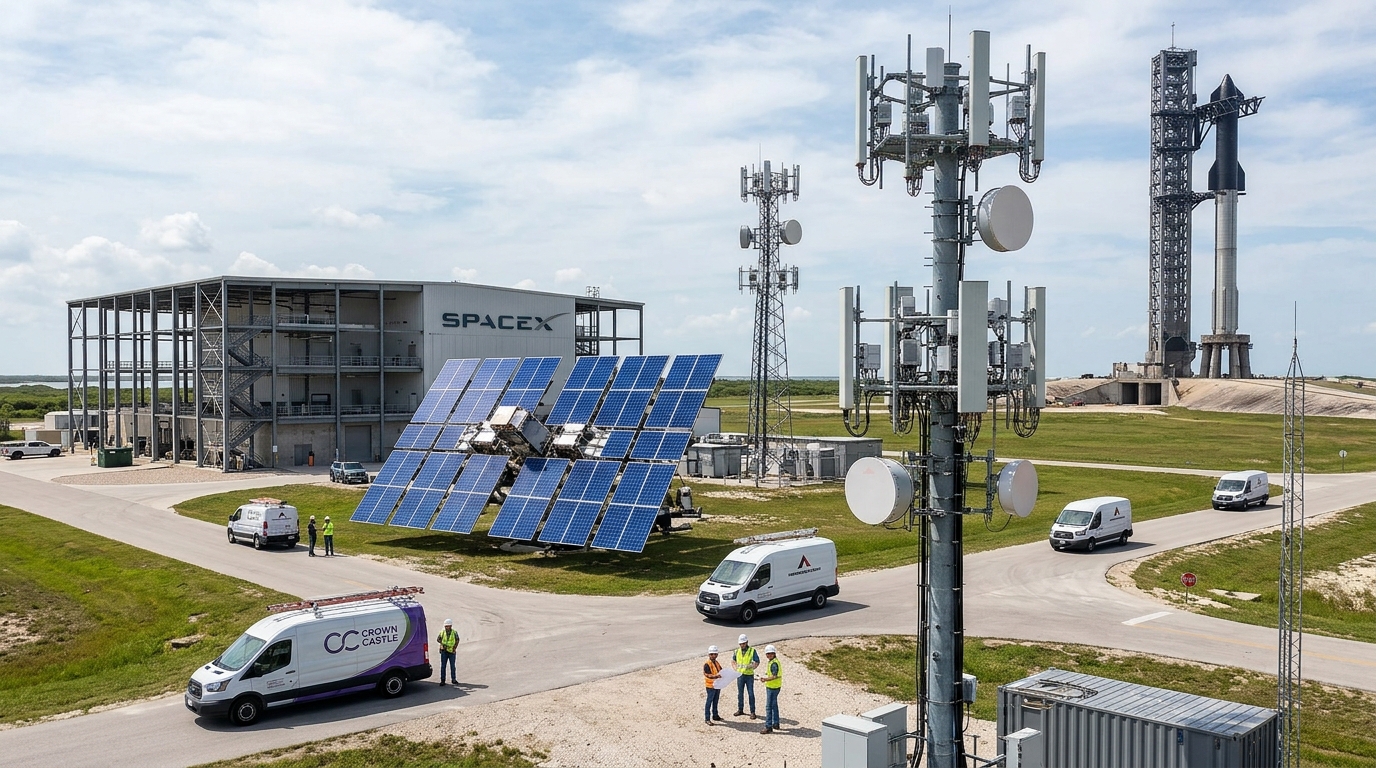
The number that moved markets Friday was 80,000. That is how many US cell sites SpaceX is negotiating to access, Bloomberg reported Thursday evening, as Starlink Mobile pushes toward becoming the country’s fourth nationwide wireless carrier. Crown Castle jumped more than 11%, American Tower gained about 5%, and SBA Communications rose roughly 5%. AT&T shed nearly 8%, T-Mobile dropped 5%, and Verizon slipped roughly 1.6% heading into its Q3 report Monday morning.
But the market spent Friday debating the wrong question. The real issue is not whether tower REITs win or carriers lose. It is what this lease campaign does to the SpaceX financial model that public investors received just weeks ago.
The Story Behind the Trade
Eighty thousand sites would represent about half of all the purpose-built cell towers in the US, which numbered 158,500 in 2025 according to the Wireless Infrastructure Association. Crown Castle runs roughly 40,000 US towers, American Tower about 42,000, and privately held Vertical Bridge around 18,000. Leasing across all three to hit the target means SpaceX is not cherry-picking cheap rural sites. It is building a grid.
The potential leases reportedly could run into the billions of dollars. That is not a rounding error on a corporate budget. SpaceX reported $6.8 billion of operating cash flow for 2025. But beyond that, the specific claims about SpaceX’s cash falling from $24.7 billion to $15.9 billion in a single quarter and Q1 capex reaching $10.1 billion cannot be verified from SpaceX’s public filings, so those figures should be treated as unconfirmed. Even without them, a multi-billion annual tower obligation would add a meaningful fixed cost layer on top of a business that is already capital intensive.
SpaceX previously committed approximately $17 billion to acquire AWS-4 and H-Block spectrum licenses from EchoStar, alongside a follow-on $2.6 billion agreement for additional EchoStar holdings. On October 8, 2026, the company agreed to acquire up to 14 MHz of paired, nationwide 800 MHz spectrum from Grain Management, pending FCC approval, with Reuters reporting that the Wall Street Journal put the price at about $8 billion in cash. Spectrum alone has already consumed roughly $27 billion. Towers are the next line item.
Bernstein estimates a competitive nationwide mobile network could cost $50 billion to $130 billion to build. SpaceX is not building from scratch, but the tower commitment is the first concrete signal of what the terrestrial half of that equation actually costs.
Technical and Fundamental Alignment
No tower lease has been signed. The Bloomberg report relies on unnamed sources, and SpaceX has not commented. That matters for sizing and timing. A headline-driven spike has historically been prone to fading, especially when the news describes a negotiation rather than a signed lease. Crown Castle is down roughly 20% over the past year, so part of Friday’s move is a rebound.
The timing of any signed lease also intersects with a separate supply-side pressure on SPCX shares. SpaceX’s prospectus-documented unlock schedule releases tranches of locked shares through October and December, adding a predictable headwind to any tower-driven rally.
On the carrier side, Verizon reports Q3 before the open Monday, October 26, 2026. Analysts expect EPS of $1.27 and revenue of about $34.85 billion. SpaceX’s tower pursuit landed Thursday night. The management team will face questions about competitive response before the quarter’s numbers have a chance to matter.
Options Perspective
The trade here is not in the tower REITs, where the easy money already ran Friday. The sharper opportunity is a defined-risk put spread on VZ into Monday’s report. Verizon’s stock rose 5.84% the day after its July 24, 2026 report and 11.83% after its January 30, 2026 report, so the name can move. But that was before SpaceX’s terrestrial buildout became front-page news. Any guidance commentary that sounds defensive on competitive positioning is the catalyst for a sell-the-news reaction, regardless of whether the quarterly numbers beat.
The volatility dynamic here mirrors a pattern seen at other inflection points. Post-IPO options pricing on SPCX showed how a structurally new competitor can reprice implied volatility across an entire sector.
A two-week bear put spread on VZ captures event risk and the lingering SpaceX overhang without open-ended downside. Implied volatility on telecom names remains elevated after Friday’s sell-off, which compresses the net debit on a spread while still delivering meaningful reward if the stock gives back another 3-4% on cautious management commentary.
Risk Management
The primary risk is a blowout Verizon quarter paired with aggressive subscriber guidance that shifts the conversation away from SpaceX. Verizon raised its full-year guidance for the second consecutive quarter in 2026. A third would squeeze the short side hard. Position sizing at 1-2% of portfolio risk is appropriate. Crown Castle carries about 6.5x net debt to adjusted EBITDA and no lease is signed, meaning tower enthusiasm could reverse fast if negotiations stall.
The Beast Verdict
SpaceX is building a carrier the way it builds rockets: by committing capital before the critics believe the timeline is real. Eighty thousand cell sites is not a signed deal, but it is a reported negotiating target with a dollar sign attached. Verizon walks into earnings Monday carrying that weight, and options are pricing only a modest move. The asymmetry favors the put spread. Watch Monday’s call for any mention of accelerated network investment or revised competitive assumptions. That is the tell.