
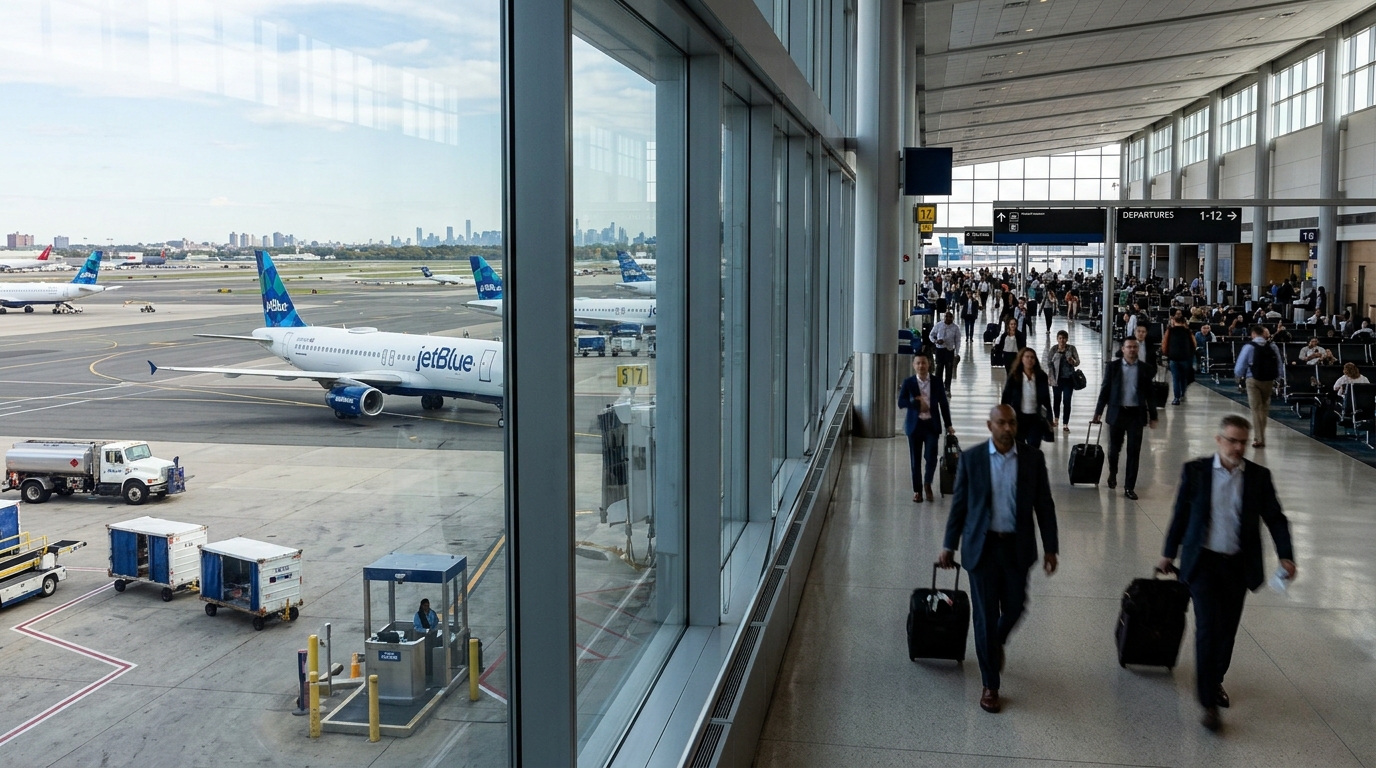
A stock that moves 40% in eleven days is not a stock you buy outright. It is a stock you use options to trade.
Shares of JetBlue are up about 40% so far this November. That is real. So is the reason it had so far to run: JBLU hit a 52-week low of $2.16 intraday on October 26, 2026. From catastrophe-pricing to $4 in barely two weeks is a sharp reversal, but it does not mean the underlying problem has been solved. The stock is still trading about 40% below its 52-week high of $6.62.
Why This Trade Stands Out
Today’s catalyst is live and named. JetBlue CEO Joanna Geraghty is scheduled to join CNBC’s Phil LeBeau Wednesday. Any update on liquidity, creditor talks, or Q4 unit revenue guidance lands directly into a stock that has already proven it can swing violently in a single session. That is not a reason to sit on the sidelines. It is a reason to define your risk before the interview begins.
The Story Behind the Trade
The month started badly. Creditors, including holders of JetBlue’s $2 billion in bonds due 2031 and a roughly $742 million first-lien loan, hired restructuring adviser PJT Partners and law firm Akin Gump, Bloomberg reported in late October. Hiring restructuring advisers does not necessarily mean a bankruptcy is imminent, but it suggests creditors are preparing for negotiations over how much of their money they can realistically recover.
Geraghty pushed back hard on those concerns on CNBC after the late-October stock slide. She said JetBlue had no intention or plans to file for bankruptcy and said the company was not engaged with any restructuring company. The market responded: shares rose nearly 19% on what became their biggest one-day advance since April 2025.
The bull case leans heavily on fuel. Brent crude, which had been a punishing headwind earlier this year after spiking above $110, briefly fell below $90 a barrel on Tuesday, with Brent settling at $91.49. Brent’s price has fallen more than 14% from its early-November levels. For an airline losing money on every gallon burned, that matters. The bear case is the balance sheet: JetBlue carried $8.393 billion in total debt as of September 30. Its net loss for the first nine months of 2026 nearly doubled to $823 million. Cheaper fuel helps the income statement going forward. It does not retire a dollar of that debt.
CreditSights warned in an October report of a potential liquidity crunch by late 2027, examining downside scenarios involving JetBlue’s loyalty-backed debt. A potentially more realistic middle ground is an out-of-court restructuring, allowing JetBlue to negotiate with creditors without formally entering Chapter 11. The stock can keep rallying while that possibility remains open. It can also reverse sharply if Geraghty’s remarks today disappoint.
Technical and Fundamental Alignment
The technical picture is two-sided. The bounce off the 52-week low is dramatic enough to suggest genuine short covering and momentum buying. The 50-day moving average sits around $3.81, the 200-day around $4.87. At $4, JBLU is squeezed between those two averages: above the shorter-term trend and well below the medium-term trend. Any negative word from Geraghty today, or any hedge fund deciding the rally has run its course, compresses the stock back toward the lower range fast. The fundamentals confirm the tension: revenue per seat mile improving, debt nowhere near resolved.
Options Perspective
This is where the edge lies. JBLU options have historically shown elevated implied volatility relative to realized movement. With a live CEO appearance and unresolved creditor questions, the stock could gap 10% to 15% in either direction before the week is out. Buying shares here means absorbing full downside if the creditor story returns to the front page. A defined-risk debit spread captures the same directional move for a fraction of the capital at risk.
The trade: a December call debit spread, buying the $4 call and selling the $5 call. With JBLU near $4, the $4 strike is at the money, and the spread costs roughly $0.35 to $0.45 depending on fills. Maximum loss is the premium paid. Maximum gain near $0.55 to $0.65 if JBLU closes above $5 at December expiration. That is better than a 1:1 reward-to-risk ratio with the upside catalyst happening today and Q4 revenue data as the next confirmation point. Keep position size small. This is a catalyst trade, not a conviction hold.
Risk Management
The thesis breaks if Geraghty’s comments on CNBC today introduce any ambiguity around liquidity or if she acknowledges conversations with creditors. It also breaks if Brent reverses back toward $100 on fresh Iran tensions, which have already proven capable of moving oil $20 in a week this year. Bloomberg reported that JetBlue was in compliance with debt covenants as of mid-2026, but falling below the threshold and failing to remedy the breach could trigger a default, giving creditors additional leverage just as the airline needs financing most. That risk does not disappear with a good TV appearance.
The Beast Verdict
JetBlue today is a story built on a single word: momentum. The fuel tailwind is real, the revenue improvement is measurable, and the CEO is making her case publicly. But $8.393 billion in debt, creditors with advisers on retainer, and a stock still about 40% off its high do not add up to a situation where you want naked equity exposure. The December $4/$5 call spread gives you participation in a continued rally, holds your loss to the premium, and lets the CNBC appearance do its work without putting your capital at the mercy of whatever Geraghty says in the first sixty seconds. That is the trade.