Have you seen THIS video yet?
It’s making the rounds online by highlighting a simple secret to booking a private jet… for as little as $169.

If you have a flight coming up anywhere within the next year… DO NOT BOOK IT.
Watch this video first and learn more about how to skip the lines, hidden fees and cancelations.
P.S. The private jet hack is just one secret revealed by a 30-year travel writer in THIS video. Travel-industry insiders hate it, but countless travelers have already watched it. See what all the fuss is about by clicking here now.
Carvana’s $800M Quarter Should Silence the Credit Bears. The Options Market Hasn’t Caught Up.
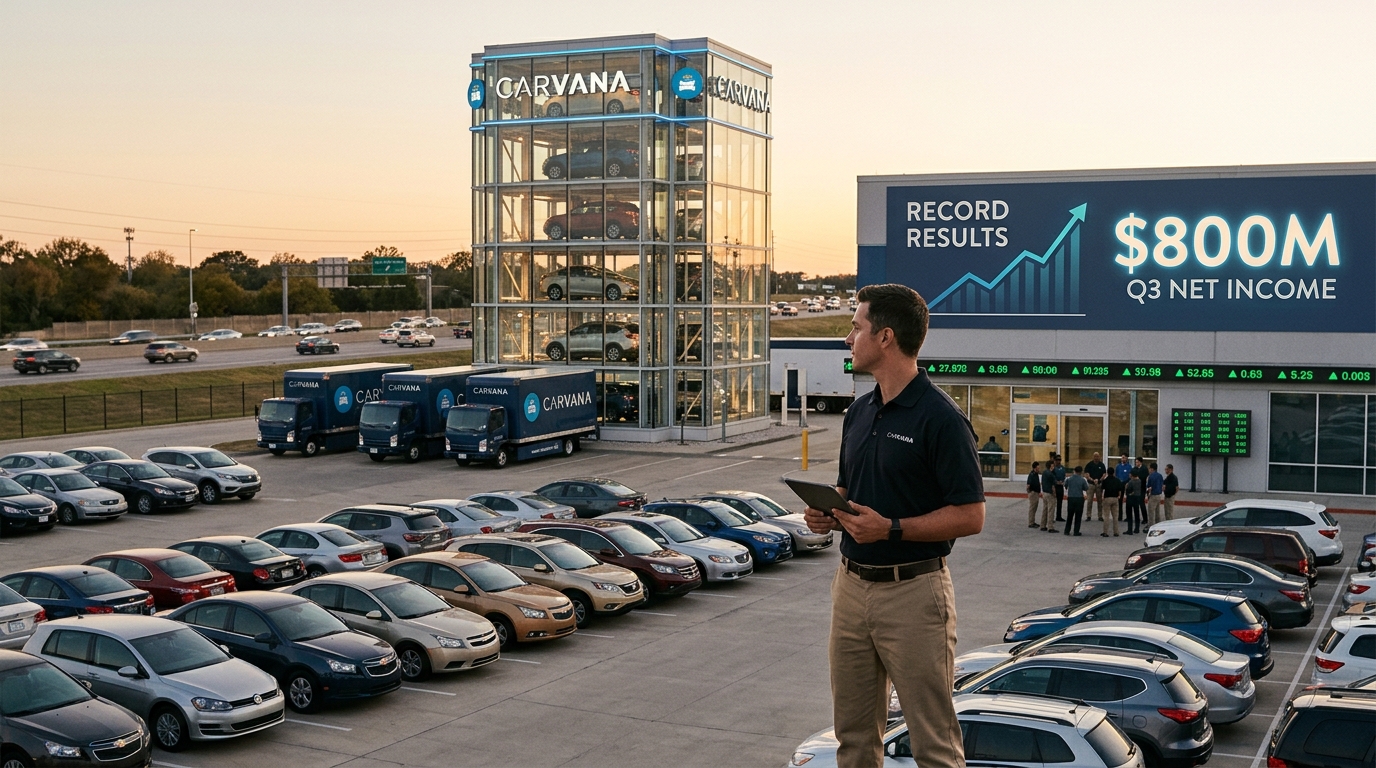
Going into Tuesday’s close, the options market on Carvana had puts outnumbering calls at a ratio of 1.21 to 1, with implied volatility sitting at 75 and the stock trading just above its 52-week low. The fear was priced in. Then the numbers came out.
Carvana reported 217,385 retail units and $8.04 billion in revenue for Q3 2026, both all-time quarterly records, alongside net income of $483 million and record adjusted EBITDA of $800 million. CVNA moved about 8% higher after hours, following a 0.30% decline to $59.05 in the regular session. That move landed well inside what the market had priced: options were pricing a 50% probability of a move exceeding 14.88%, or about $8.78 per share. The bears got neither the collapse they hedged for nor the ambiguous report that keeps doubt alive.
What the Numbers Actually Say
Carvana is the fastest-growing automotive retailer with eight consecutive quarters of approximately 40% growth in an industry that’s flat. That fact tends to get buried under the debt discussion. It shouldn’t. The company ended Q3 with net debt equal to 0.8 times trailing 12-month adjusted EBITDA and adjusted EBITDA covering interest expense by 6.9 times, both company records. At 5% Treasuries, a business generating $800 million of adjusted EBITDA in a single quarter and carrying net leverage below 1x is not a credit story. It’s a growth story that got mispriced as a credit story.
Net income climbed to $483 million despite a $53 million one-time debt-redemption expense. Strip that out and the underlying earnings power is larger still. Management said full-year 2026 adjusted EBITDA should come in at the higher end of its previously guided range of $2.7 billion to $3.0 billion.
The Real Constraint: Supply, Not Demand
Here is the part the bears consistently miss. Management framed the quarter as evidence that Carvana’s operating model can keep scaling, while stressing that execution, not demand, is the main constraint. Management said it wants inventory availability to grow faster. While Carvana slightly outproduced retail unit sales in Q3, the growth rate of vehicles immediately available on the website remains below the company’s sales growth rate. Garcia said the company would add thousands more reconditioned vehicles immediately if it could, but increasing capacity requires continued work in its inspection and reconditioning centers.
That is a meaningful distinction. A demand problem means the growth rate slows as the cycle turns. A supply problem means the growth rate is a floor, not a ceiling. Management said the company remains focused on building a business capable of selling 3 million vehicles annually while reaching a 13.5% adjusted EBITDA margin. With just 2% of the used-car market and 1.5% of the overall automotive market, Carvana positioned itself as still early in its growth trajectory despite achieving meaningful scale.
Supply constraints driving growth ceilings higher are not unique to automotive. Ross Stores showed the same dynamic when customer traffic, not pricing power, drove a record off-price quarter while the market underestimated the runway.
The Options Opportunity
The stock closed October 28 at $59.05, down 39% from its January 2026 high of $97.38. The after-hours move recaptures roughly $4.40 of that gap. Implied volatility sat at 75.16 heading into earnings, well above the 52-week median. After the result, that IV crushes, which is the mechanic that makes a near-term long call or a bull call spread attractive: you bought the vol when fear was rich, the underlying moves in your direction, and the position benefits from both delta and the direction of sentiment.
The preferred structure here is a bull call spread expiring in late November, targeting a move back toward $72 to $75. The spread caps the premium at risk, which matters because CVNA carries a beta above 3 and can reverse sharply. Define the risk before the trade begins. The revenue beat of $8.04 billion against a $7.67 billion estimate drove the initial move, and market share gains at scale are the thesis that sustains it. The invalidation is simple: a broader equity selloff or a reversal of the after-hours gain on the open. Neither changes the fundamental read on the quarter.
The Beast Verdict
Carvana delivered the quarter credit-bears said was impossible at 5% rates. The balance sheet is cleaner than it has ever been. The growth constraint is reconditioning throughput, not consumer demand, which means the growth rate expands as capacity comes online rather than contracting with the cycle. Management expects a sequential increase in retail units sold for the final quarter of the fiscal year. The stock is still 39% below its 52-week high. The options market feared the worst and got the best. That gap between fear and fact is where this trade lives.