
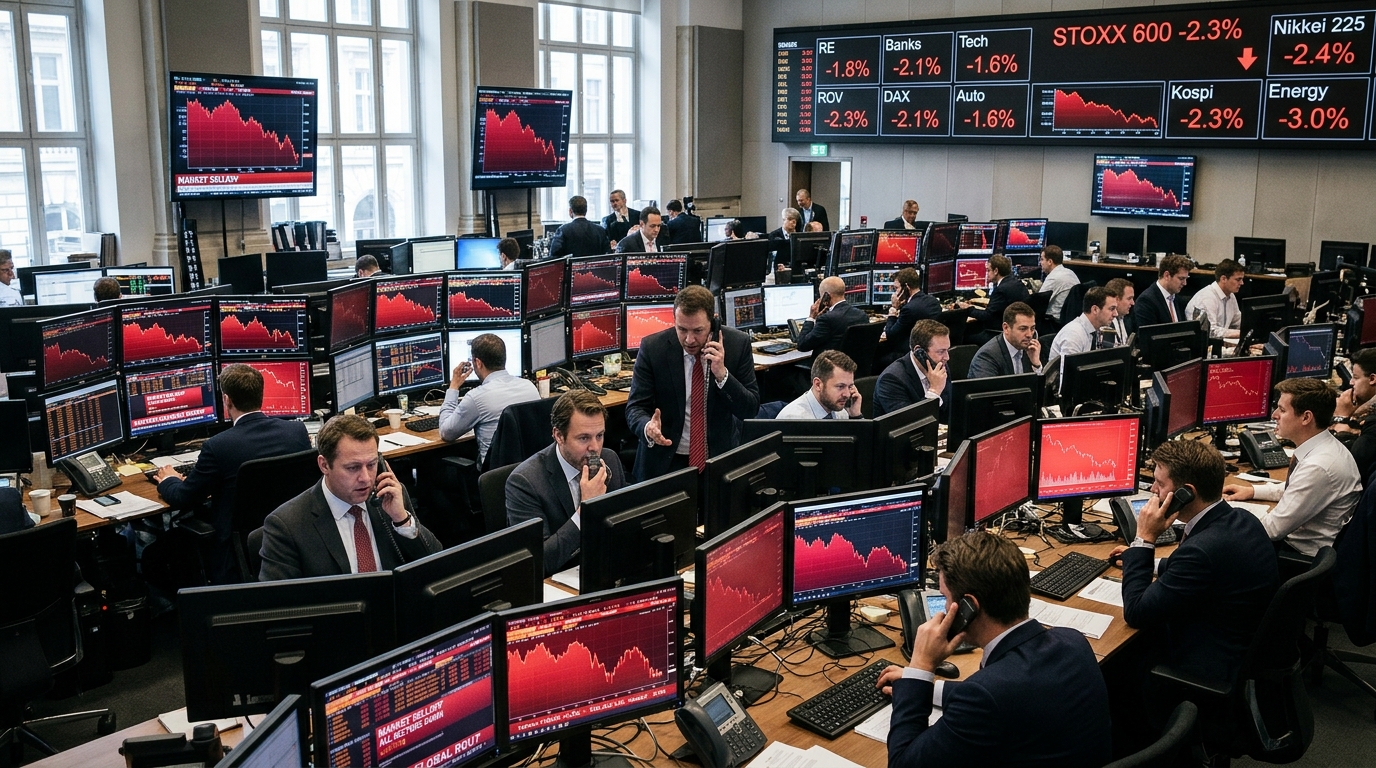
The diversification trade broke down in real time this morning. Europe was supposed to absorb some of the damage from Thursday’s Wall Street rout. Instead, European shares joined the global selloff, wiping out their weekly gain as concerns over the Democratic sweep of Congress and its implications for the artificial intelligence trade triggered losses across sectors. Every sector. That is the number to sit with.
The pan-European Stoxx 600 dropped 1.6% to 644.72 points by 0810 GMT, with benchmarks in most major regional markets also lower by more than 1% each. Media, healthcare, and retail led broad-based declines, falling over 2% each. These are not AI-adjacent businesses. The contagion is no longer selective.
The selloff that produced Thursday’s carnage on Wall Street was already severe. The Philadelphia Semiconductor Index sank 12.25% on Thursday and the three main US averages logged their worst single session since April 2025, after midterm elections handed Democrats control of both the Senate and the House. The Cboe Volatility Index jumped about 70% Thursday to close at 28.18, its highest finish since March 30, 2026. That fear did not stay in New York.
Overnight, it went further. Japan’s Nikkei 225 fell about 6% on Friday, November 6, leaving it more than 20% below its June peak, which meets the conventional definition of a bear market. The gap in performance between the tech-heavy Nikkei and the broader Topix has widened, hinting at how heavily the selling has focused on technology stocks. In Seoul, the damage was blunter: South Korea’s Kospi gauge plunged as much as 8.8% at one point, triggering a trading halt and briefly falling below the closely watched 5,000 level. In South Korea, where chip firms SK Hynix and Samsung Electronics have been major winners of the AI era, stocks fell so much a circuit breaker was triggered.
South Korea and Taiwan are not peripheral to this story — they are the physical manufacturing layer of the AI trade. SK Hynix and Samsung had built their entire profit cycle around AI memory demand that a regulatory clampdown on data-center buildouts would directly threaten.
The catalyst is a political one. The Associated Press reported Friday that after a campaign season filled with outrage against data centers, the midterm elections ushered in a wave of Democrats pledging to clamp down on the energy-hungry buildout. Markets hate regulatory uncertainty more than they hate bad earnings, and that is what is now being priced.
For options traders, the instrument that captures this most cleanly is SMH, the VanEck Semiconductor ETF. SMH fell 11.21% Thursday. The fund has long been a favored destination for market participants seeking multi-stock exposure to the AI infrastructure trade. The Philadelphia Semiconductor Index is down about 12% this week, putting it on track for its worst weekly performance since April 2025.
The options market has reacted accordingly. Reports Thursday said investor Michael Burry reduced his SMH put position by 25% to lock in partial gains as US technology stocks sold off. That trim is not a capitulation; it is profit-taking after a correct directional call. His remaining short position still stands, as reported.
Here is the trade worth considering now. With implied volatility elevated after two brutal sessions, a bear put spread on SMH gives defined-risk short exposure without paying the full premium of a naked long put. Buy a put at a strike near current levels, sell one roughly 10% lower to cut cost. The spread profits if SMH continues to slide toward the lows implied by a genuine regulatory regime change, while the short put leg caps maximum profit and the maximum loss is limited to the net debit paid. Time decay works against both legs, keeping theta drag more manageable than a standalone long put.
What would invalidate this? A bipartisan compromise on data-center permitting, a reversal in Democratic rhetoric, or a sharp reversal in US equity futures could all stabilize the chip complex quickly. Regional stocks did pare some losses amid a recovery in US equity futures, with S&P 500 futures modestly higher early Friday. The bounce is real but it has not changed the political calculus. Watch whether Democratic leadership quantifies any proposed data-center moratorium in the coming days. That is the binary that moves this trade.
Diversification failed this week because the selloff was thematic, not geographic. When a single political event resets the infrastructure layer of the global economy, there is nowhere to rotate that the damage does not follow. The Stoxx 600’s weekly gain evaporated in one session. That is the evidence. Position accordingly, with risk defined before you enter.