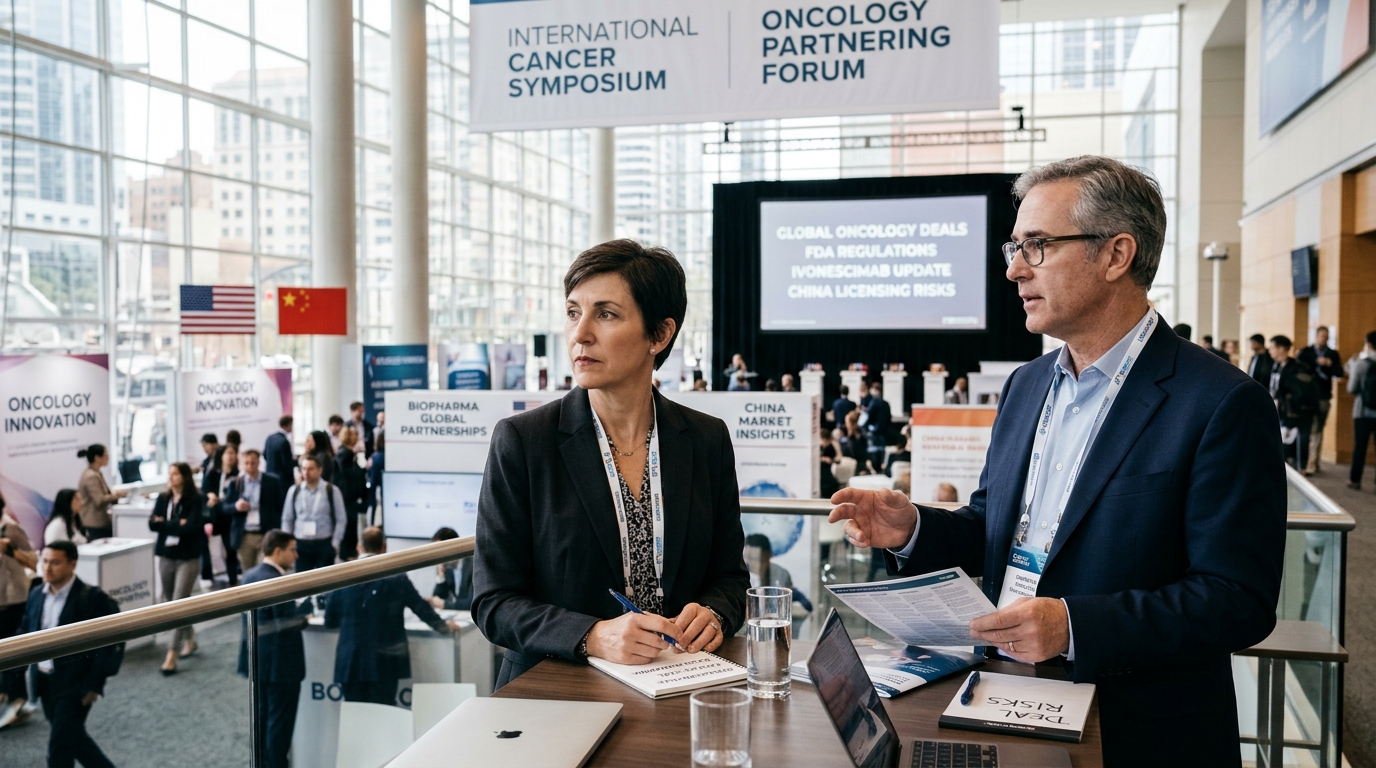
The FDA’s decision to reject ivonescimab lands not just on Summit Therapeutics and Akeso but on an entire dealmaking thesis that has absorbed more capital than any other bet in modern pharma.
The Verdict
Summit Therapeutics announced on November 15, 2026, that the US Food and Drug Administration issued a complete response letter for its ivonescimab application in lung cancer after prior EGFR tyrosine kinase inhibitor therapy. The ground was narrow but unambiguous: the FDA said substantial evidence of effectiveness was not established without a statistically significant overall survival improvement, and that a progression-free survival benefit without a statistically significant overall survival result does not support a positive benefit-risk profile for approval.
The HARMONi numbers tell the story plainly. Ivonescimab clearly slowed disease progression (median progression-free survival 6.8 versus 4.4 months, hazard ratio 0.52), but the primary survival analysis missed significance (median overall survival 16.8 versus 14.0 months, hazard ratio 0.79, p=0.057). Later data cuts improved the survival signal, but these were described as nominal and did not persuade the FDA.
Why Wall Street Cares
This rejection is the first regulatory verdict on the PD-1xVEGF bispecific class, the most aggressively licensed category in oncology. Through the third quarter, China-origin assets accounted for 51% of big pharma licensing deals with at least $50 million upfront and 65% of the upfront dollars in those deals, according to a J.P. Morgan biopharma licensing report.
The three anchor deals alone are staggering: AstraZeneca with CSPC Pharmaceutical Group (up to $18.5 billion), Hengrui Medicine with Bristol-Myers Squibb (up to $15.2 billion), and Innovent Biologics with Pfizer (a multi-program collaboration with financial terms that Pfizer has not described as a single $10.5 billion headline figure in its announcement).
The underlying commercial logic was always that Chinese companies could generate proof-of-concept data at a fraction of Western costs, and that FDA approval was an execution problem rather than a scientific one. The ivonescimab letter challenges that assumption directly.
The Bull Case
Market watchers view the FDA rejection as a temporary setback, expecting ivonescimab to come good in follow-up filings. Summit did not announce a resubmission plan, but its first-line HARMONi-3 study remains the most important US programme for the drug. If HARMONi-3 delivers a survival result, the FDA’s objection disappears.
Supporters of the broader China-licensing wave point out that most of the mega-deals signed in 2026 involve multi-program portfolios, not single late-stage assets dependent on one readout. Diversification, the argument goes, is built in.
The Bear Case
The more uncomfortable reading is that ivonescimab is not an isolated data point. Hengrui Pharmaceuticals’ camrelizumab combination for hepatocellular carcinoma received complete response letters from the FDA on three separate occasions: May 2024, March 2025, and July 2026. Those letters were tied to manufacturing and inspection issues rather than a failure of clinical efficacy, but they still underline how fragile the US translation path can be.
According to Summit, the FDA had previously warned the company about this overall survival requirement as early as May 2025. The agency flagged it, Summit filed anyway, and the rejection followed exactly the stated logic. That sequence makes it difficult to argue the bar was unclear.
What Investors Are Missing
The debate is focused almost entirely on ivonescimab’s resubmission path. The larger question is what this verdict does to the FDA’s posture toward the entire PD-(L)1xVEGF class. The novel, hotly pursued class of PD-(L)1xVEGF-targeting bispecific antibodies has now received its first complete response letter from the US FDA. The delay could help other companies developing PD-(L)1xVEGF drugs in mid- to late-stage clinical testing close the gap.
Pfizer, for one, paid $1.25 billion upfront to 3SBio for a PD-1/VEGF bispecific in May 2025. That asset now has a clear blueprint for what the FDA will and will not accept.
Stocks to Watch
- SMMT (Summit Therapeutics): The CRL removes near-term revenue, but HARMONi-3 squamous cohort data and AstraZeneca’s $2 billion equity stake provide a runway. The stock is a binary on first-line survival data.
- MRK (Merck): Ivonescimab’s absence leaves one less competitor in EGFR TKI-pretreated NSCLC. Every month of delay extends Keytruda’s unchallenged position in first-line NSCLC.
- BMY (Bristol Myers Squibb): Its up to $15.2 billion Hengrui deal is now being read through a more skeptical lens. The assets are early-stage, but investor confidence in the FDA translation story has taken a concrete blow.
- PFE (Pfizer): The Innovent portfolio deal and the 3SBio PD-1/VEGF asset both sit in a category the FDA just rejected once. Pfizer’s clinical teams will be rewriting their regulatory strategies this week.