
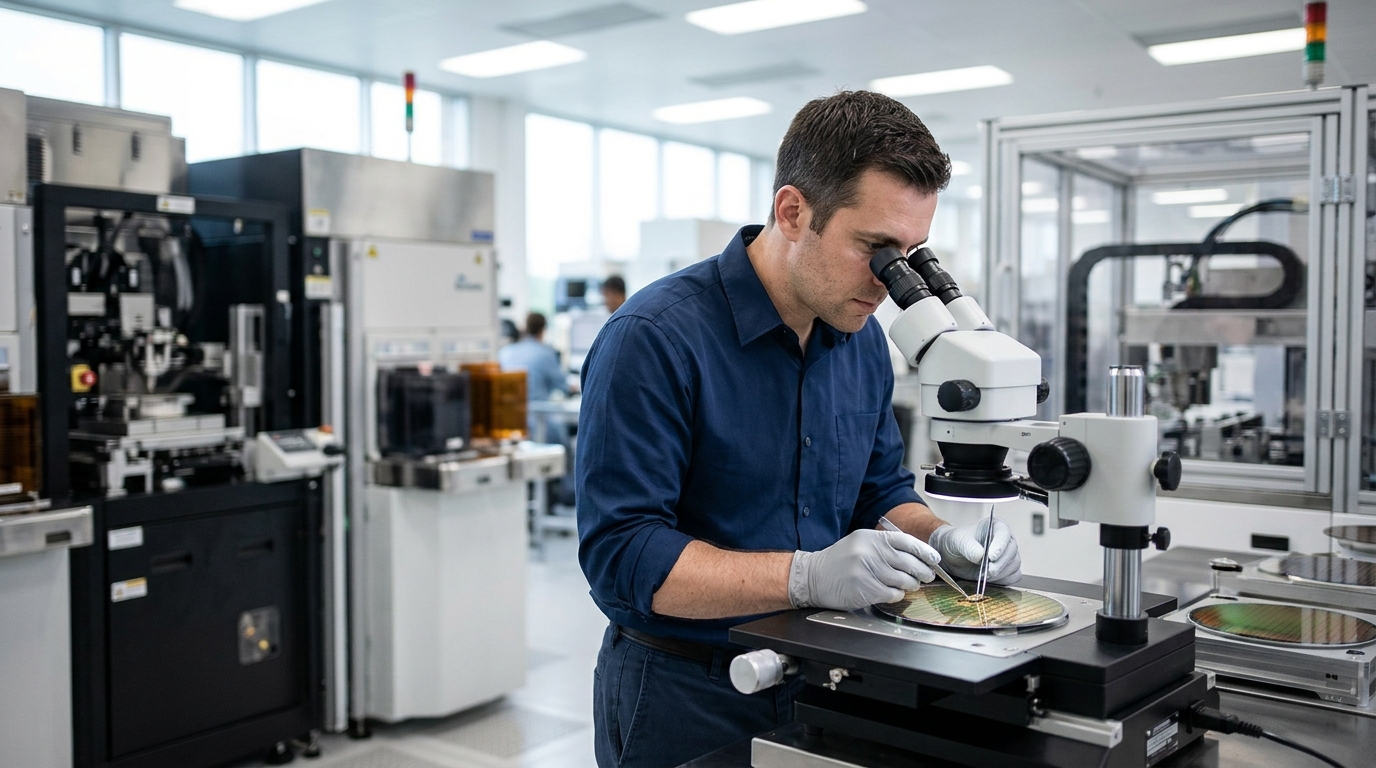
Applied Materials generated record Q4 revenue of $10.409 billion. On a GAAP basis, the company reported gross margin of 50.4% and operating income of $3.66 billion. On a non-GAAP basis, it posted a record operating margin of 35.3% and record EPS of $4.16. The stock fell 2.8% the following day. It now trades roughly 50% below its 52-week high of $739.67.
That divergence between the business and the stock price is the entire story.
The Business
Applied Materials builds the machines that make AI chips possible. It leads in the most critical areas of wafer fabrication equipment: DRAM, advanced packaging, and leading-edge logic. Management says the company is on track to grow its Semiconductor Systems business more than 40% in calendar 2026. Applied delivered record fiscal 2026 revenue of $34.446 billion, up 21% year over year, with non-GAAP EPS growing 37% to $12.89.
Q4 Semiconductor Systems revenue hit a record $8.0 billion, up 14% sequentially and 64% year over year, with record sales in Korea and Taiwan and record revenue in DRAM and advanced packaging. Advanced packaging revenue was up around 90% in calendar 2026, and the company said it is on track to increase inspection and metrology revenue more than 50% in calendar 2026. Applied Materials achieved its 14th consecutive quarter of year-over-year gross margin expansion, with Q4 non-GAAP gross margin at 50.6% and operating margin at a record 35.3%.
Why Wall Street Is Paying Attention
Applied Materials guided for first-quarter revenue of $11.1 billion, plus or minus $500 million, versus estimates of $10.89 billion. The company anticipates first-quarter adjusted earnings of $4.35, plus or minus $0.20, versus estimates of $4.26 per share. That is not the guide of a company losing momentum. Free cash flow reached $6.196 billion for the full year, with $2.6 billion in Q4 alone, and the firm returned $3.18 billion through buybacks across the year.
What Could Go Wrong
China is the central overhang. Applied Materials has flagged China export controls as a meaningful constraint on its China-related business, and China’s share of Q3 revenue fell to 28% from 35% a year earlier. In February 2026, Applied Materials entered a settlement agreement with the Commerce Department Bureau of Industry and Security to resolve an export controls inquiry, agreeing to pay $252.5 million. Further restrictions on mature-node equipment or advanced packaging tools would materially reduce Applied’s addressable market in China, and BIS can expand controls faster than companies can redirect revenue.
Any additional tightening of export rules, which have expanded scope repeatedly, could carve more revenue from the business before AI demand in Korea, Taiwan, and the United States fully compensates.
The Bottom Line
At roughly $370, Applied Materials trades at about 29 times fiscal 2026 non-GAAP EPS of $12.89. Record revenue, record free cash flow, and Q1 guidance above consensus do not describe a business in structural decline. The China risk is real, and the export restriction hit is not hidden exposure. What the current price is offering is the chance to own the leading semiconductor equipment franchise in the world at a valuation that treats the worst-case export scenario as the permanent state of affairs. The gap between $370 and $739 reflects fear, not fundamentals.