TITLE: Also Inc. Is Shipping. The E-Bike Is Not the Point.
SUBTITLE: A $1B Rivian spinoff is nearing first e-bike deliveries. Amazon and DoorDash are what matters.
BODY (HTML):
The Bike Is the Proof. The Quad Is the Business.
On the last day of July, a startup most investors have never heard of quietly began moving from promise to product. No press conference. No ticker symbol. Just the kind of update early customers watch closely: confirmation that the Launch Edition TM-B e-bike was beginning the process of shipping to the United States for final delivery.
The company is Also Inc., a Palo Alto-based micromobility startup born inside Rivian. And while the headline is about a delayed consumer e-bike finally moving, the actual story is about last-mile logistics, Amazon, DoorDash, and a $305 million bet that the hardest unsolved problem in urban delivery may have a two-wheeled answer.
Market Temperature
Rivian recently reported results for its second quarter of 2026, alongside an operational update: the company said Q2 deliveries exceeded its 9,000 to 11,000 outlook due to growth in EDV and R1 plus the introduction of R2 deliveries. Rivian also raised full-year 2026 delivery guidance to 65,000 to 70,000 vehicles.
That reaction tells you something. The market is watching Rivian through a narrow lens: vehicles delivered, losses narrowed, cash consumed. What it is mostly ignoring is the ecosystem Rivian CEO RJ Scaringe has been quietly assembling off to the side, one spinout at a time.
Also is the most important piece of that ecosystem right now. And this week, it crossed its first concrete threshold.
What Also Actually Is
Also began in 2022 as a skunkworks project inside Rivian, with Scaringe exploring whether an e-bike could complement a lineup of electric trucks and SUVs aimed at adventurous consumers. The idea grew. Rivian brought in Jony Ive’s design firm LoveFrom for an early collaboration. The project eventually became too distinct to live inside the parent company’s structure.
In March 2025, Rivian spun Also out as its own company, seeding it with $105 million alongside venture firm Eclipse. Rivian retained a substantial minority stake. Scaringe joined Also’s board as chairman.
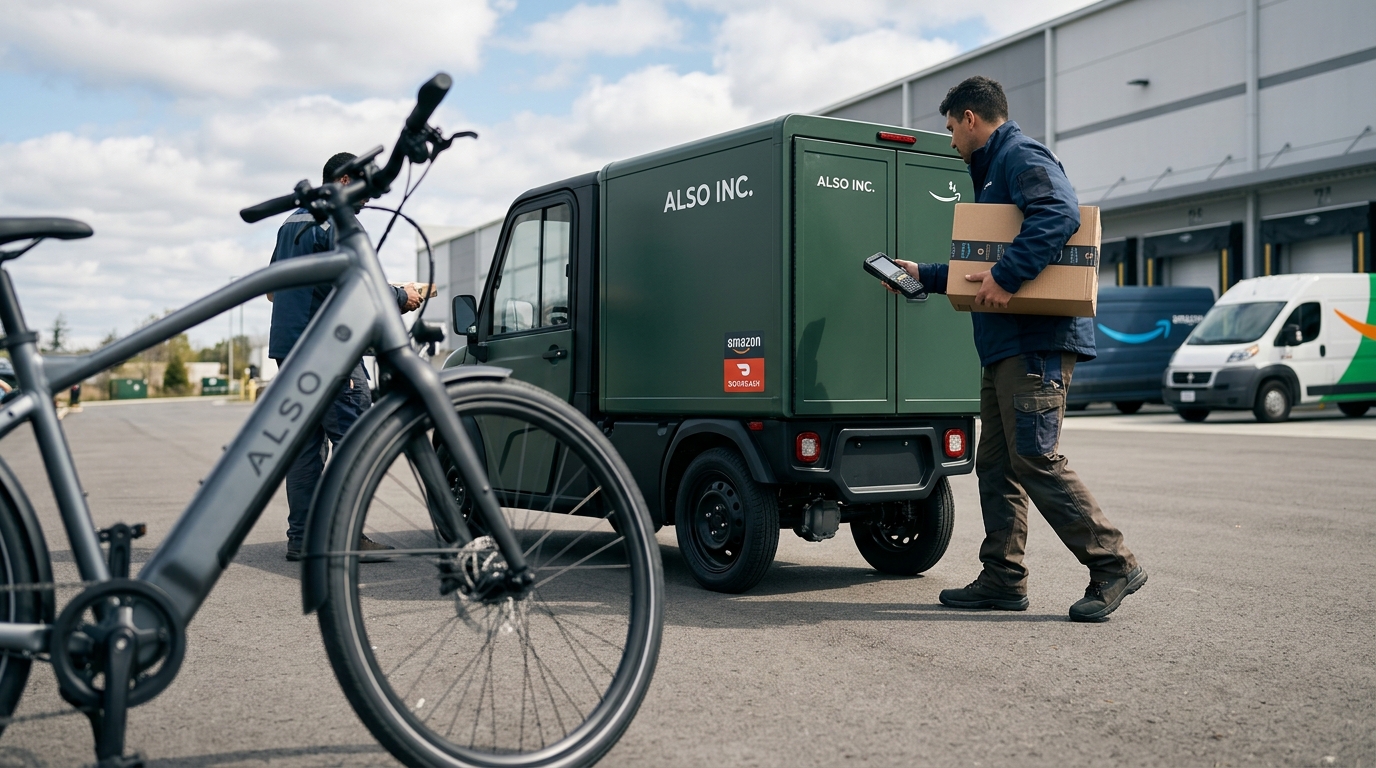
By October 2025, Also had unveiled its product lineup: the TM-B e-bike, a consumer quad called the TM-Q, and a commercial TM-Q designed for logistics. Alongside the launch, Also announced a multi-year collaboration with Amazon to develop a custom pedal-assist e-cargo quad, with plans to expand Amazon’s micromobility fleet to thousands of units across Europe and the U.S.
Then, in March 2026, Also closed a $200 million Series C led by Greenoaks Capital. DoorDash co-invested and signed a multi-year commercial agreement to develop autonomous delivery vehicles. DoorDash Co-Founder Stanley Tang joined Also’s board as an observer. Total funding reached $305 million. Valuation: $1 billion.
That is a lot of institutional conviction for a company that had not yet shipped a single product.
The Delay Problem and Why It May Not Matter
Also originally targeted spring 2026 for TM-B deliveries. It missed. Supply chain stress on electronic components and raw materials pushed the window into summer. Customers noticed. On Reddit, early buyers vented about repeated timeline changes and what they described as poor communication.
On July 31, TechCrunch reported that the Launch Edition TM-B, priced at $4,500, was starting to ship from the manufacturer to Also’s U.S. warehouse, with customer deliveries expected to begin in August.
The delay matters, but not in the way a hardware product review might treat it. For a startup raising institutional capital at a $1 billion valuation before shipping a single unit, getting the first units into customers’ hands is less about revenue and more about proving that the manufacturing relationship works, that the vertically integrated platform holds up under real-world conditions, and that the supply chain can scale.
Also cleared that threshold this week. The consumer e-bike is chapter one. The real test is whether chapters two and three arrive on schedule.
Data-Driven Deep Dive
Also’s commercial opportunity rests on three distinct revenue streams, each considerably larger than consumer e-bike sales.
- Amazon fleet contract: Amazon agreed to a multi-year collaboration with Also to customize and deploy thousands of TM-Q pedal-assist cargo quads for urban delivery across Europe and the U.S. The vehicles are designed to carry more than 400 pounds of packages while staying narrow enough for bike-lane use. Amazon’s total shipping costs exceeded $84 billion in 2023. Even a marginal shift of urban density routes to lower-cost pedal-assist vehicles at scale represents a meaningful contract value.
- DoorDash autonomy agreement: The multi-year commercial deal is explicitly about autonomous operation, not just human-driven delivery. DoorDash is targeting the intersection of roadways, bike lanes, and road-adjacent spaces, environments where traditional autonomous vehicles struggle and Also’s compact form factor could have a structural edge.
- Consumer TM-Q and TM-B broader lineup: The base TM-B is positioned below the $4,500 Launch Edition, and the consumer quad is expected to follow as the lineup expands. These represent the volume end of the product range.
The technology platform is worth examining separately. Also’s TM-B features a pedal-by-wire drivetrain with no mechanical connection between pedaling and propulsion, Rivian-grade battery components, and up to 100 miles of estimated range on configurations with the larger battery. The commercial TM-Q is designed around a shared software and battery architecture. That commonality matters for fleet maintenance economics and for the autonomous software stack Also will need to build for the DoorDash agreement.
Also employed roughly 70 people as of early 2026, with backgrounds spanning Apple, Google, Tesla, and Uber. The team is small but technically dense.
Strategic Insight: Why This Moment Is Bigger Than It Looks
Rivian’s parent story is well known: ambitious EV startup, enormous Amazon van contract, VW joint venture on software architecture, a balance sheet that still burns cash. What is less understood is how Scaringe has structured Rivian’s broader portfolio.
Also is the second major spinout. Mind Robotics, focused on industrial AI and factory automation, was deconsolidated by Rivian in March 2026. In its quarterly filing, Rivian recorded a $506 million gain on that deconsolidation.
Also sits at the intersection of three trends that are attracting serious capital right now: urban decarbonization, last-mile logistics efficiency, and autonomous delivery economics. The Amazon relationship gives it a demand anchor for commercial vehicles. The DoorDash relationship gives it a credible path toward autonomy. The Rivian connection gives it manufacturing and software infrastructure it would otherwise spend years and hundreds of millions to build.
The e-bike delivery progress this week is the signal that the hardware is real. Investors watching Rivian’s stock through the lens of quarterly losses may be missing the adjacent value being assembled quietly outside the parent company’s income statement.
Risks
Also is a private company, which means limited financial transparency and no public market to provide ongoing price discovery. The $1 billion valuation was set in 2026, before the TM-B delays extended into summer. Customer frustration over communication and timelines is real and could affect brand credibility in the consumer segment.
The commercial vehicle opportunity with Amazon and DoorDash is contingent on Also successfully scaling manufacturing. The TM-B delay, while explainable by supply chain pressure, suggests the manufacturing ramp is not yet smooth. Pedal-assist cargo quads are considerably more complex than a consumer e-bike, and any further production setbacks could damage both commercial relationships.
The autonomy ambition adds a separate layer of risk. Developing self-driving capability for bike-lane-adjacent urban environments is technically unsolved at commercial scale. The DoorDash partnership provides capital and demand, but the engineering challenge is not trivial.
Rivian’s own financial position adds indirect risk. Rivian retains a minority stake in Also, but if Rivian’s capital position tightens significantly, the symbiotic infrastructure relationship could face strain.
Big Picture
The global micromobility market is expected to grow substantially over the remainder of the decade, driven by urban density, last-mile delivery economics, and city-level decarbonization policies. Traditional e-bike manufacturers, led by companies like Rad Power and Tern, have built large consumer audiences but lack the commercial fleet relationships and autonomy infrastructure Also is assembling.
Amazon’s involvement is the clearest signal of commercial seriousness. The company already has a 100,000-vehicle electric van order with Rivian for last-mile delivery. Extending that relationship into a lighter, cheaper, bike-lane-capable format for dense urban cores is a logical evolution, not a speculative bet. Amazon’s logistics economics at the final mile depend on reducing cost-per-delivery, and pedal-assist cargo quads address exactly the density and labor constraints that electric vans struggle with in cities.
Rivian’s Q2 delivery update, combined with Also’s first shipments landing in the same window, paints a picture of an EV ecosystem maturing faster than the stock price suggests.
The pattern emerging across Rivian’s orbit: vertically integrated software and hardware platforms, spun into focused companies with major commercial partners, financed by institutional investors who see the structural opportunity before it shows up in a public market filing.
Final Thought
Most investors watching Rivian this week saw a company navigating the same constraints it always has: ramp costs, capital needs, and the hard arithmetic of scaling manufacturing. A narrower group saw something else: a company that is pushing the R2 into the market and has a spinoff begin the messy, important work of getting its first product to customers, while holding Amazon and DoorDash relationships tied to what could become a much larger commercial vehicle business.
Also is not a public stock to buy today. But it is a useful lens for evaluating Rivian itself. Scaringe has built something more structurally interesting than a truck company trying to survive its cash burn. The shipping update reported on July 31 is a small milestone for Also. For investors trying to understand what Rivian’s ecosystem may eventually be worth, it may be worth treating it as something more.
Also could be worth watching closely as deliveries begin and the Amazon and DoorDash timelines come into focus over the next two quarters.
Disclaimer: This editorial is for informational purposes only and does not constitute investment advice. Past performance does not guarantee future results. All investments carry risk. The information provided is based on publicly available sources and is believed to be accurate as of the date of publication, but no warranty is made regarding its completeness or accuracy. Consult a qualified financial professional before making any investment decisions.