
October 28, 2026
With subprime auto delinquencies near multi-decade highs and the 10-year near 5%, defined-risk options beat carrying CVNA stock through the number.
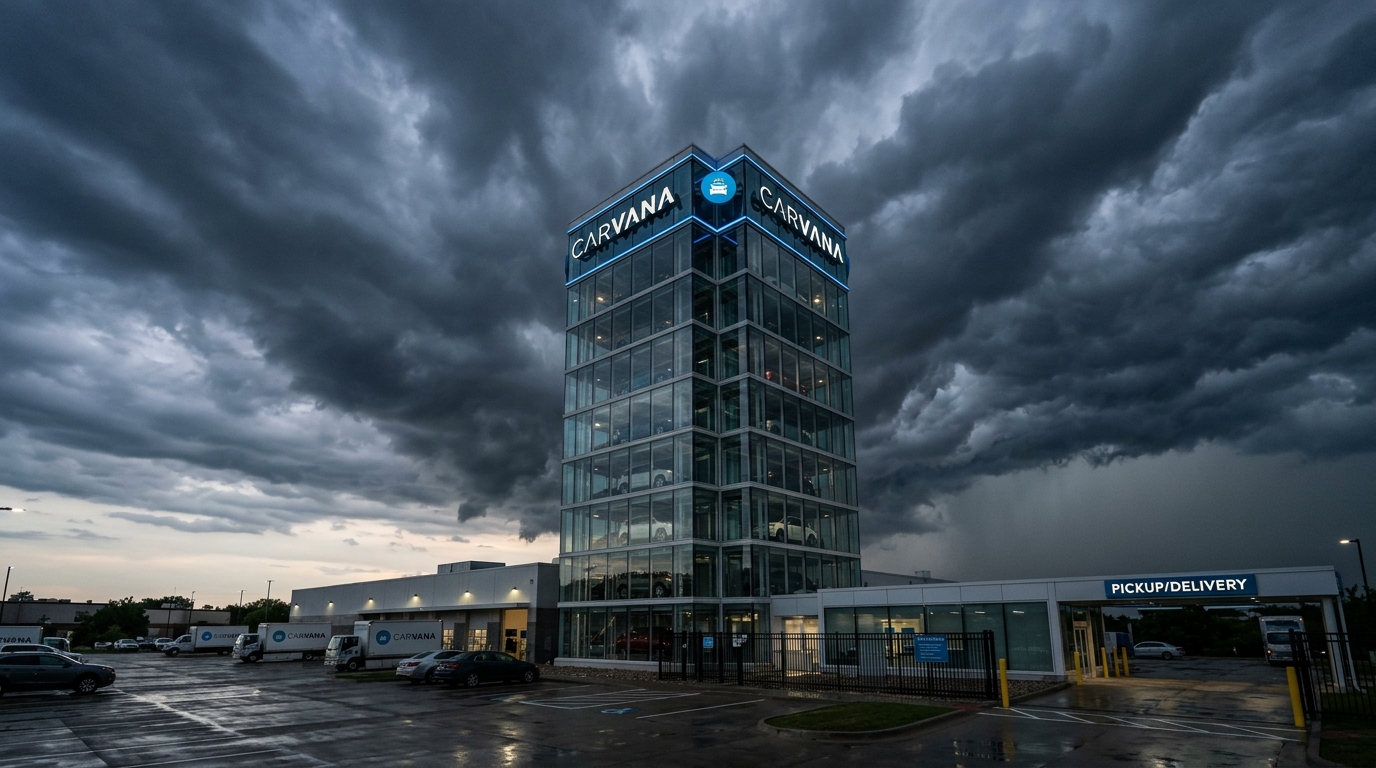
Tonight’s Carvana report lands in one of the most hostile rate environments the used-car market has faced in a generation. The 10-year Treasury yield touched about 5.03% this morning, and the 30-year fixed-rate mortgage averaged 7.32% as of October 22, its first pullback after weeks of increases. That backdrop matters for Carvana in a direct way: buyers who cannot afford a house are not upgrading their cars either, and the financing market for used vehicles is quietly fracturing beneath the headline volume numbers.
Musk’s Quiet AI Empire Could Trigger the Next Boom
While everyone watches Nvidia and Microsoft… Elon Musk is building a secretive AI empire.
We’ve uncovered a stock that gives investors “backdoor” access to his next major move…
Without buying Tesla or OpenAI.
The Story Behind the Trade
Subprime auto loan delinquencies (60-day-plus) have hovered around 6% to 7% in recent quarters, levels that the Federal Reserve Bank of Philadelphia has described as the highest in more than two decades of available data. The deterioration did not stop there. As of Q3 2026, 4.02% of Ally Financial’s retail auto loans were at least 30 days past due, up from 3.93% a year earlier, and loans 60 days past due rose to 1.10% from 1.03%. Ally’s CFO described the consumer as one “dealing with affordability.” That is the credit water Carvana swims in.
Carvana shares are down about 16% to 17% over the past year while the S&P 500 is up about 14%. The 52-week range spans $54.46 to $97.38, meaning the stock has already surrendered roughly 40% from its high. Heading into tonight, CVNA closed October 27 at about $59.23.
Technical and Fundamental Alignment
Carvana reports after the close today. The recent trend is constructive on revenue: Q2 2026 EPS came in at $0.42 versus an estimate of $0.39, while revenue of $7.38 billion cleared the $6.90 billion consensus by a wide margin. Carvana has beaten top-line estimates in each of the past four quarters. But Q2 was also a quarter where profitability and outlook commentary mattered, and tonight’s guidance color will matter at least as much as the headline numbers.
Over the last 30 days, there has been a meaningful downward revision in the consensus EPS estimate for the quarter. Analysts are trimming, not raising. That is not the posture of a market positioned for a blowout.
The $48,000 Mistake Millions of Americans Make Every Year
What if you could enjoy a $7,500-a-month lifestyle for just $3,500? No risky investments or extra income needed.
Discover how Americans are stretching their retirement dollars further.
The rate pressure behind those analyst cuts is not isolated to Carvana. The 10-year yield climbing past 5% forced a broad repricing of rate-sensitive consumer stocks as capital rotated away from credit-dependent business models.
Options Perspective
As of late October, measures of 30-day implied volatility have been running materially above recent realized volatility. The options market is pricing in a move meaningfully larger than what the stock has been realizing day to day. The implied move into the October 30 expiration is roughly 13% to 14%. At a stock near $59, that prices a roughly $8 swing in either direction by Friday’s close.
The thesis here is not directional conviction, it is asymmetry under uncertainty. A bull call spread or bear put spread, both defined-risk structures, lets you express a view without the binary exposure of owning stock through a number surrounded by credit risk, guidance risk, and a macro rate environment that has not cooperated with used-car demand for over a year. Long premium via a debit spread captures the elevated implied move if the thesis triggers, while capping the loss to the net premium paid if it does not.
Risk Management
Three things invalidate a bullish read tonight: guidance that implies margin compression into year-end, any commentary suggesting rising finance-credit losses within Carvana’s own loan portfolio, and wholesale vehicle price softness that crimps per-unit economics. Analysts are modeling lower per-unit profitability versus the year-ago quarter, so even a beat on units sold may not save the margin line.
5 Stocks to Buy for Q4 2026
This year has thrown the market a war with Iran, $100 oil and the Fed’s first rate hike since 2023. Stocks climbed anyway. This free report reveals 5 companies with the earnings and catalysts to finish 2026 strong. See which ones made our list.
The same affordability ceiling weighing on Carvana’s buyers is visible across the broader consumer economy. Frozen housing demand and rising mortgage rates have already identified which sectors absorb the pain and which find opportunity in the rate-locked consumer.
Position sizing is non-negotiable here. This is a stock that routinely makes large single-day moves. This is not a stock where legging into undefined risk makes sense before a catalyst.
The Beast Verdict
Carvana is reporting into a rate and credit environment that has not been this hostile for the used-car consumer in years. Revenue growth may again surprise, but the stock is down roughly 30% year to date, and analyst targets have been cut across the board from Wells Fargo to Barclays to Stephens. Tonight’s report is high-volatility and binary. Carvana has a history of exceeding Wall Street expectations, but the stock’s reaction has been punishing even on good numbers when guidance disappoints. Defined-risk options, sized appropriately, are the right tool: the reward if the catalyst lands is meaningful, the cost if it does not is fixed before the trade begins.