
Back in the 1860s, settlers from France, Italy, and Germany built grand Parisian boulevards…
…neoclassical facades…

… and cobblestone Bavarian villages halfway across the globe.
Then the rest of the world largely forgot about them.
Today, expats are uncovering a European standard of living…
… Lakefront rental homes for $721 a month…
… private chauffeur service…
… and elite healthcare – completely free from tourist crowds and inflated European price tags.
Microsoft Says It Will Pay for Its Own Power. Who Wins?
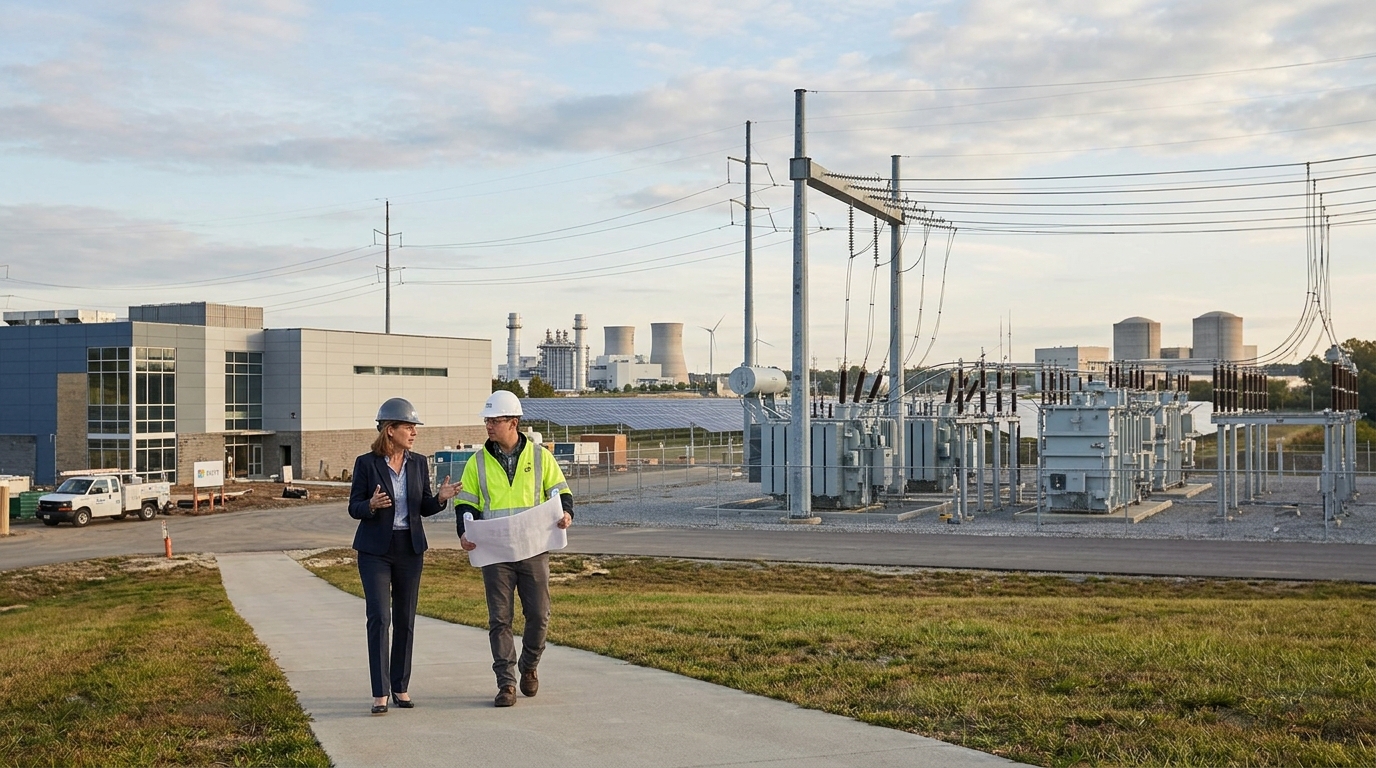
Microsoft made a commitment Tuesday that no hyperscaler had ever put on the record before. At a BloombergNEF conference in Houston, cloud executive Noelle Walsh told Bloomberg Law the company does not want other customers “paying for its growth,” adding: “We will pay our own way.” Clean copy, memorable line, and by itself, worth nothing to an options trader positioned in MSFT.
Here is the problem with playing the headline directly: Walsh’s pledge carries no expiration date and no regulatory mechanism. Hawley’s push for a moratorium has been tied to guarantees that utility customers will not see electricity-rate increases, and Microsoft’s answer is a company pledge rather than a law. A voluntary commitment from a Fortune 5 company moves sentiment, not earnings, unless that commitment unlocks something downstream.
What it does unlock is the permitting argument. One route is Project Kilby, a behind-the-meter power-and-data site in West Texas that Microsoft is developing with Chevron and Joulent via their Energy Forge One joint venture. Chevron has said it is targeting first power in 2028 and ramping to full output by 2031. Because the facility is supplied on-site rather than drawing power through the local utility’s metered grid, it can reduce grid expansion costs shifted onto other customers, cutting political friction and accelerating permitting.
Chevron’s role here is larger than a single joint venture. Chevron management confirmed Project Kilby’s 20-year power purchase agreement with Microsoft and signaled additional co-located power deals are already in discussion.
That matters enormously right now. On September 21, 2026, Governor Greg Abbott directed the Texas Commission on Environmental Quality to halt all permits sought by data centers until ERCOT completes its audit. That directive has been treated as a statewide pause on permitting tied to that ERCOT process. And then the November 3, 2026 midterms delivered a second blow: multiple news reports said Texas Governor-elect Gina Hinojosa campaigned on a data-center moratorium.
The selloff in power names has been severe. VST is down about 17% year-to-date through November 11, 2026. CEG is down roughly 22% year-to-date on most widely followed trackers. GEV has fallen from a 52-week high of about $1,195.94 to about $808 as of November 11. The stock remains below its longer-term moving averages. That is where the opportunity is sharpest.
CEG’s selloff reflects a broader misread of how hyperscalers are actually contracting for power. Constellation’s existing reactor fleet commands a structural premium over any greenfield nuclear promise because hyperscalers are signing long-term PPAs against capacity already running.
Walsh’s pledge reframes the Texas problem. Behind-the-meter, self-funded power projects are structurally less exposed to grid interconnection politics than on-grid builds. Earlier this year, Chevron announced a 20-year power agreement tied to Project Kilby to supply a dedicated behind-the-meter gas plant for a Microsoft data center in West Texas. A model that sidesteps the grid can sidestep the politics driving the moratorium.
The trade thesis centers on GEV. Demand for GE Vernova’s equipment has surged alongside data center build-outs. In its Q2 2026 earnings call, the company said it had booked more than $5 billion of data center orders in Electrification in the first half of 2026, more than double full-year 2025. On Street expectations, published consensus trackers put GEV’s average 12-month price target around $1,174 to $1,178, roughly 45% above recent levels. CEG rounds out the picture as a confirmed earnings beater: Constellation reported adjusted operating earnings of $5.06 per share for Q3 2026 versus an estimate that was widely cited around $3.90 ahead of the report.
On volatility: GEV’s 30-day implied volatility was recently about 55%, within a 52-week range of roughly 42% to 71%. That mid-range reading keeps call debit spreads reasonably priced for a thesis that plays out over several months. A January or February call spread on GEV, long the $850 strike and short the $950, risks defined premium against roughly $100 of potential move if the permitting overhang resolves by year-end.
What invalidates the thesis: the ERCOT audit extends beyond mid-December, the new Texas governor moves faster than expected on data center restrictions, or Microsoft walks back self-funded power commitments under balance sheet pressure. Bloomberg Law reported Microsoft plans to build $117 billion of computing capacity in 2026 for AI and cloud services, and recent financial disclosures show free cash flow growth has turned negative year over year in recent quarters.
Walsh’s statement is a policy signal, not a trade trigger. But the stocks that benefit from behind-the-meter buildout are down hard from their highs on fears that are partly misunderstood. That gap is the asymmetry worth owning with defined risk.